

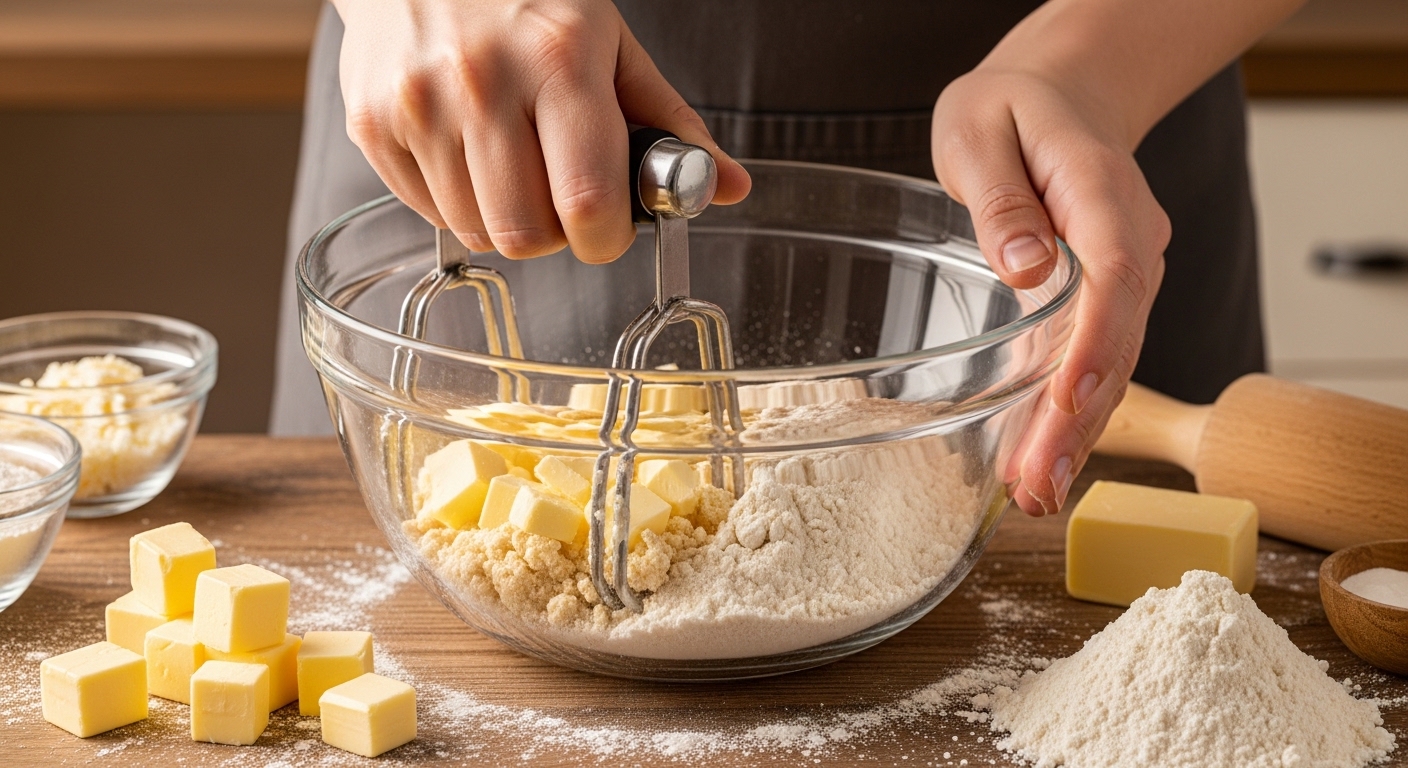
A pastry blender used for those moments when you’re standing in your kitchen thinking you’ve done everything right, but the butter just refuses to behave, kinda clumping up or melting too fast and you’re like “why is this so harder than it looks on videos?” Yeah, that situation. If you’ve ever been halfway into making dough and suddenly questioned your entire baking skill set, you’re already the exact person this tool quietly saves without much drama.
Most people don’t even realise the little wire-handled gadget sitting in kitchen drawers has such a specific job, and honestly, it looks too simple to matter. But then you try making flaky pastry without it and things start getting… messy real quick. A bit frustrating too, not gonna lie.
What is a pastry blender used for in everyday baking
A pastry blender used for cutting cold fat like butter, shortening, or even lard into flour so it forms small uneven bits that later melt during baking and create that flaky texture everyone secretly loves but struggles to achieve at home.
But let’s slow that down a bit because it sounds too neat when written like that.
When you’re making pie crust or biscuits, you don’t want the butter fully mixed in like cake batter. You want it broken into tiny chunks coated in flour. Those chunks melt in the oven and leave little air pockets. That’s what gives you flakiness instead of a dense, sad lump of dough.
America’s Test Kitchen once explained it in a pretty grounded way (paraphrasing here): “The size of butter pieces determines how flaky your pastry will be.” That’s basically the whole game.
And yeah, you can do it with your fingers, but hands warm things up fast, and then you’ve got sticky dough instead of layered magic.
Why butter and flour behave so weird together
If you’ve ever wondered why recipes insist on “cold butter only,” it’s not some chef being dramatic. It’s physics acting up in your kitchen.
Flour has gluten proteins. Water activates them. Butter coats flour and slows that down. But if the butter melts too early, the flour hydrates too evenly and you lose those flaky pockets.
It’s honestly a bit finicky, and people often mess it up the first few tries, don’t worry.
Here’s what usually goes wrong:
- Butter gets too warm from hands
- Flour gets overmixed into paste-like texture
- No visible chunks remain (which is actually bad in pastry making)
- Dough turns tough instead of tender
A pastry blender just keeps things cooler and more controlled, even if you’re slightly impatient or multitasking like most home bakers do.
What a pastry blender actually looks like in action
It’s not fancy. It’s basically a handle with curved metal wires or blades that you press down into flour and butter. You press, twist a little, lift, repeat. Feels almost like you’re chopping something but softer.
And it sounds boring until you realise how much easier it makes life.
You don’t smear butter everywhere. You don’t overwork dough. You just… break things down gently.
Some bakers even say it gives more consistent results than fingers because your hand temperature doesn’t interfere. And that part is surprisingly true, even if it sounds a bit dramatic.
Where a pastry blender used for really shines
Not every baking task needs this tool, but when it does, it really earns its place.
Pie crusts
This is the classic one. A good pie crust depends on cold butter chunks. Without them, you end up with something closer to bread than pastry.
Biscuits
Southern-style biscuits especially rely on that layered, tender structure. A pastry blender makes it easier to keep butter distributed unevenly, which sounds wrong but is actually correct here.
Scones
Scones are basically a test of patience. Overmix them even slightly and they turn into bricks. The blender helps keep things light.
Crumbles and streusel toppings
That crumbly, sandy texture you see on fruit bakes? Same idea—cut fat into flour without melting it.
A quick look:
| Baking Item | Why pastry blender helps |
|---|---|
| Pie crust | Keeps butter cold and chunky |
| Biscuits | Creates layered texture |
| Scones | Prevents overmixing |
| Crumble toppings | Makes even crumbs |
It’s not mandatory for everything, but once you use it for these, you kinda don’t want to go back.
Types of pastry blenders you’ll see
Not all pastry blenders are exactly same, even if they look like cousins.
Wire-style blender
This is the most common one. It has several thick metal wires. It’s flexible, easy to clean, and works for most dough types.
Blade-style blender
Instead of wires, it has flat metal blades. It feels a bit more aggressive, like it’s actually cutting through butter rather than just pressing it.
Heavy-duty professional blender
Usually found in bakeries. Stronger handle, sharper edges, built for large batches. Not really needed for home kitchens unless you bake like every weekend.
Some bakers even say wire ones feel gentler while blade ones are faster, but honestly it depends on how stubborn your butter is behaving that day.
If you don’t have a pastry blender (you’re not doomed)
People panic when they don’t have one, but there are workarounds.
Here’s what you can use instead:
- Two forks pressed and scraped together
- Clean hands (fast but risky if warm)
- Food processor (careful, it overdoes things quickly)
- Knife chopping method (old-school but works)
- Box grater for frozen butter (weird but effective)
Each method has its quirks. Forks take longer. Hands warm things up. Food processors can go from perfect to paste in like 3 seconds if you blink wrong.
So yeah, pastry blender just makes life calmer.
Common mistakes people make with pastry blenders
Even though it’s simple, there’s still room for messing up. And people do, quite often actually.
- Pressing too hard and smashing butter into paste
- Not using cold enough butter (this one is huge)
- Overmixing until flour looks smooth instead of crumbly
- Using it too late in the process after butter has softened
- Expecting dough to look uniform (it shouldn’t)
A pastry instructor from King Arthur Baking once mentioned something like: “Stop when mixture looks uneven, not smooth.” That uneven look is actually what you want.
And yeah, that feels wrong the first time you hear it.
How to choose a good pastry blender
If you’re thinking of getting one, don’t overthink it too much. But a few things matter more than others.
- Comfortable handle grip (you’ll be pressing a lot)
- Strong metal that doesn’t bend easily
- Easy-to-clean design (butter hides in weird places)
- Solid connection between handle and blades
Cheap ones work fine, but they sometimes bend when butter is too cold and hard. That can be annoying mid-recipe, especially when you’re already slightly stressed and flour is everywhere.
Why bakers still use it even in modern kitchens
With all the fancy mixers and food processors, you’d think this tool would disappear. But it hasn’t.
Because it gives control.
Not speed, not automation, but control over texture. And in baking, texture is kinda everything.
You can feel the butter size as you go. You can stop exactly when it looks right. Machines don’t always give you that feedback loop.
And honestly, that tactile part is why many people still prefer it even after years of baking.
Final thoughts on what is a pastry blender used for
A pastry blender used for turning a messy mix of flour and cold fat into something structured but still rough enough to bake into flaky, tender pastry that doesn’t feel like cardboard later. It’s simple, a bit old-school, and maybe not exciting at first glance, but once you use it properly, it kind of becomes one of those tools you quietly respect.
And yeah, the first few tries might still feel a bit off. Dough might look weird. Butter might not cooperate. That’s normal more than people admit.
But once it clicks, you’ll stop fighting the dough and start understanding it a little better, even if your kitchen still ends up a bit messy like always.

Jamesmathew is an expert Amazon affiliate writer, helping readers discover top products, smart deals, and practical buying guides through honest reviews and insightful content.