

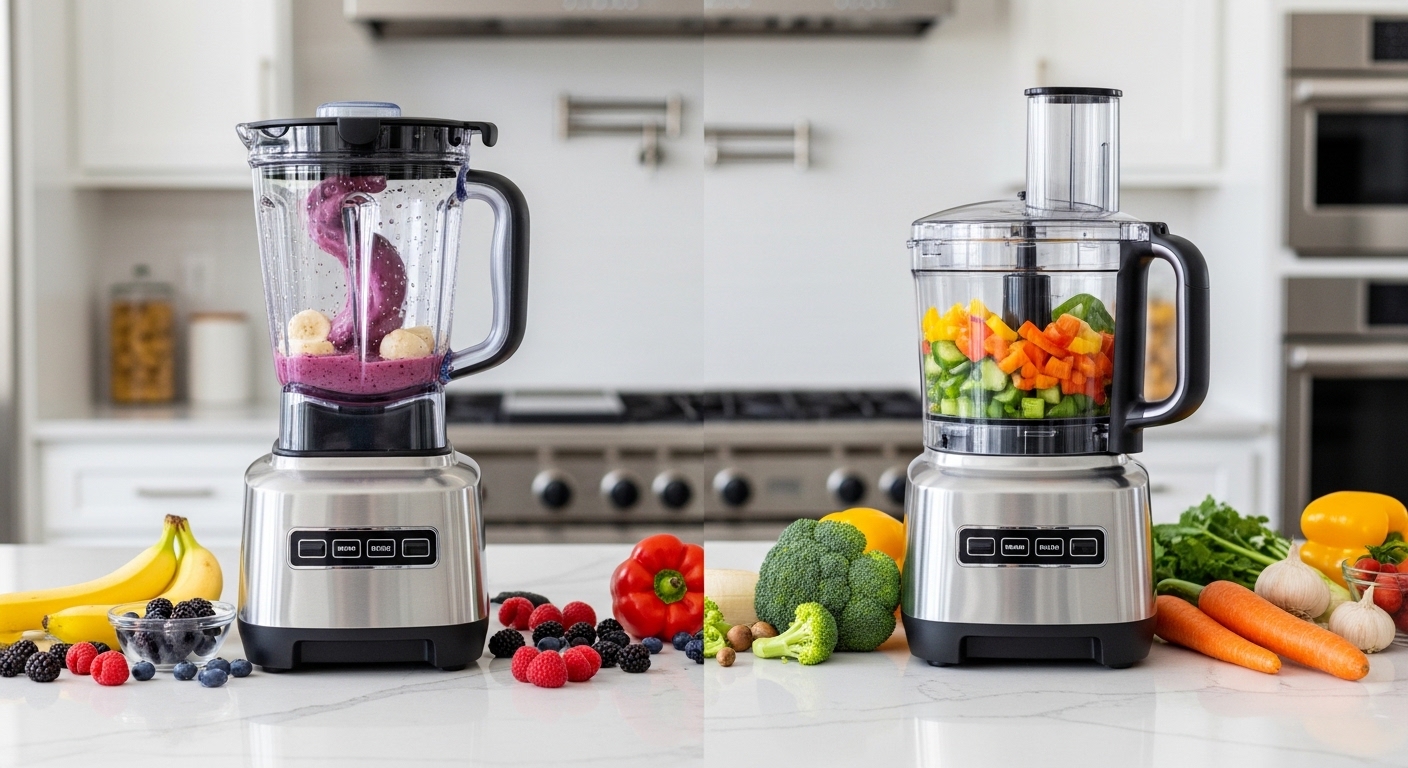
You’re probably staring at your Ninja blender right now thinking, can i use my ninja blender as a food processor or am I just about to make a weird chunky smoothie accident instead of dinner, and yeah… that hesitation is very real.
Because on one hand, you don’t really wanna buy another appliance. On the other hand, you also don’t wanna ruin your onions into onion soup when all you needed was a quick chop. It’s that awkward middle zone where kitchen tools start feeling like they’re gaslighting you a little bit.
Let’s actually figure this out properly, not in that overly neat way people usually explain things, but like how you’d want someone to tell you if you were just standing there in your kitchen, lid in one hand, doubt in the other.
So… Can You Use a Ninja Blender as a Food Processor?
Short answer, yes… but also no… but mostly yes if you’re not expecting miracles.
A Ninja blender can act like a food processor in a lot of situations. It chops, it mixes, it crushes stuff with an enthusiasm that sometimes feels personal. But it doesn’t behave exactly like a traditional food processor, and that difference matters more than you’d think at first glance.
Blenders are designed to liquify and blend, while food processors are built to chop, slice, shred, and mix without turning everything into paste.
So when you ask, can i use my ninja blender as a food processor, what you’re really asking is:
“Can I get away with it?”
And the honest answer is, yeah… most of the time, you kinda can.
What Your Ninja Blender Actually Does Well
Let’s not undersell it. Ninja blenders are kinda aggressive in a good way. They’ve got strong motors, sharp blades, and they don’t hesitate.
Here’s where they surprisingly do a solid job:
Chopping Vegetables (Sort of)
If you pulse carefully (and I mean carefully, like don’t just hold the button like you’re starting a lawn mower), you can chop:
- Onions
- Garlic
- Carrots
- Peppers
But the texture won’t be perfectly even. Some pieces will be tiny, some will be like “how did you survive that blade?”
That unevenness is normal, not you messing it up.
Making Dips and Sauces
This is where your Ninja actually shines more than a food processor sometimes.
Think:
- Hummus
- Salsa
- Guacamole (though go easy or it becomes baby food real quick)
Blenders love semi-liquid mixtures. It’s their comfort zone, their emotional support consistency.
Mixing Dough (Light Ones Only)
You can mix softer doughs like pancake batter or simple cookie dough. But don’t try heavy bread dough unless you’re feeling brave and slightly reckless.
Motors have limits, even if Ninja acts like it doesn’t.
Crushing Nuts and Making Pastes
Need crushed peanuts or almond butter? Yeah, it’ll do that. But again, pulse control is everything.
Too long = nut butter
Too short = chunky bits
There’s no middle unless you babysit it a little.
Where It Starts to Fall Apart (Literally Sometimes)
Now here’s the part people don’t always say clearly.
A Ninja blender is not great at precision tasks.
Slicing and Shredding
Food processors have special discs for:
- Slicing cucumbers evenly
- Shredding cheese
- Grating vegetables
Your Ninja blender? It just… spins blades like it’s in a hurry. No finesse, no slicing discs, just chaos energy.
So if you need clean slices or shredded textures, yeah, that’s not happening here.
Even Chopping
Food processors are designed to circulate food in a way that keeps everything moving evenly.
Blenders tend to create this weird vortex where:
- Bottom = overprocessed mush
- Top = untouched chunks just chilling
You’ll notice yourself stopping, shaking, restarting… it becomes a whole thing.
Dry Ingredients
Trying to process dry stuff like breadcrumbs or flour mixes can feel off. Blenders prefer some moisture to keep things moving.
Without it, ingredients just bounce around like they’re avoiding responsibility.
Ninja Blender vs Food Processor (Quick Reality Check)
Here’s a simple breakdown so you don’t overthink it too much:
| Task | Ninja Blender | Food Processor |
|---|---|---|
| Smoothies | Excellent | Meh |
| Sauces & dips | Very good | Very good |
| Chopping veggies | Decent (uneven) | Excellent |
| Slicing/shredding | Not possible | Built for it |
| Dough mixing | Light only | Stronger |
| Precision prep | Weak | Strong |
So yeah, if you’re doing everyday casual cooking, your Ninja can absolutely step in. If you’re trying to cook like a perfectionist chef, you’ll start noticing the gaps real quick.
Tips to Make Your Ninja Work Like a Food Processor (Almost)
This is where things get a bit tactical, like you’re learning how to “handle” your blender instead of just using it.
Use the Pulse Button Like It Owes You Money
Don’t hold the blend button. Just don’t.
Instead:
- Tap pulse quickly
- Stop
- Check texture
- Repeat
This gives you more control and stops things from turning into paste before you even realize what happend.
Cut Ingredients Smaller First
Yeah it’s annoying, but it helps a lot.
If you throw in a whole onion, the blender struggles to process evenly. Cut it into chunks first so the blades don’t have to do all the thinking.
Don’t Overfill the Jar
Crowding is the enemy here.
Too much food = uneven processing = frustration = you questioning your life choices slightly.
Keep batches smaller, even if it takes a bit longer.
Add a Tiny Bit of Liquid (When Needed)
For things like dips or thicker mixes, a splash of water, oil, or lemon juice helps everything move better.
Not too much though, or you’ll accidentally invent soup again.
Real-Life Example (Because This Is Where It Gets Real)
Let’s say you’re making salsa.
You throw in tomatoes, onions, garlic, chilies, maybe some coriander.
If you blend normally, you’ll get a smooth salsa… which is fine, but maybe not what you wanted.
If you pulse:
- First pulse: big chunks
- Second pulse: better
- Third pulse: okay this looks like actual salsa
That’s the difference. Same ingredients, different approach, totally different result.
What Experts and Data Actually Say
Kitchen appliance testing groups like Consumer Reports have pointed out that high-powered blenders can handle many food processor tasks, but they consistently note that texture control and consistency are where food processors outperform blenders.
There’s also a 2023 appliance usage survey that found around 42% of users rely on blenders for multi-purpose prep, especially in smaller kitchens where space is tight. So if you’re doing this, you’re not alone, not even a little bit.
One chef (and I remember this line because it stuck weirdly) once said:
“Blenders are for movement, food processors are for control.”
And that kinda sums it up better than any technical manual ever could.
When You Should Just Get a Food Processor
Alright, let’s be honest for a second.
You should probably consider a real food processor if:
- You cook often and prep a lot of vegetables
- You care about uniform cuts (like for presentation or even cooking)
- You regularly shred cheese or slice things thinly
- You’re tired of stopping and scraping your blender every 10 seconds
At that point, using a blender starts feeling like using scissors to mow a lawn. It works… but it shouldn’t.
But If You Don’t Want Another Appliance…
Totally fair, honestly.
Kitchen space is limited, budgets are real, and sometimes you just don’t wanna deal with another thing to clean.
In that case, your Ninja blender is more than enough if you:
- Adjust your expectations slightly
- Use pulsing instead of blending
- Accept a bit of texture inconsistency
Cooking doesn’t always need to look perfect to taste good. That’s something people forget a bit too often.
Final Thoughts That Are Slightly Less Neat Than Usual
So yeah, can i use my ninja blender as a food processor… you can, and you probably already are without even realizing it.
It’s not perfect, it’s not precise, and sometimes it feels like it’s doing its own thing entirely, but it gets the job done more often than not.
And honestly, that’s kinda enough for most kitchens.
You just gotta work with it instead of expecting it to magically become a different machine. Once you get that rhythm, the whole thing feels less confusing, less frustrating, and a bit more like you actually know what you’re doing… even if you’re still guessing a little.

Jamesmathew is an expert Amazon affiliate writer, helping readers discover top products, smart deals, and practical buying guides through honest reviews and insightful content.