

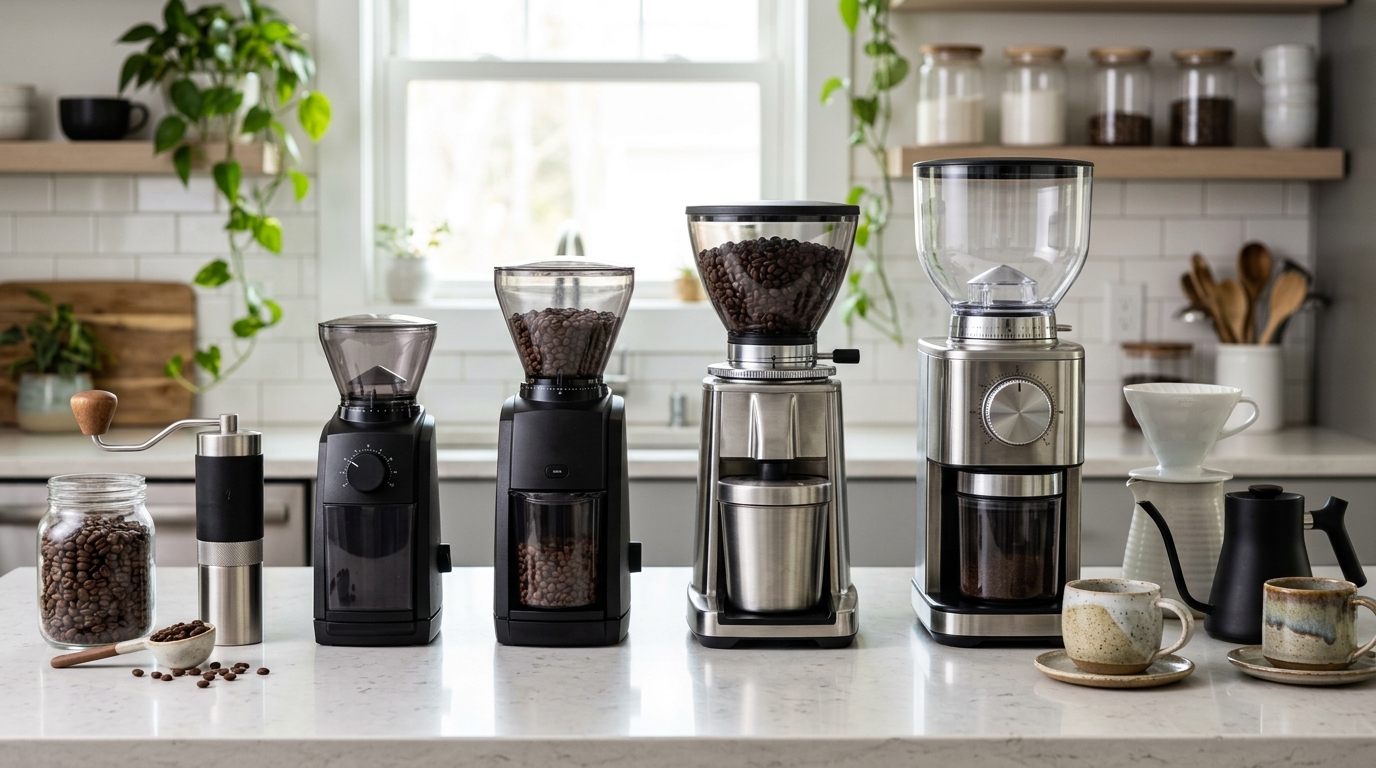
So you’re standing there, phone in hand, wondering how much is a coffee grinder gonna set you back before you even bother clicking “add to cart,” and honestly, that confusion makes total sense because the price range on these things is genuinely all over the map. You could spend twenty bucks or you could spend four hundred and both purchases would technically be called “a coffee grinder,” which doesn’t help you at all right now. I’ve been down this rabbit hole myself, comparing spec sheets at midnight like it was gonna change my life, and what I found out is that the price mostly comes down to one question nobody tells you to ask first: do you want a blade or a burr.
The Short Answer (Because You Probably Just Want a Number)
Okay here’s the quick version before I get into all the nuance and rambling. Cheap blade grinders start around twenty dollars, sometimes even less if there’s a sale happening somewhere. Decent electric burr grinders, the kind that actual coffee people recommend without rolling their eyes, start somewhere in the one-thirty to one-fifty range and climb from there. Manual hand grinders sit in a weirdly wide bracket too, anywhere from thirty dollars for something basic up to two hundred or more for one with proper steel burrs and a nice adjustment dial. And then there’s the high end stuff, the single-dose flat burr grinders that coffee nerds get genuinely emotional about, which can run you two hundred fifty dollars and keep going well past that if you let it.
None of these numbers are made up for effect, by the way — actual market data backs this up. As one detailed grinder buying guide puts it plainly, electric blade grinders can be found for as low as $21, while electric burr coffee grinders will cost around $130-$150 even at their cheapest. That gap right there, between twenty and a hundred thirty, is basically the whole story of why grinder shopping feels so confusing to begin with.
Blade Grinders: Cheap but Kind of a Trap
Blade grinders are the ones that look like little blenders, and thats basically what they are inside too. A couple spinning blades chop up your beans into whatever size they feel like that day, which is not exactly a scientific process. People online can be pretty blunt about this, and honestly I don’t blame them — blade grinders aren’t really grinders, they use a spinning blade to chop coffee beans into random-sized bits, rather than grinding them evenly as proper burr grinders do. The result is a mix of dust-fine particles and chunky boulders sitting in the same batch, which means your coffee extracts unevenly no matter how careful you are with your water temperature or your timing.
Here’s the thing though — if you’re brand new to grinding your own beans and just testing the waters, a fifteen or twenty dollar blade grinder isn’t the worst place to start. Its cheap, its available basically everywhere, and it beats buying pre-ground coffee that’s been sitting on a shelf losing flavor for who knows how long. Just don’t expect café-quality results, and don’t be shocked when your pour-over tastes a little muddled.
Burr Grinders: Where the Real Money Starts Going
Once you cross over into burr grinder territory, prices jump pretty fast, and there’s a reason for that jump. Burr grinders crush beans between two textured surfaces set a precise distance apart, instead of just chopping randomly, and that precision is what gives you a consistent grind size — which, it turns out, is the single biggest factor in whether your coffee tastes good or bad. One coffee retailer explains it well: inconsistent grind size is the single most common cause of bad coffee at home, because when grounds are uneven, water extracts them at different rates, and fines over-extract and turn bitter while coarse particles under-extract and stay sour or weak.
Entry Level Electric Burr Grinders
For an actual decent electric burr grinder, you’re looking at roughly one hundred thirty to two hundred fifty dollars for something reliable. The Baratza Encore has been sort of the gold standard here for years, and reviewers keep coming back to it because it just works. It’s currently priced around $139, sometimes dipping a bit lower with a discount code, and one longtime reviewer notes it’s still under £150 and handles dual-wall espresso if needed in 2026, which for UK buyers roughly maps onto that same low-hundreds bracket in dollars.
Mid Range and Prosumer Grinders
Once you start looking at things like the 54mm flat burr grinders that specialty coffee folks talk about constantly, prices land somewhere around two hundred twenty to two hundred forty dollars. As an example, one popular single-dose model is listed with an MSRP of $239 and a typical sale price around $229, and it comes packed with features like stepless grind adjustment and anti-static tech that used to only show up on grinders costing way more. This is genuinely a big shift in the market — a few years back this kind of build quality basically didnt exist below three or four hundred dollars.
Premium and Enthusiast Territory
At the very top you get into grinders that cost as much as a decent used bicycle, honestly. These aren’t for casual coffee drinkers, they’re for people who’ve already decided coffee is basically a hobby now, not just a morning habit. Premium hand grinders in this bracket, like the Comandante C40, run around two hundred sixty five dollars (or two hundred twelve with a discount code, which apparently exists more often than not). One review calls this model the benchmark premium hand grinder, with exceptional build quality, legendary consistency, and a cult following among specialty coffee enthusiasts, adding that it’s an investment but the best option if you want the best manual grinder period.
Manual Grinders: A Whole Different Price Conversation
Manual, hand-crank grinders deserve their own little section because the math works differently here. You’re not paying for a motor or electronics, you’re paying almost entirely for the burr quality and the build of the housing itself, which is why a good manual grinder can sometimes outperform an electric one costing twice as much.
Here’s a rough breakdown of what you’ll typically find at different manual grinder price points:
| Price Range | What You Get | Example Models |
|---|---|---|
| $30-$50 | Basic ceramic or steel burrs, simple adjustment, good for French press | Hario Mini Mill |
| $100-$150 | Better steel burrs, external adjustment collar, decent for espresso too | KINGrinder K6 |
| $150-$200 | Premium burrs, refined engineering, travel-friendly designs | 1Zpresso J Ultra, Timemore models |
| $200-$300+ | Flagship-level consistency, cult following, built to last decades | Comandante C40, Kinu M47 |
One buying guide summed up the value case pretty well, noting that the best manual coffee grinders offer burr-ground consistency that rivals grinders costing three to four times more, and if you’re serious about your cup but not ready to drop $400 on an electric grinder, a quality hand grinder is the highest-value upgrade you can make. That tradeoff is real though — you’re giving up speed for precision, since grinding a single dose by hand takes a minute or two rather than a few seconds.
So What Should You Actually Budget?
I know, I know, you wanted one number and instead I gave you like five brackets. But here’s my honest attempt at simplifying it based on how most people actually shop:
- If you just want to stop buying pre-ground coffee — budget $20 to $40, get a basic blade grinder or a cheap manual one, accept its limitations
- If you’re getting serious about pour-over or French press at home — budget $100 to $200, look at either a Baratza Encore or a mid-tier manual grinder
- If espresso is part of your routine — budget $200 to $300 minimum, since fine, consistent grinds matter way more for espresso than for other brew methods
- If coffee has become a genuine hobby, not just a habit — the sky’s kinda the limit here, but $250 to $400 gets you into genuinely excellent, long-lasting equipment
It’s also worth remembering that burr material plays into long term cost too. Steel burrs tend to hold their edge longer and are generally the safer pick for espresso-range grinding, while ceramic burrs stay sharp for a good while and don’t overheat your beans as easily, though they’re a bit more prone to chipping if you’re rough with them. Neither is objectively “better” in every case — it really depends what you’re brewing and how careful you tend to be with your gear.
A Quick Word on Why the Grinder Matters More Than People Think
A lot of first-time buyers assume the grinder is a secondary purchase, something you grab after you’ve already picked your coffee maker or espresso machine, almost as an afterthought. But plenty of experienced coffee people would tell you that’s backwards. As one coffee brand puts it simply, the grinder is not the glamorous purchase, it is the foundational one, because everything you brew runs through it first. Which, when you actually think about it for a second, makes a lot of sense — a great espresso machine paired with an inconsistent grind is still gonna produce a mediocre shot, no matter how expensive the machine was.
Final Thoughts on What a Coffee Grinder Actually Costs You
At the end of the day, asking how much a coffee grinder costs is kind of like asking how much a car costs — technically theres an answer, but the real answer depends entirely on what you actually need it to do. Twenty dollars gets you something that grinds beans, sure, but a hundred fifty or two hundred gets you something that grinds them well, consistently, cup after cup, for years. If your coffee’s been tasting flat or bitter or just kind of off lately and you’re still using a blade grinder or, worse, pre-ground beans from the grocery store, that inconsistency is very likely the actual culprit, not your brewing technique. Spend what you can on the burrs, because thats really where the money’s going anyway.

Jamesmathew is an expert Amazon affiliate writer, helping readers discover top products, smart deals, and practical buying guides through honest reviews and insightful content.