

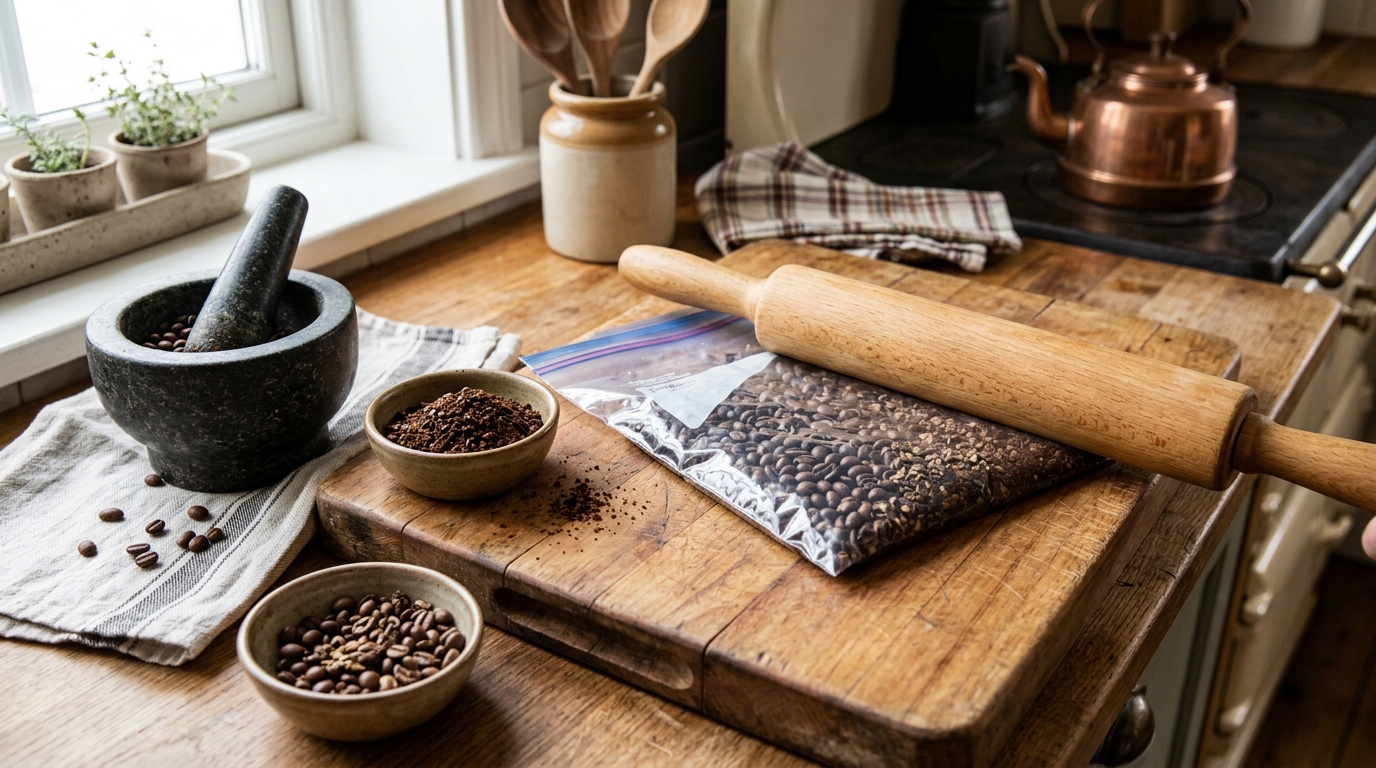
So you woke up, reached for the grinder, and it’s either broke, missing, or still packed in a box from when you moved three months ago — and now you’re standing in the kitchen googling how to crush coffee beans without grinder like your morning depends on it, because honestly, it kinda does. We’ve all been there, staring at a bag of whole beans like they personally betrayed us.
Here’s the thing nobody tells you: you don’t actually need a fancy burr grinder to get a decent cup of coffee going. People have been crushing beans by hand for literally centuries before electric grinders were even a thing, and some of them still swear the manual methods taste better, though that’s debatable and honestly kind of a personal taste thing.
This guide walks you through every method that actually works, the ones that sort of work but make a mess, and a couple you should avoid unless your goal is broken glass on the kitchen floor.
Why You Might Not Have a Grinder Handy
Not everybody drinks coffee often enough to justify owning a grinder, and thats fair. Maybe you’re travelling, camping, staying at a rental, or your grinder just died at 6am on a Tuesday which is somehow always when appliances choose to quit. Whatever the reason, the good news is coffee beans are not that hard to break down with tools you probably already got lying around the house.
According to the National Coffee Association, roughly six in ten Americans drink coffee daily, which means a whole lot of people are relying on functioning equipment every single morning — and when that equipment fails, panic sets in fast.
Best Methods to Crush Coffee Beans Without a Grinder
1. Mortar and Pestle
This is probably the most traditional way to crush coffee beans without a grinder, and its been used in kitchens across the world long before electricity existed. You just add a small handful of beans, maybe a quarter cup at a time so you don’t overwhelm the bowl, and press down with a twisting, grinding motion rather than just smashing straight down.
It takes some elbow grease, not gonna lie, but the control you get over texture is honestly pretty impressive once you get the hang of it.
2. Rolling Pin (or Wine Bottle)
Put your beans inside a sturdy ziplock bag, or wrap them in a clean kitchen towel, then roll a rolling pin over them with firm, even pressure. If you don’t own a rolling pin, an empty wine bottle works surprisingly good too, just hold it by the neck and roll the body over the beans like your rolling out dough.
A few tips that make this less annoying:
- Double bag it, single bags tear easier than you’d think
- Press down and roll rather than just rolling lightly across the top
- Rotate the bag occasionally so beans near the edges get crushed too
3. Hammer or Meat Tenderizer
Blunt force works, plain and simple. Place beans in a thick ziplock bag or between two sheets of parchment paper, then whack them with a hammer or the flat side of a meat tenderizer. This method is loud, kind of chaotic, but genuinely effective if your just trying to get a coarse grind for something like a French press.
Do not, under any circumstance, skip the bag step. Loose beans flying across your kitchen at hammer-speed is a genuinely bad time.
4. Blender or Food Processor
If you own a blender or food processor, this is probably your fastest option by a mile. Pulse the beans in short bursts, maybe two or three seconds at a time, checking the consistency between pulses. Don’t just hold the blend button down for ten seconds straight or you’ll end up with something closer to coffee dust than actual grounds, which burns way easier during brewing.
A lot of people don’t realize their blender can double as a makeshift grinder in a pinch, it just wont give you the same consistency as a proper burr grinder.
5. Knife (Chopping Method)
This one takes patience but it works. Lay beans flat on a cutting board and rock a large chef’s knife over them repeatedly, similar to how you’d mince garlic. It’s slow going, and you’ll want a really sturdy cutting board underneath, but for a single cup of coffee it does the job fine.
6. Mallet or Pan (Improvised Smashing)
In a real pinch, even the bottom of a heavy frying pan can crush beans if you press and twist it against them on a cutting board, kind of like how you’d smash garlic cloves. It’s messy and not exactly precise but when your desperate, desperate measures apply.
Comparing the Methods
| Method | Grind Consistency | Effort Level | Best For |
|---|---|---|---|
| Mortar and Pestle | Medium to fine | High | French press, pour over |
| Rolling Pin | Coarse to medium | Medium | French press |
| Hammer/Tenderizer | Coarse, uneven | Medium | French press, cold brew |
| Blender | Medium (uneven) | Low | Drip coffee, French press |
| Knife | Coarse to medium | High | French press |
| Pan/Mallet Smash | Very coarse | Medium | Cold brew, French press |
Does Grind Consistency Actually Matter That Much?
Short answer, yeah it kinda does. Coffee professionals talk about extraction constantly, and grind size directly effects how fast water pulls flavor compounds out of the coffee. Too fine a grind for a method like French press and you get sludge and bitterness, too coarse for espresso and you get weak, sour water that barely resembles coffee at all.
As one longtime barista put it during an interview about home brewing struggles, uneven grind size from manual crushing methods is basically the biggest hurdle home baristas run into, since some particles extract way faster than others sitting right next to them in the same cup.
That said, when your improvising with a rolling pin or a hammer, perfect consistency isn’t really the goal. Getting something drinkable is.
Which Brewing Method Works Best With Hand-Crushed Beans
Not every brewing method forgives an uneven, hand-crushed grind equally.
- French press is by far the most forgiving, since it uses a coarse grind anyway and the metal filter doesn’t care much about uniformity
- Cold brew is also pretty forgiving because of the long steep time, which gives even uneven grounds time to extract properly
- Pour over is trickier, since inconsistent particle sizes lead to some grounds being over extracted while others stay under extracted
- Espresso is basically off the table without a proper grinder, the pressure and speed involved need very precise, fine, consistent grounds
If your stuck without a grinder, lean toward French press or cold brew, they’re way more tolerant of imperfect, hand-crushed beans.
Quick Tips for Better Results
A few small things make a surprisingly big difference when your crushing beans by hand:
- Work in small batches, trying to crush a huge pile at once just leads to uneven results
- Use double bags or thick freezer bags so beans don’t puncture through mid-smash
- Aim for consistency over speed, rushing usually means more mess and worse coffee
- Sift out any huge chunks if you can, even a basic mesh strainer helps separate the big pieces
- Store leftover crushed beans in a sealed container, they lose freshness way faster once broken down
Final Thoughts
Not having a grinder isn’t the coffee emergency it feels like at 6am. Whether you go with a mortar and pestle, a rolling pin, a blender, or straight up beating your beans with a hammer in a ziplock bag, there’s a method here that’ll get you caffeinated without needing to run to the store. It wont be identical to what a proper burr grinder produces, sure, but for most people in a genuine pinch, drinkable coffee beats no coffee every single time.
Next time your grinder decides to give up on you mid-morning, you’ll already know exactly what to reach for instead.

Jamesmathew is an expert Amazon affiliate writer, helping readers discover top products, smart deals, and practical buying guides through honest reviews and insightful content.