

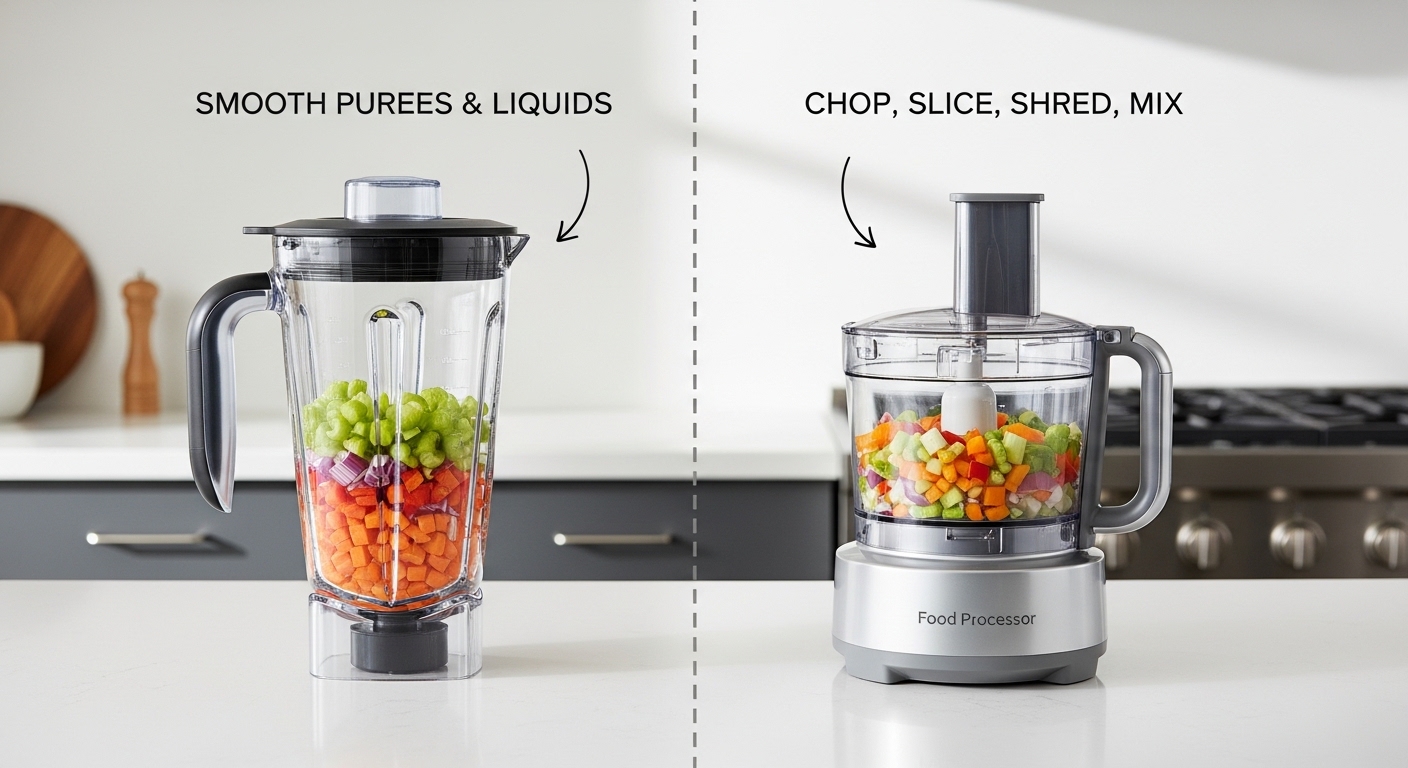
You’re probably standing there, staring at your kitchen counter, wondering can I use a blender instead of a food processor, because honestly… who even has space for both, right? And maybe you already tried once, got a weird mush instead of chopped veggies, and now you’re not totally sure if it was you or the machine acting funny.
Let’s untangle this properly, but not in that stiff, robotic way. Just real talk, some slightly messy truth, and the kind of detail you actually need before tossing almonds into a blender and hoping for magic.
Blender vs Food Processor: What’s Actually Different?
At a glance, they look like cousins. Same transparent jar vibe, same spinning blades doing their loud dramatic thing. But deep down, they’re built for very different jobs, like one wants to make soup and the other wants to make salad but both somehow end up in your cupboard anyway.
A blender is mostly about liquids. Smoothies, soups, sauces, things that flow. The blades are angled to pull ingredients downward, creating that vortex thingy that makes everything swirl into submission.
A food processor, though, is more about control and texture. It slices, chops, shreds, and sometimes kneads dough like it’s got a personality or smth.
Quick Comparison Table
| Feature | Blender | Food Processor |
|---|---|---|
| Best For | Liquids, smoothies, purees | Chopping, slicing, shredding |
| Blade Design | Fixed, angled downward | Interchangeable discs & blades |
| Texture Control | Low | High |
| Dry Ingredients | Not ideal | Works well |
| Dough Handling | No | Yes |
So yeah, they overlap a bit, but not perfectly, not even close sometimes.
Can You Use a Blender Instead of a Food Processor?
Short answer: yes, but also… not always, and sometimes it gets kinda awkward.
Longer answer is where things get interesting.
You can use a blender instead of a food processor for certain tasks, especially if you adjust how you use it. But expecting identical results is like expecting a bicycle to behave like a motorbike just because both got wheels.
When It Actually Works
There are moments when your blender can step up and do a decent job, maybe even surprisingly good if you treat it right.
1. Making Sauces and Dips
Blenders are honestly great here. Hummus, pesto, salsa (if you don’t over-blend it into soup), they can all work.
Tip: Use pulse mode instead of letting it run continuously, or you’ll end up with baby food texture, which… not ideal.
2. Pureeing Vegetables
Soups, mashed stuff, even baby food if that’s your thing, blenders shine here. No complaints.
3. Crushing Nuts (Carefully)
You can chop nuts in a blender, but go slow. Like, really slow. Pulse, shake the jar, pulse again. Otherwise, you’ll accidentally invent nut butter.
4. Mixing Batters
Thin batters, like pancakes or crepes, sure. Thick dough? Nope, your blender will protest loudly, maybe even smell a bit burnt, which is not a good sign.
When a Blender Just… Doesn’t Cut It
Here’s where people usually get frustrated and think they did something wrong. But nah, sometimes it’s just the wrong tool.
1. Chopping Vegetables Evenly
A food processor gives you nice, consistent pieces. A blender gives you chaos. Some chunks, some paste, some weird in-between bits.
2. Shredding Cheese or Vegetables
Blenders don’t have shredding discs. So yeah, not happening unless you enjoy uneven clumps of sadness.
3. Making Dough
Food processors can knead dough because they’re built for that pressure. A blender? It’ll struggle, heat up, and probably give up before you do.
4. Slicing Ingredients
No slicing attachments means no proper slices. Just chopped or blended, nothing fancy.
How to Use a Blender Like a Food Processor (Kind Of)
If you’re stuck with just a blender, don’t worry, you can still make it work, just gotta be a bit clever with it.
Use Pulse Mode Like It’s Your Best Friend
Instead of letting the blender run continuously, tap the pulse button in short bursts. This gives you more control and avoids turning everything into mush.
Don’t Overfill the Jar
Less is more here. Smaller batches give better control and more even results. Overloading leads to uneven blending, and frustration follows quickly.
Add a Little Liquid (Sometimes)
For certain tasks, a tiny bit of liquid helps things move. But too much and you’re back to soup again, so balance it carefully.
Shake or Stir Between Pulses
Yeah, it’s a bit annoying, but it helps redistribute ingredients so everything gets chopped more evenly.
Real-Life Examples: What Happens in Your Kitchen
Let’s say you’re making salsa. In a food processor, you toss everything in, pulse a few times, done. Nice chunky texture.
In a blender? One second too long and boom, tomato juice with commitment issues.
Or chopping onions. A food processor gives you neat bits. A blender gives you a mix of finely chopped pieces and onion paste, which kinda changes the whole vibe of your dish.
What Experts Say About It
According to culinary experts and appliance manufacturers, blenders and food processors are designed with different mechanical goals in mind. Kitchen appliance brands often emphasize that forcing one appliance to do the job of the other can lead to inconsistent results and even shorten the lifespan of the machine.
Chef-level advice often sounds like this: “Use the right tool for the right texture.” Which sounds obvious, but when you’re mid-recipe and missing equipment, it suddenly feels less obvious, honestly.
Pros and Cons of Using a Blender Instead of a Food Processor
Pros
- Saves money (no need to buy another appliance)
- Works well for liquids and semi-liquid recipes
- Can handle some chopping tasks with practice
- Easier cleanup in many cases
Cons
- Poor texture control
- Uneven chopping results
- Limited functionality (no slicing or shredding)
- Risk of over-processing ingredients
When Should You Actually Buy a Food Processor?
If you find yourself doing these things often, then yeah, maybe it’s time:
- Prepping large quantities of vegetables
- Making dough regularly
- Wanting consistent textures
- Cooking more complex recipes
Otherwise, if you’re mostly blending smoothies and occasionally making dips, your blender is probably enough, no need to overcomplicate your kitchen life.
A Slightly Honest Conclusion
So, can you use a blender instead of a food processor? Yeah, you can, and sometimes it works just fine, even better than expected if you get the hang of it. But other times, it feels like trying to cut paper with a spoon, like technically possible but deeply inconvenient.
If you adjust your expectations and techniques, your blender can cover a surprising amount of ground. Just don’t expect perfection every time, because it won’t give you that, and that’s okay.
At the end of the day, it’s less about having the perfect tools and more about knowing how to use what you’ve got, even if it means your salsa turns out a bit smoother than planned, which honestly… still tastes pretty good.

Jamesmathew is an expert Amazon affiliate writer, helping readers discover top products, smart deals, and practical buying guides through honest reviews and insightful content.