

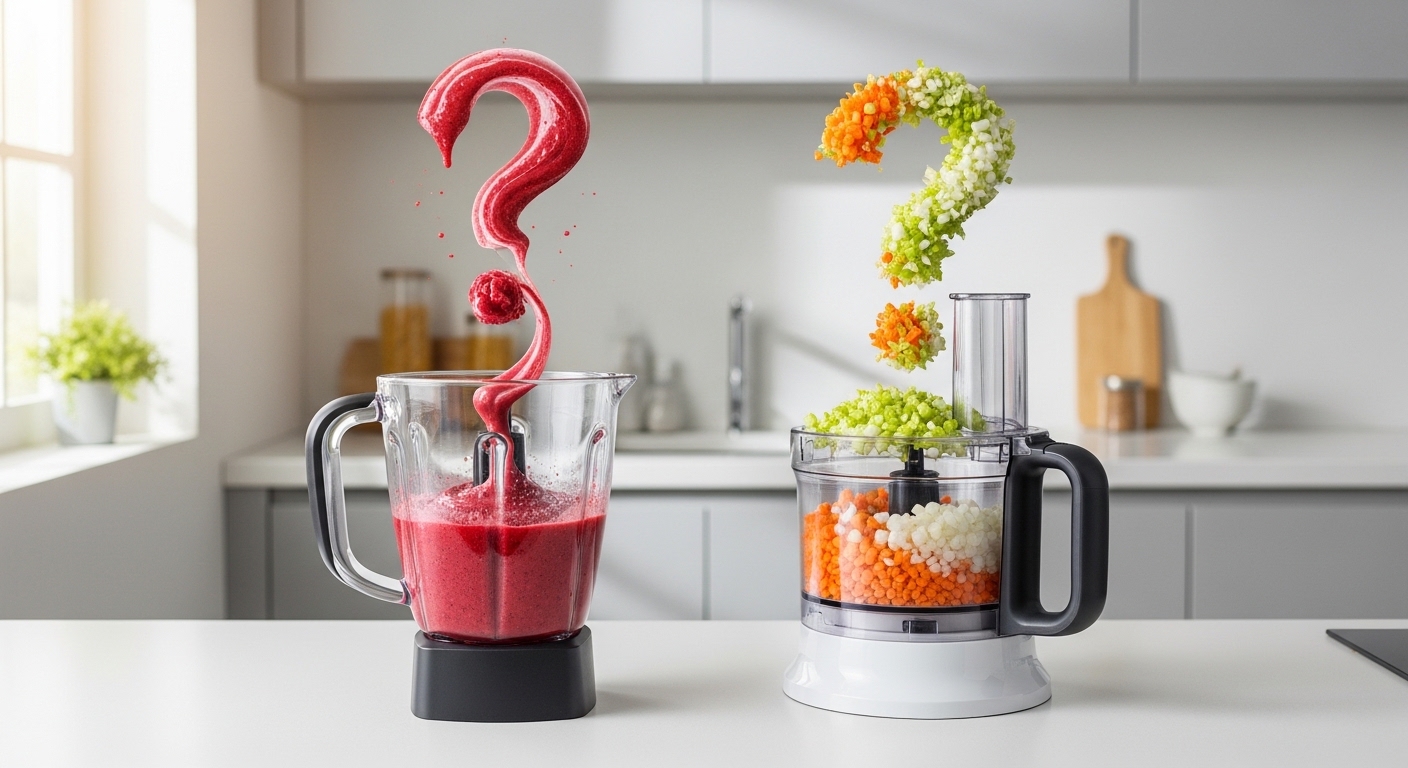
You’re probably standing there, lid half-on, wondering can i use a food processor as a blender because the smoothie mood already started but the blender… well, it’s either missing or just not cooperating today, and now you’re kinda stuck in that small kitchen dilemma that feels bigger than it should be.
And yeah, this question pops up more than people admit. You’ve got a food processor sitting right there, looking capable, kinda confident even, like it should do the job. But should it? Or will it just… make a chunky mess and leave you regretting life choices.
Let’s untangle that, slowly but properly.
So, Can You Use a Food Processor as a Blender?
Short answer, yes, but also not really, and that sounds annoyingly vague but stay with me a sec.
A food processor can act like a blender in certain situations. It spins, it chops, it mixes things into something else, so technically you can blend-ish things in it. But it doesn’t behave like a blender in the way you probably expect, especially if you’re thinking silky smoothies or that perfectly liquid soup texture.
The difference isn’t just branding, it’s in how the machines are designed to move stuff around. A blender pulls ingredients downward into the blades, while a food processor sort of just spins things around in a wider space. That one tiny difference ends up mattering more than you’d think.
Why They Feel Similar but Work Differently
At first glance, both machines seem like cousins who grew up in slightly different households. Same vibe, different habits.
Here’s a clearer breakdown, not too stiff, just enough to make sense:
| Feature | Food Processor | Blender |
|---|---|---|
| Blade Position | Flat at bottom | Angled, pulls downward |
| Bowl Shape | Wide and shallow | Tall and narrow |
| Best For | Chopping, slicing, dough | Liquids, smoothies |
| Texture Output | Chunky to coarse | Smooth to silky |
You see it? The blender is kinda obsessed with smoothness. The food processor is more like “eh, close enough” and moves on.
When Using a Food Processor Actually Works
There are moments where using a food processor instead of a blender feels totally fine, maybe even slightly rebellious in a good way.
1. Thick Mixtures
If you’re making something like hummus, pesto, or thick sauces, the food processor might even do better. It handles dense textures like it’s been doing that all its life.
You won’t miss the blender at all here, honestly.
2. Rough Smoothies (Yes, Really)
If you don’t mind a smoothie that’s… not perfectly smooth, then yeah, you can go for it.
A banana + milk + peanut butter situation? That’ll blend-ish. But frozen fruits might sit there like stubborn little rocks unless you help them along.
Tip: Add more liquid than usual. Like, more than you think you need.
3. Soups (But With Patience)
Cooked vegetables blend easier, so if you’re making soup, a food processor can handle it.
But you might need to:
- Work in batches
- Scrape down the sides
- Accept slightly uneven texture
It won’t be restaurant smooth, but it’ll be edible and comforting, which sometimes is enough.
When It Just Doesn’t Work Well
Now, here’s where things go a bit sideways.
1. Ice Crushing
Trying to crush ice in a food processor feels like asking it to do something it didn’t sign up for. It might manage small amounts, but don’t expect consistency.
Also, it can be kinda loud in a worrying way.
2. Super Smooth Drinks
If you’re chasing that café-style smoothie texture, the kind that feels like liquid velvet, a food processor will likely disappoint you a little.
Tiny bits remain. They just do. It’s their personality.
3. Large Liquid Volumes
Food processors aren’t built to hold and circulate lots of liquid. Pour too much, and you risk leaks or uneven blending.
And cleaning that spill? Not fun, trust me.
Real-World Example (Because This Happens)
Imagine this: it’s hot, you want a mango smoothie, blender’s not around. You toss mango chunks, milk, some sugar into the food processor.
You press start.
At first, it looks promising. Then the mango pieces just spin around like they’re avoiding responsibility. You stop, stir, try again. Eventually, it does become drinkable, but there are tiny bits that remind you this wasn’t the original plan.
That’s the food processor experience in a nutshell.
Tips to Make It Work Better
If you’re going to use a food processor as a blender, you might as well do it in a smarter way, right.
Here’s what actually helps:
- Add liquid first so blades catch something immediately
- Cut ingredients smaller than usual
- Pulse instead of constant blending for better control
- Scrape sides often (yeah, it’s annoying but necessary)
- Don’t overload the bowl
Small adjustments, but they make a noticeable difference.
A Quick Reality Check (Not Trying to Be Dramatic)
People sometimes expect appliances to be interchangeable just because they look similar. But kitchen tools are weirdly specific, like they each have their own little personality quirks.
A food processor isn’t trying to be a blender. It’s just… flexible enough to pretend sometimes.
And honestly, that flexibility is kinda useful.
What Experts Usually Say
Kitchen professionals often point out that while both tools overlap, they’re optimized differently.
One culinary instructor once said something along the lines of: “Use the tool for its strength, not its possibility.”
Which basically means just because you can doesn’t mean it’ll be great every time.
Should You Replace Your Blender With a Food Processor?
If you’re thinking long-term, like “do I even need a blender anymore,” the answer leans toward no.
A food processor can cover some blending needs, but not all. If smoothies, shakes, or pureed soups are a regular thing for you, a blender still earns its spot on the counter.
But if you rarely blend liquids and mostly chop, slice, and mix, then yeah, you might survive just fine without one.
A Slightly Honest Pros and Cons List
Because sometimes you just want things laid out simply.
Pros
- Works for thick mixtures
- Can handle some basic blending
- Multi-purpose, saves space
Cons
- Not great for smooth textures
- Requires more effort (scraping, stirring)
- Struggles with ice and frozen stuff
Not perfect, but not useless either.
The Subtle Psychological Thing No One Mentions
There’s also this small, weird expectation thing. When you use a blender, you expect smoothness. When you use a food processor, you’re slightly more forgiving.
That shift in expectation actually changes how satisfied you feel with the result, which is kinda funny when you think about it.
Final Thoughts (But Not Overly Final, You Know)
So, can i use a food processor as a blender? Yeah, you can, and sometimes it’ll even surprise you a little. But it’s not going to fully replace what a blender does best, and pretending otherwise just leads to mild kitchen disappointment.
If you’re in a pinch, go ahead, use it, experiment a bit, maybe even enjoy the slightly imperfect textures. But if you’re planning your kitchen setup for the long run, it’s worth knowing that each tool earns its place for a reason.
And honestly, half of cooking is just figuring things out like this anyway, slightly messy, slightly improvised, but it somehow works in the end.

Jamesmathew is an expert Amazon affiliate writer, helping readers discover top products, smart deals, and practical buying guides through honest reviews and insightful content.