

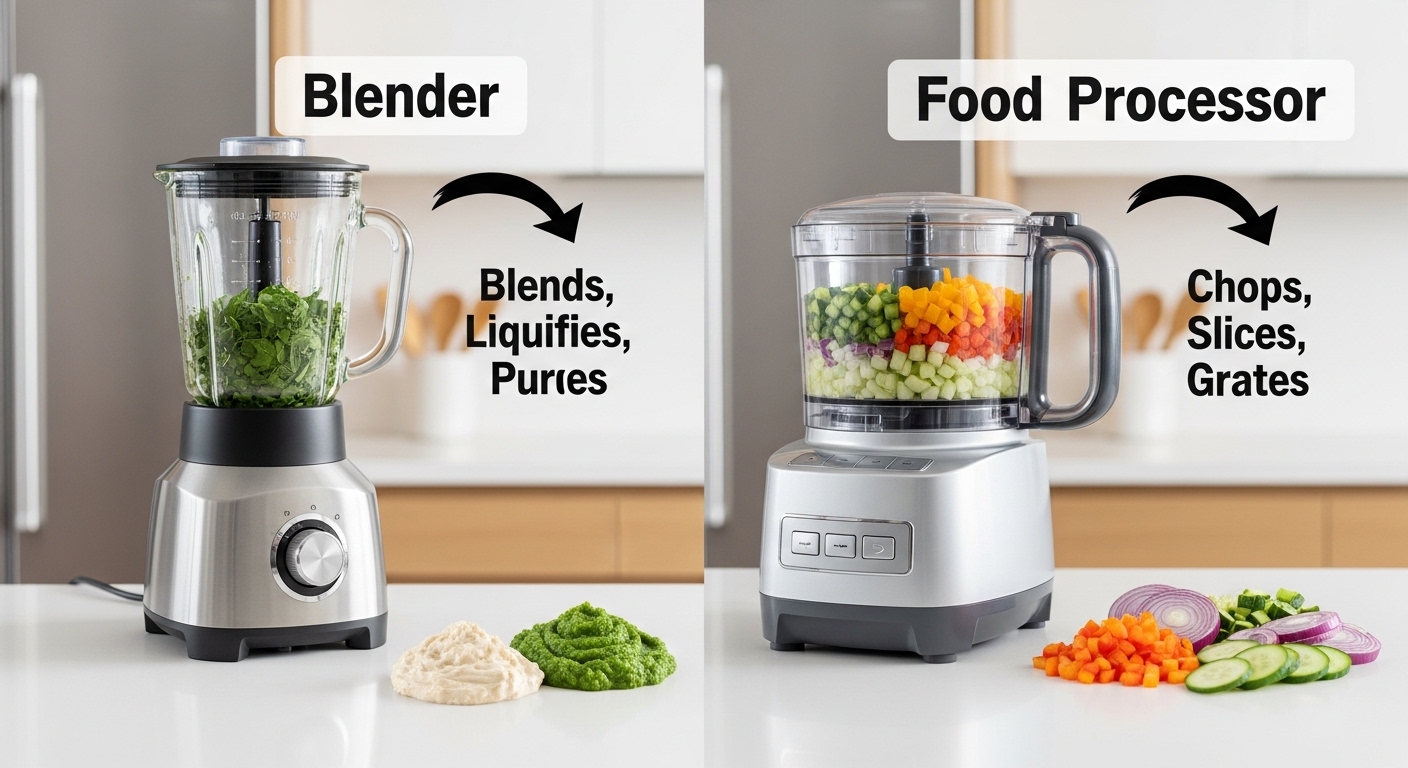
You’re standing there, probably staring at your blender and wondering, can you use a blender instead of a food processor or is this one of those kitchen shortcuts that just ends in a weird paste and mild regret. It’s a very real kinda moment, honestly, because not everyone owns both machines and sometimes you just wanna make the recipe work without buying another bulky thing that barely fits in the cupboard.
So yeah, short answer? You can use a blender instead of a food processor… but also, not always, and not without a bit of adjusting and, sometimes, accepting slightly off-texture results that are still… edible-ish, or even good, just different in a way you didn’t exactly plan.
Blender vs Food Processor: What’s Actually Different
Before you start throwing chickpeas or dough or whatever into your blender and hoping for the best, it helps to kinda get what each machine is trying to do, even if you never thought about it before.
A blender is built for liquids. Smoothies, soups, sauces — stuff that flows. It spins super fast, like aggressively fast, and pulls ingredients down into the blades. A food processor, on the other hand, is more like a controlled chaos machine. It chops, slices, mixes, but it doesn’t rely on everything being liquidy.
Here’s a quick comparison that makes it less abstract:
| Feature | Blender | Food Processor |
|---|---|---|
| Best for | Liquids, smoothies | Solid foods, chopping |
| Blade speed | Very high | Moderate |
| Texture control | Low | High |
| Dry ingredients | Not great | Excellent |
| Dough making | Difficult | Designed for it |
So yeah, they overlap a bit, but they’re not twins, more like cousins who look similar from far away but behave very differently at family gatherings.
When You Can Use a Blender Instead of a Food Processor
Now this is where it gets useful, because there are definitely situations where your blender can step in and do a pretty decent job, even if it’s not perfect.
1. Making Sauces and Purees
This is where the blender kinda shines anyway, so using it instead of a food processor isn’t even a compromise.
Think:
- Hummus (with extra liquid)
- Tomato sauces
- Salad dressings
- Baby food purees
You might notice the texture gets smoother than expected, almost too smooth, like it forgot to stop blending, but honestly that’s not always a bad thing.
2. Crushing Soft Ingredients
If you’re dealing with softer stuff like cooked vegetables or fruits, a blender can handle it pretty okay.
Examples:
- Mashed sweet potatoes (though a bit runnier)
- Cooked carrots for soups
- Bananas for baking
Just don’t expect chunky results, because the blender doesn’t really do “chunky,” it does “obliterated.”
3. Grinding Small Quantities (With Caution)
You can grind things like:
- Nuts (for nut butter or crumbs)
- Oats (for oat flour)
But here’s the thing, you gotta pulse carefully. If you let it run too long, it goes from chopped to paste in like 2 seconds, which is… sometimes what you want, but sometimes absolutely not.
When a Blender Just… Doesn’t Work Well
There are moments where trying to use a blender instead of a food processor feels like using a spoon to cut steak. Technically possible, but why would you do that to yourself.
1. Dough Making
Food processors are actually kinda great for dough. They mix and knead just enough without overworking it.
A blender?
Not so much.
The dough gets stuck, overheats, or just spins uselessly while the blades scream internally. It’s not a good scene.
2. Chopping Vegetables
You can try, but you’ll end up with:
- Some pieces too big
- Some completely mushy
- A weird emotional mix of both
Food processors chop evenly. Blenders just… attack.
3. Slicing and Shredding
Food processors have those fancy discs for slicing cucumbers or shredding cheese.
Blenders do not.
So if your recipe depends on neat slices or consistent shreds, the blender is basically out of the conversation.
Tips to Make Your Blender Work Like a Food Processor (Sort Of)
If you’re committed to making this work, there are ways to improve your results. It’s not magic, but it helps a lot more than just hoping.
Use the Pulse Function
Don’t just turn it on and walk away. Pulse in short bursts.
This gives you some control, kinda mimicking the stop-start action of a food processor. It’s still not perfect, but way better than continuous blending.
Add a Little Liquid
Blenders need movement. If things aren’t moving, they’re not blending.
Even a small amount of:
- Water
- Oil
- Milk
can make a big difference. But yeah, it also changes the final texture, so keep that in mind.
Work in Small Batches
Overloading the blender is like asking it to fail faster.
Do smaller amounts, even if it feels annoying. You’ll get more consistent results and less frustration, which is worth it honestly.
Shake or Stir Between Blends
Sometimes ingredients just sit there like they’ve decided not to participate.
Stop, stir, shake the jar a bit (safely), then continue. It helps redistribute things so the blades can actually reach everything.
Real-World Examples: What Happens If You Try
Let’s say you try making hummus in a blender instead of a food processor.
You’ll probably need more olive oil or water. The result? Smoother, almost whipped texture. Some people actually prefer it, even if it wasn’t the plan.
Now imagine chopping onions.
You pulse once, twice, and suddenly half the onion is mush while the rest is still chunky. It’s not unusable, but it’s not pretty either.
And dough? You try it once, and then probably never again, because it just doesn’t cooperate in the same way.
What Chefs and Experts Tend to Say
A lot of professional cooks will tell you something along the lines of:
“A blender is for making things smoother, a food processor is for making things smaller.”
It sounds overly simple, maybe even a bit too neat, but it’s surprisingly accurate when you think about it.
There’s also data showing that food processors maintain texture better because of their wider bowls and slower blade speed, which prevents over-processing. Blenders, spinning at higher RPMs, break things down faster and more completely, which is why they’re better for liquids but worse for controlled chopping.
Should You Buy a Food Processor or Just Stick With a Blender?
This kinda depends on how often you run into these limitations.
If you:
- Cook a lot from scratch
- Make dough regularly
- Chop vegetables in bulk
Then yeah, a food processor is worth it.
But if you mostly:
- Make smoothies
- Blend sauces
- Occasionally need to improvise
Your blender is probably enough, even if it’s not perfect.
There’s also the space factor. Not everyone wants two appliances doing somewhat overlapping jobs, even if they’re technically different.
The Middle Ground: High-Powered Blenders
Some high-powered blenders (like the more expensive ones) can handle thicker mixtures and even dough-like textures a bit better.
They’re not exactly replacing a food processor, but they blur the line enough that you might not feel the need for both.
Still, even those struggle with slicing or precise chopping, so it’s not a complete replacement, just… a better compromise.
Common Mistakes People Make
You’re not alone if you’ve tried this and it didn’t go well. A lot of people make the same mistakes, kinda unknowingly.
- Overfilling the blender
- Not using pulse mode
- Expecting identical results
- Skipping liquid when needed
- Letting it run too long
It’s not that the blender is bad, it’s just being used outside its comfort zone, which happens.
Final Thoughts: So, Can You Use a Blender Instead of a Food Processor?
Yeah, you can use a blender instead of a food processor, but it’s one of those “it depends” answers that’s actually honest for once. It works well for smooth, liquid-based recipes and kinda struggles with anything that needs structure or precision.
If you go in expecting identical results, you’ll probably be disappointed. But if you adjust your method a bit and accept some differences, it can totally get the job done in a lot of situations.
So next time you’re mid-recipe and realize you don’t have a food processor, don’t panic or abandon the whole thing. Just tweak, pulse, maybe add a splash of liquid, and see where it goes. Worst case, it’s a bit messy. Best case, you accidentally make something better than expected, which happens more than you’d think.

Jamesmathew is an expert Amazon affiliate writer, helping readers discover top products, smart deals, and practical buying guides through honest reviews and insightful content.