

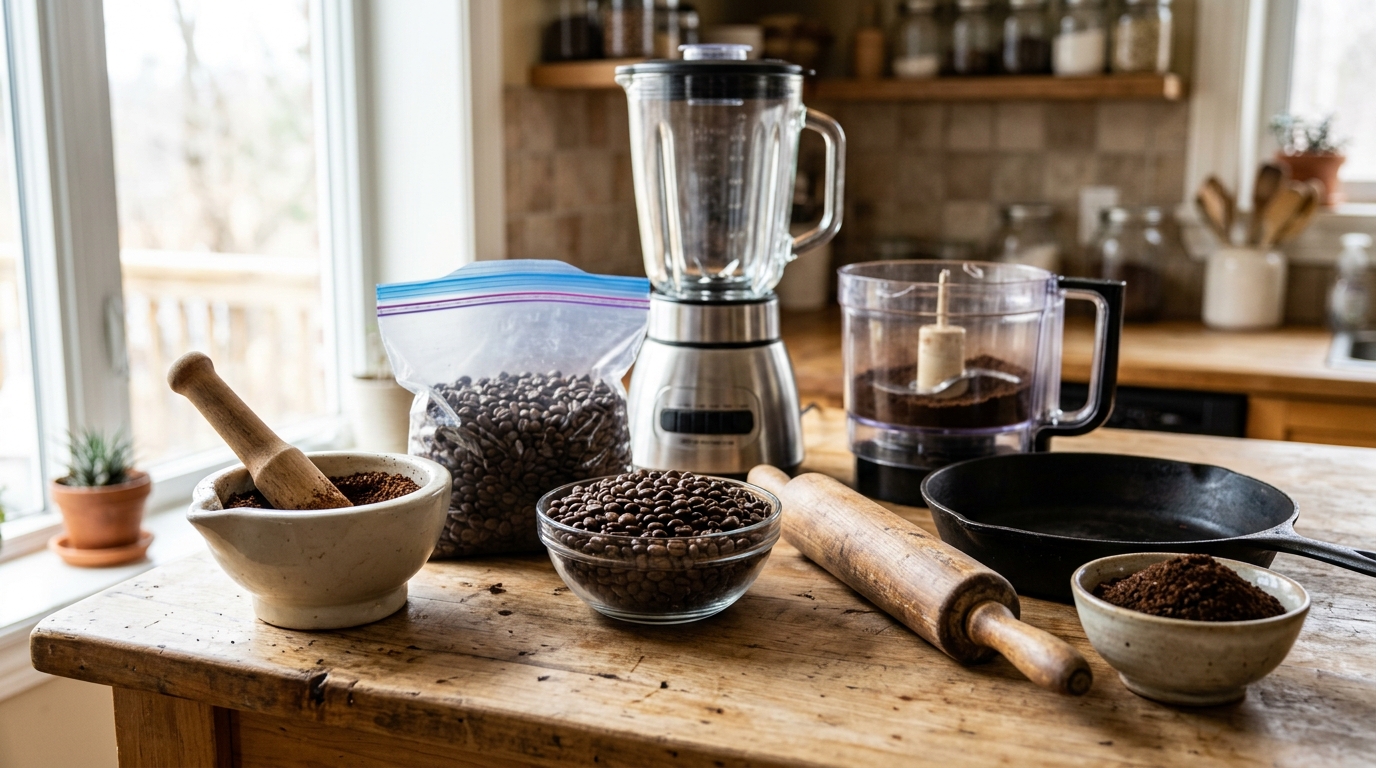
So you woke up, stumbled to the kitchen half asleep, and realized the one thing standing between you and coffee is that stupid grinder that decided to die on you overnight — and now you’re standing there wondering how can you grind coffee beans without a grinder like some kind of caffeine-deprived detective trying to solve a crime. Trust me, I been there, more times than I’d like to admit, and it’s not the end of the world, even though at 6am it definitely feels like it.
The good news, and I mean this genuinely, is that people been grinding coffee beans for literally hundreds of years before electric grinders even existed. Your great grandmother probably had ways to do this that would put our fancy burr grinders to shame. So lets talk about what actually works, what’s a waste of time, and how you can get that morning cup without running to the store at an ungodly hour.
Why Would You Even Need To Grind Coffee Without A Grinder
Before we jump into the how, real quick on the why, because it matters more than people think. Maybe your grinder broke (happens more often than manufacturers want you to know), maybe your traveling and didn’t pack one, or maybe you just bought whole bean coffee on impulse without thinking it through. Whatever the reason, you’re not alone — a 2023 survey from the National Coffee Association found that nearly 65% of American coffee drinkers still prefer drip coffee at home, and a good chunk of them are working with whatever tools happen to be lying around, not professional equipment.
The point is, this is a common problem, and common problems usually have simple solutions if you know where to look.
Best Ways To Grind Coffee Beans Without A Grinder
Using A Mortar And Pestle
This one is probably the closest thing to what a grinder actually does, mechanically speaking. You put a small handful of beans in, and you crush them with a rolling, grinding motion using the pestle. It takes some elbow grease, not gonna lie, your arm might be a little sore after, but the control you get over the consistency is honestly kind of impressive once you get the hang of it.
A few tips that actually helps here:
- Only do small batches at a time, like a tablespoon or two, otherwise the beans just scatter everywhere and you’ll be picking them off your counter for days
- Use a rocking motion instead of straight up pounding, it gives you more even results
- Expect a coarser grind, this method isn’t great for espresso but works fine for French press or cowboy coffee
The Rolling Pin Method (Bag And Bash)
Honestly this is probably my favorite when I’m in a rush, cause it requires almost zero cleanup. Put your beans into a heavy duty ziplock bag or between two sheets of parchment paper, then take a rolling pin and go to town. Roll it back and forth, press down hard, whatever gets the job done.
James Hoffmann, the coffee expert and former World Barista Champion, has mentioned in several of his videos that grind consistency matters way more for espresso than it does for immersion brewing methods like French press, which is good news for anyone using improvised tools, because let’s be real, you’re not gonna get espresso-fine consistency banging beans with a rolling pin no matter how hard you try.
Blender Or Food Processor
If you got one of these sitting in your kitchen, congratulations, you basically have a makeshift grinder. Pulse the beans in short bursts, don’t just hold the button down or you’ll end up with coffee dust in some spots and whole chunks in others. Five to ten short pulses usually does the trick for a medium grind.
One thing worth noting though, blenders generate heat from the blade friction, and heat is not really coffee’s friend when it comes to flavor. It can slightly cook the beans and mess with the aromatic oils, so don’t expect it to taste exactly like fresh ground from a proper burr grinder.
Hammer Method
Look, sometimes you just gotta get creative, and this is one of those times. Put your beans in a sturdy bag (double bag it honestly, learned that the hard way once), lay it on a cutting board, and gently tap with a hammer or meat mallet. Emphasis on gently, cause you’re not trying to demolish your kitchen counter, just crack open some beans.
This method gives a pretty uneven, chunky grind, so it works best for methods that are forgiving like percolators or cowboy coffee where you boil grounds directly in water.
Using A Knife
This sounds weird but it actually works in a pinch. Lay beans on a cutting board and rock a chef’s knife back and forth over them, similar to how you’d mince garlic. It’s slow, and honestly kind of tedious, but if you only need enough for one cup it’s not that bad.
Comparing The Methods
Here’s a quick breakdown so you can figure out which method actually fits your situation best.
| Method | Time Needed | Grind Consistency | Best Brewing Method | Effort Level |
|---|---|---|---|---|
| Mortar and Pestle | 5-8 minutes | Medium to Fine | French Press, Turkish | High |
| Rolling Pin | 3-5 minutes | Coarse | French Press, Cold Brew | Medium |
| Blender | 1-2 minutes | Uneven Medium | Drip, French Press | Low |
| Hammer | 3-4 minutes | Coarse, Chunky | Percolator, Cowboy Coffee | Medium |
| Knife | 8-10 minutes | Fine but Inconsistent | Espresso (in a pinch), Moka Pot | High |
What About Grind Size Actually Mattering
This is something a lot of people underestimate. Grind size isn’t just some arbitrary detail baristas obsess over for fun, it genuinely changes the extraction and therefore the taste. Too fine of a grind for a method like French press and you’ll get over-extracted, bitter sludge. Too coarse for something like espresso and you get weak, sour, underwhelming shots.
According to the Specialty Coffee Association, extraction yield — basically how much of the coffee’s soluble compounds end up in your cup — ideally sits between 18% and 22% for a balanced flavor. Grind size is one of the biggest variables controlling that number, right alongside water temperature and brew time. So when your improvising with a hammer or a rolling pin, just know your working with less precision, and that’s okay, it’s not gonna ruin your life, just maybe adjust your expectations a little.
Quick Tips For Better Results Without A Grinder
- Start with fresh beans, stale beans crumble weird and unevenly no matter what tool you use
- Sift your grounds through a fine mesh strainer afterward if you can, this helps separate the big chunks from the dust
- Adjust your brew time to compensate, if your grind ended up coarser than usual, let it steep a little longer
- Don’t overthink perfection, coffee made with improvised tools has been keeping humans functional for centuries, it doesn’t need to be Instagram worthy
Final Thoughts
At the end of the day, not having a grinder is genuinely not the emergency it feels like in the moment. Between a mortar and pestle, a rolling pin, a blender, or even just a hammer and some patience, you got plenty of options to still get your coffee fix. It won’t be identical to a professionally ground batch, sure, but it’ll do the job, and honestly there’s something kind of satisfying about doing it the old fashioned way once in a while.
Next time your grinder decides to quit on you right when you need it most, you’ll already know exactly what to do instead of standing there in your kitchen, coffee bag in hand, wondering how can you grind coffee beans without a grinder like it’s some unsolvable mystery. It’s not. You got this.

Jamesmathew is an expert Amazon affiliate writer, helping readers discover top products, smart deals, and practical buying guides through honest reviews and insightful content.