

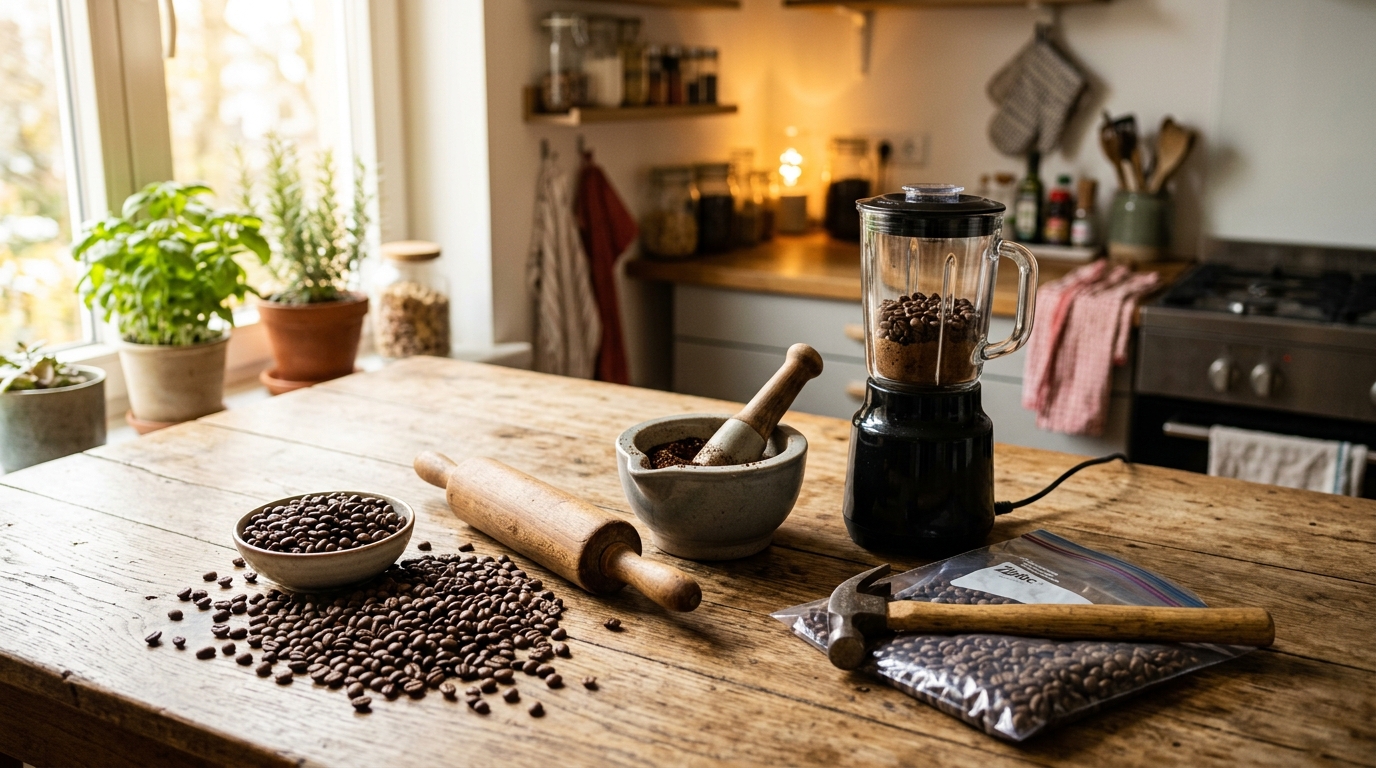
You probably searched how to grind coffee beans without a grinder because the coffee is sitting there, smelling amazing, while the grinder is… nowhere. Maybe it broke this morning, maybe you forgot it while traveling, or maybe you never owned one in the first place. It happens more often then people admit. The good news? You don’t have to give up your morning cup just yet.
Coffee beans are surprisingly forgiving if you treat them with a bit of patience. You won’t get laboratory-level consistency using kitchen tools, sure, but you can absolutely make coffee that tastes rich, balanced, and honestly better than many people expect. Some methods are noisy, some are oddly satisfying, and a couple might leave your arms feeling like they’ve done a tiny workout. That’s part of the fun, I guess.
Can You Grind Coffee Beans Without a Grinder?
Yes, you can. Coffee beans only need to be broken into pieces that match your brewing method. A burr grinder simply does this more evenly than household tools.
The challenge isn’t crushing the beans. That’s easy enough. The difficult bit is crushing them consistently so that the water extracts flavor evenly. Uneven grounds create an uneven cup. Tiny particles become bitter while larger chunks stay under-extracted, which is why your coffee might taste both sour and harsh at the same time. Strange, but true.
According to the Specialty Coffee Association (SCA), grind size is one of the biggest factors affecting extraction and final flavor. Even small changes in particle size noticeably influence sweetness, acidity, and body.
Why Grind Size Matters
Different brewing methods need different grind sizes. Using the wrong one can completely change your coffee.
| Brewing Method | Recommended Grind |
|---|---|
| French Press | Coarse |
| Cold Brew | Extra Coarse |
| Pour Over | Medium |
| Drip Coffee Maker | Medium |
| AeroPress | Medium-Fine |
| Espresso | Fine |
| Turkish Coffee | Extra Fine |
Trying to make espresso with chunky grounds is like trying to cut butter using a spoon. It’ll technically happen… sort of… but nobody would recommend it.
Before You Start Grinding
A few quick preparations make every method easier.
- Measure only the beans you need.
- Place beans inside a thick freezer bag if crushing.
- Use sturdy kitchen tools.
- Work on a stable countertop.
- Clean every tool before and after use.
Little things like this save you from coffee dust scattered across half the kitchen. Learned that one the slightly annoying way.
1. Use a Rolling Pin
A rolling pin is probably the closest substitute to a manual grinder.
Place your beans inside a heavy-duty freezer bag. Remove as much air as possible before sealing it. Lay the bag flat on a towel to stop it sliding around.
Start by pressing down firmly to crack the beans. Once they’re broken into smaller pieces, roll the pin back and forth while applying steady pressure. Rotate the bag occasionally so everything gets crushed fairly evenly.
Best for:
- French Press
- Pour Over
- Drip Coffee
Pros
- Easy to control
- Fairly consistent
- Uses common kitchen equipment
Cons
- Takes several minutes
- Not ideal for espresso
2. Crush Coffee Beans with a Mortar and Pestle
People have crushed spices this way for thousands of years. Coffee works pretty well too.
Instead of pounding aggressively, press and twist the pestle into the beans. Begin gently until every bean cracks. Then continue grinding with circular movements. It’s slower than modern grinders but gives surprisingly consistent results if you’re patient enough.
Professional coffee cuppers sometimes use oversized laboratory-style mortar and pestle sets because they allow careful control over particle size.
Works best for:
- Pour Over
- French Press
- AeroPress
3. Use a Blender
A blender isn’t perfect, though it gets the job done when needed.
Add a small amount of coffee beans. Pulse instead of running continuously. Continuous blending creates heat, and heat can slightly alter coffee’s delicate aromatic compounds before brewing even begins. That’s kinda frustrating after buying nice beans.
Shake the blender between pulses to redistribute larger pieces.
Tips
- Use short bursts.
- Blend small batches.
- Don’t overheat the beans.
4. Grind Coffee with a Food Processor
Food processors behave similarly to blenders but usually create a slightly more even grind.
Pulse repeatedly instead of letting the blades spin continuously. Scrape larger pieces toward the center between pulses.
Expect medium consistency rather than perfectly uniform grounds.
Ideal for:
- Drip coffee
- Pour over
- Cold brew
5. Use a Hammer or Meat Tenderizer
This method sounds dramatic because… well… it kinda is.
Seal beans inside a thick freezer bag. Place the bag between folded kitchen towels. Strike gently until the beans crack, then continue using controlled taps instead of full-force swings.
You’re crushing, not demolishing the countertop.
This produces coarse grounds that work nicely for French Press or cold brew.
6. Try a Cast Iron Skillet
A heavy skillet can act like a giant crushing surface.
Spread beans on a sturdy cutting board. Press the flat bottom of the skillet firmly onto them. Twist slightly while applying pressure.
Repeat until the grounds reach your desired texture.
It isn’t especially quick, although it gives more control than many people assume.
7. Use a Heavy Mug
Sometimes you’re staying in a hotel, cabin, or vacation rental with basically nothing useful nearby.
A thick ceramic mug can help.
Press the flat bottom onto a small amount of beans and rotate slowly while applying downward pressure. Continue until the coffee reaches a coarse consistency.
It’s definitely not elegant, but neither is instant coffee if you’re trying to avoid it.
8. Crush with a Knife
Use the flat side of a chef’s knife.
Lay the blade flat over several beans. Press carefully using your palm until the beans crack. Continue pressing and rocking the blade until they’re broken into smaller particles.
Always keep fingers away from the cutting edge.
Safety comes before coffee, even if Monday mornings try convincing you otherwise.
9. Use a Pepper Mill
Some manual pepper mills can grind coffee beans.
This only works if the grinder uses durable burrs rather than delicate mechanisms designed exclusively for peppercorns.
Clean the mill thoroughly before and after use.
Otherwise your morning brew may have unexpected pepper notes. Some folks actually enjoy that. Most don’t.
10. Buy Pre-Ground Coffee as Backup
Sometimes the simplest backup plan is the smartest.
Keeping one small airtight bag of quality pre-ground coffee means you’re never completely stuck if your grinder fails.
Vacuum-sealed packaging helps preserve freshness for longer than opened bags.
Which Method Produces the Best Results?
Here’s a quick comparison.
| Method | Consistency | Difficulty | Best Brew |
|---|---|---|---|
| Rolling Pin | Very Good | Easy | Drip, Pour Over |
| Mortar and Pestle | Excellent | Moderate | Most Methods |
| Blender | Moderate | Easy | Drip |
| Food Processor | Moderate | Easy | Cold Brew |
| Hammer | Coarse | Easy | French Press |
| Skillet | Moderate | Moderate | Pour Over |
| Mug | Basic | Easy | French Press |
| Knife | Basic | Moderate | Coarse Brewing |
| Pepper Mill | Good | Easy | Drip |
Common Mistakes to Avoid
Grinding coffee manually leaves more room for little mistakes.
Avoid these common ones:
- Grinding too much coffee at once.
- Using thin plastic bags that tear.
- Running blenders continuously.
- Mixing extremely fine and extremely coarse particles.
- Brewing immediately after overheating beans.
- Using damp equipment.
None of these ruin coffee completely, though together they certainly don’t help.
How Fine Should You Grind Coffee?
Think about your brewing time.
Water stays in contact with coarse grounds much longer, which is why French Press uses larger particles. Espresso extracts in roughly 25–30 seconds, requiring very fine grounds.
Here’s a simple memory trick:
- Long brewing = Coarse grind
- Medium brewing = Medium grind
- Fast brewing = Fine grind
Funny enough, remembering that one sentence is easier than memorizing seven different brewing charts.
Storage Tips After Grinding
Freshly ground coffee loses aroma much faster than whole beans.
Research published by the Coffee Quality Institute and supported by multiple food science studies shows ground coffee rapidly loses volatile aromatic compounds after grinding because more surface area becomes exposed to oxygen.
To preserve flavor:
- Store grounds in an airtight container.
- Keep away from sunlight.
- Avoid moisture.
- Don’t refrigerate daily-use coffee.
- Grind immediately before brewing whenever possible.
Coffee doesn’t exactly “go bad” overnight, but its personality slowly wanders away if left exposed.
Frequently Asked Questions
Can you grind coffee beans in a blender?
Yes. Pulse in short bursts instead of blending continuously. You’ll get medium consistency that’s suitable for drip coffee or pour over.
Is crushing coffee beans the same as grinding?
Not exactly. Crushing breaks beans apart, while grinding aims for evenly sized particles. Burr grinders do this much better, although manual methods can still produce good coffee.
Can I use a food processor instead of a grinder?
Absolutely. Pulse several times and shake the bowl between pulses for a more even result.
Which household tool works best?
A mortar and pestle usually produces the most consistent grind among common kitchen tools. A rolling pin comes very close and is easier for many people.
Will coffee taste different without a grinder?
Possibly. Uneven grounds can create inconsistent extraction, though careful technique greatly reduces the difference.
Expert Tip
Coffee expert James Hoffmann has repeatedly emphasized that grind consistency matters more than chasing ultra-fine particles. Even extraction almost always beats uneven extraction, regardless of brewing method. That’s a surprisingly comforting thought when you’re standing in the kitchen holding a rolling pin instead of a grinder.
Final Thoughts
Knowing how to grind coffee beans without a grinder isn’t just a neat kitchen trick. It’s one of those oddly useful skills that saves an otherwise disappointing morning. Whether you use a rolling pin, mortar and pestle, blender, or even a sturdy mug, you can still make flavorful coffee with a little patience.
No homemade method completely replaces a quality burr grinder, and pretending otherwise wouldn’t be fair. Still, if fresh beans are all you have, these techniques prove you don’t need fancy equipment to brew something genuinely enjoyable. Sometimes the coffee tastes slightly rustic, sometimes surprisingly excellent, and every now and then you’ll wonder why you ever panicked in the first place.

Jamesmathew is an expert Amazon affiliate writer, helping readers discover top products, smart deals, and practical buying guides through honest reviews and insightful content.