

You probably searched how to grind coffee without a grinder because the beans are sitting there, the water is already heating, and somehow the grinder is the only thing missing. That’s annoyingly specific, isn’t it? It happens more often than people admit. Maybe your grinder broke this morning, maybe you’re traveling, or maybe you bought whole beans thinking you’d “figure it out later.” Well, later showed up. The good news is that you don’t actually need fancy equipment to make decent coffee. A little patience, a couple of everyday kitchen tools, and you’ll still end up with something worth drinking, even if the grind isn’t textbook perfect.
Freshly ground coffee simply tastes better because coffee beans begin losing their aromatic compounds within minutes after grinding. According to the Specialty Coffee Association (SCA), consistent grind size plays a major role in extraction quality, but when you don’t have a grinder available, there are surprisingly effective alternatives that can get you close enough for a satisfying cup.
Why Grinding Coffee Beans Matters
Whole coffee beans protect delicate oils and volatile compounds from oxygen, moisture, heat, and light. Once they’re broken apart, those flavors begin escaping rather quickly. That’s why pre-ground coffee usually tastes flatter than beans ground moments before brewing.
Grinding also determines how quickly water extracts flavors from coffee. A coarse grind slows extraction, while a fine grind speeds it up. If your particles vary wildly in size, you’ll probably notice some grounds becoming over-extracted and bitter while others remain under-extracted and sour. Still, don’t let perfection stop you from making coffee. Imperfect fresh grounds often beat stale pre-ground coffee anyway, funny enough.
Can You Grind Coffee Without a Grinder?
Absolutely.
People brewed coffee long before electric burr grinders became common household appliances. While manual methods won’t produce perfectly uniform particles, they’ll create grounds suitable for several brewing styles.
Here’s what you should expect:
| Method | Difficulty | Grind Consistency | Best Brewing Method |
|---|---|---|---|
| Blender | Easy | Fair | Drip coffee, French press |
| Food processor | Easy | Fair | Cold brew, drip |
| Rolling pin | Medium | Good for coarse grind | French press |
| Mortar and pestle | Medium | Very good | Pour over, AeroPress |
| Hammer or mallet | Easy | Coarse | Cold brew |
| Knife | Hard | Uneven | Emergency use only |
The trick isn’t chasing perfection. It’s matching the grind as closely as possible to your brewing method.
Best Ways to Grind Coffee Without a Grinder
Use a Blender
A blender is probably the closest substitute for an actual coffee grinder.
Most blenders include pulse settings, which help avoid overheating the beans. Instead of running continuously, pulse the beans for two or three seconds at a time. Shake the container between pulses so larger pieces settle toward the blades.
You won’t get café-level consistency, but it’s honestly better than many people expect. Just avoid blending too long because friction creates heat, and excessive heat can alter coffee’s delicate flavors.
Steps:
- Add a small batch of beans.
- Use short pulse bursts.
- Shake between pulses.
- Stop once the desired texture appears.
Small batches work much better than filling the blender halfway. It feels slower, sure, but results improve quite a bit.
Crush Coffee Beans with a Rolling Pin
This old-school method works surprisingly well for coarse coffee grounds.
Place your coffee beans inside a heavy-duty freezer bag or between folded parchment paper. Push down gently with the rolling pin to crack the beans before rolling firmly across them.
Unlike chopping motions, rolling creates a more even particle size. It takes a few minutes, though honestly it’s kinda satisfying in a weird way.
Best for:
- French press
- Cold brew
- Cowboy coffee
Avoid using thin sandwich bags because they can split open when pressure builds.
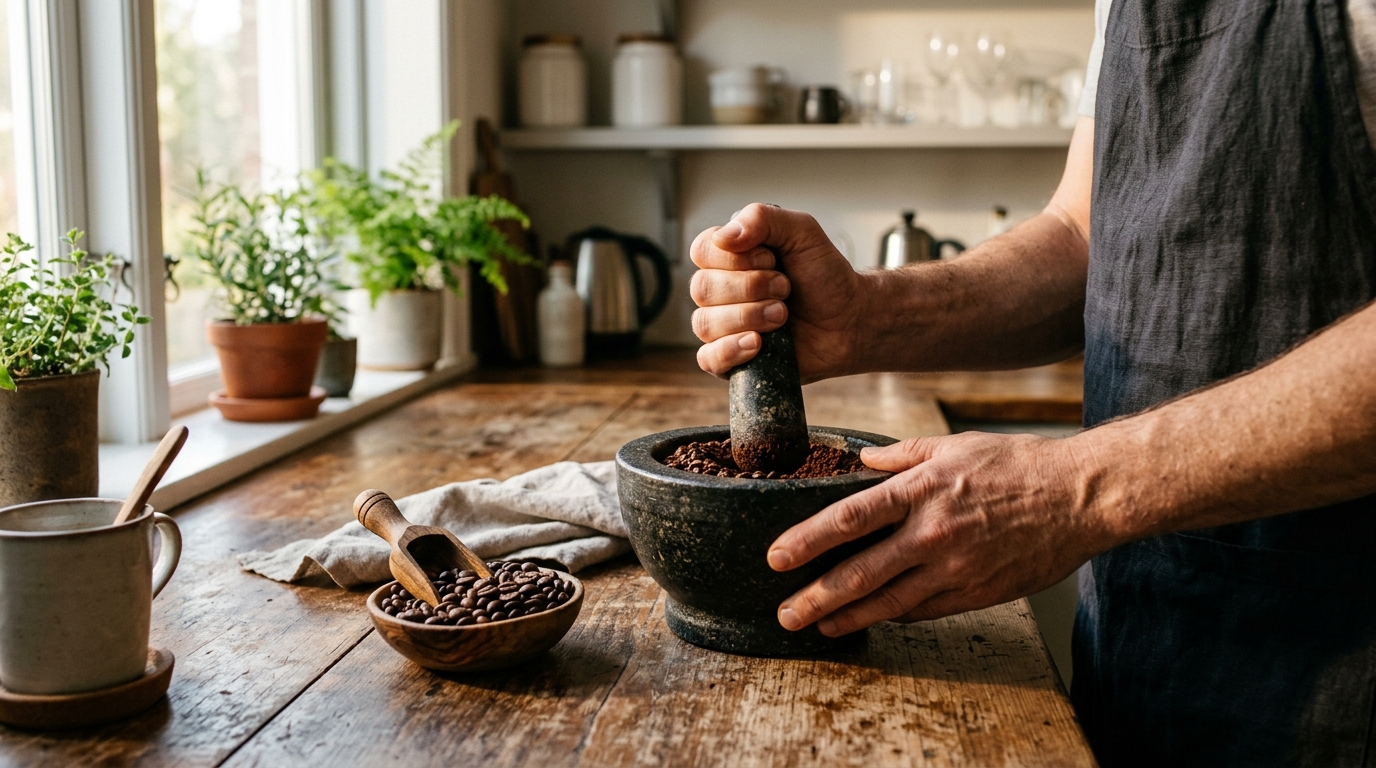
Use a Mortar and Pestle
Professional chefs have relied on mortars and pestles for centuries, and coffee beans respond surprisingly well to the same technique.
Instead of smashing aggressively, press and twist the beans. Continue rotating until particles reach the desired size.
This method offers more control than nearly every other manual option. It’s slower, yes, but consistency tends to improve because you decide when each bean is finished.
Ideal for:
- Pour over coffee
- AeroPress
- Moka pot
Many specialty coffee shops actually use a mortar and pestle for cupping demonstrations because it preserves aroma remarkably well.
Try a Food Processor
A food processor works similarly to a blender but often produces slightly larger particles.
Pulse in short bursts while gently shaking the processor bowl between pulses.
Since processor blades spread wider than blender blades, you may notice some beans escaping complete contact. That’s normal. Just stop occasionally and stir everything around before pulsing again.
This method shines for:
- Batch brewing
- Cold brew concentrate
- French press
Crush Beans with a Hammer or Meat Tenderizer
This is probably the loudest option.
Wrap coffee beans inside a thick towel before gently striking them with a hammer, mallet, or meat tenderizer. Begin with light taps rather than heavy blows. Once beans crack, continue until reaching your preferred coarseness.
Oddly enough, gentle repeated taps produce more even results than dramatic smashing.
This approach works best when making:
- Cold brew
- Percolator coffee
- Camping coffee
Don’t overdo it. Pulverizing everything into dust isn’t the goal.
Use a Heavy Pan
No rolling pin? Grab a cast-iron skillet or heavy frying pan.
Place beans inside a freezer bag and press down firmly using the flat bottom of the pan. Rock it slightly while applying pressure.
This creates coarse grounds with minimal equipment. It’s also quieter than using a hammer, which your neighbors might appreciate.
Chop Beans with a Chef’s Knife
This is definitely an emergency method.
Lay the flat side of a large chef’s knife over several coffee beans and press downward carefully. Continue chopping the broken pieces until they’re roughly the desired size.
It’s time-consuming and produces uneven grounds, though if you’re determined enough, you’ll still get coffee. Sometimes determination counts for more than equipment.
Choosing the Right Grind Size
Different brewing methods require different grind textures.
| Brewing Method | Recommended Grind |
|---|---|
| French Press | Coarse |
| Cold Brew | Extra coarse |
| Drip Coffee | Medium |
| Pour Over | Medium-fine |
| AeroPress | Medium |
| Espresso | Fine |
Without a grinder, coarse and medium grinds are much easier to achieve consistently than espresso-fine particles.
If your grounds look uneven, don’t panic. Brewing time adjustments can compensate for small inconsistencies.
Tips for Better Results
Grinding coffee without a grinder gets easier with a few practical habits.
- Work in small batches.
- Avoid overheating the beans.
- Clean tools immediately afterward.
- Use fresh whole beans whenever possible.
- Match grind size to your brewing method.
- Don’t obsess over perfect uniformity.
One thing people often overlook is patience. Rushing usually creates more dust and more large chunks, somehow at the exact same time.
Common Mistakes to Avoid
Several mistakes can noticeably affect flavor.
Grinding Too Much at Once
Large batches create uneven particle sizes because beans move unpredictably around blades or tools.
Instead, divide your beans into smaller portions.
Overheating the Beans
Continuous blending generates friction.
Heat accelerates flavor loss, reducing the sweetness and complexity you’re hoping to preserve.
Ignoring Brewing Time
Coarser grounds require longer extraction.
If your coffee tastes weak, extend brewing time slightly before assuming the grind ruined everything.
Using Thin Plastic Bags
Beans have surprisingly sharp edges after cracking.
Choose freezer bags or wrap beans in a sturdy kitchen towel to prevent unexpected spills.
Which Method Produces the Best Coffee?
If consistency matters most, here’s a general ranking:
- Mortar and pestle
- Blender
- Rolling pin
- Food processor
- Heavy pan
- Hammer
- Chef’s knife
That order isn’t absolute, of course. Someone with excellent technique can outperform expensive equipment. Skill sneaks into coffee making more often than people expect.
Real-World Example
Imagine you’re staying at a cabin for the weekend.
You packed premium whole coffee beans but forgot your grinder. The kitchen has only a rolling pin and a blender. Rather than driving thirty minutes to buy pre-ground coffee, you pulse half the beans in the blender for drip coffee, then crush the remaining beans with the rolling pin for a French press later that evening.
Will both cups rival specialty cafés? Probably not.
Will they taste fresher than months-old supermarket grounds?
Almost certainly.
That’s the funny thing about coffee. Freshness covers a surprising number of imperfections.
Frequently Asked Questions
Can I grind coffee beans with a blender?
Yes. A blender is one of the best alternatives to a coffee grinder. Use short pulse bursts instead of continuous blending for better consistency.
Is a food processor good for grinding coffee?
Yes, especially for coarse or medium grinds used in drip coffee or cold brew. It won’t match a burr grinder but performs reasonably well.
Can I make espresso without a grinder?
Not realistically. Espresso requires an extremely fine and consistent grind that manual household alternatives rarely achieve.
Does crushing coffee beans change the taste?
The crushing method itself doesn’t significantly affect flavor. However, uneven particle sizes can lead to uneven extraction, influencing the final taste.
Should I grind all my coffee beans at once?
No. Grind only what you’ll use within a few days. Whole beans retain freshness much longer than ground coffee.
Final Thoughts
Learning how to grind coffee without a grinder isn’t just about improvising during an emergency. It’s about realizing that good coffee depends more on freshness, attention, and a bit of creativity than on expensive gadgets. Sure, a quality burr grinder remains the gold standard, but everyday kitchen tools can produce surprisingly enjoyable results when used thoughtfully.
Whether you reach for a blender, rolling pin, mortar and pestle, or even a heavy skillet, you’ll still unlock the aromas trapped inside whole beans. The grind may not be flawless, and honestly that’s alright. Coffee has always rewarded curiosity more than perfection. So the next time your grinder disappears into bad timing or simply refuses to cooperate, you’ll know exactly how to keep brewing without missing your morning cup.

Jamesmathew is an expert Amazon affiliate writer, helping readers discover top products, smart deals, and practical buying guides through honest reviews and insightful content.