

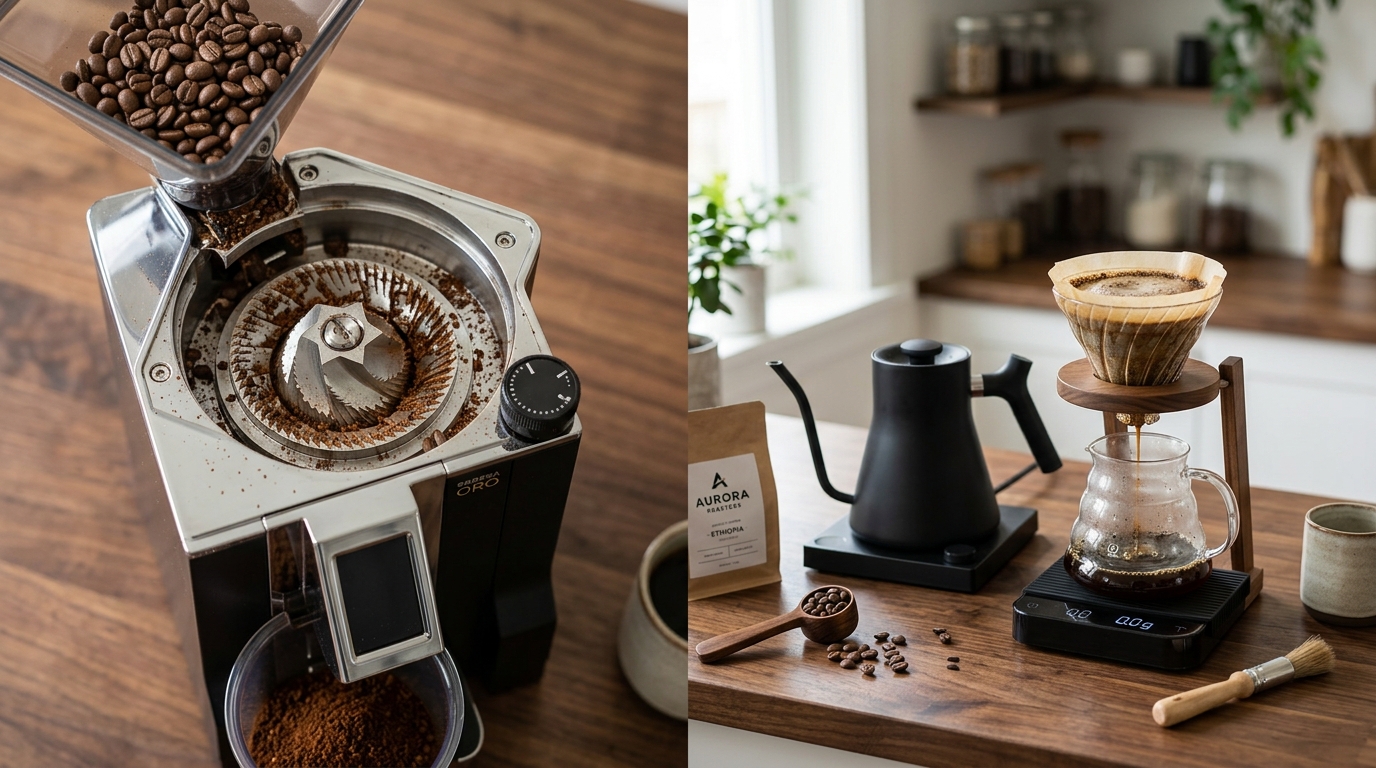
You keep hearing what is a burr coffee grinder, then somebody says you absolutely need one, then someone else shrugs and says a cheap grinder works fine. It gets weirdly confusing pretty fast, doesn’t it. If you’ve been standing in your kitchen wondering why your coffee never tastes quite like the one from your favorite café, there’s a decent chance the grinder is quietly causing more trouble than the beans themselves.
A lot of people spend serious money on premium coffee while still using a blade grinder that chops beans into a strange mix of powder and chunky bits. The result? One sip tastes bitter, the next feels sour, and somehow both happen in the same cup. That’s where burr grinders enter the picture, and honestly, they change far more than most beginners expect.
This guide explains exactly what a burr coffee grinder is, how it works, why coffee enthusiasts prefer it, and whether it’s actually worth buying. You’ll also learn about different burr types, grind settings, maintenance, and common mistakes that can quietly ruin your coffee.
What Is a Burr Coffee Grinder?
A burr coffee grinder crushes coffee beans between two precisely engineered abrasive surfaces called burrs instead of chopping them with spinning blades.
Think about cracking walnuts with two flat stones instead of swinging a hammer. That’s kinda close, although not perfect. The beans pass between two burrs, becoming smaller and smaller until they reach the exact grind size you’ve selected.
Because the space between the burrs stays consistent, nearly every coffee particle ends up close to the same size.
That consistency matters more than most people realize.
Coffee extraction depends heavily on particle size. If your grounds are uneven, tiny particles over-extract while larger ones under-extract. Your coffee ends up tasting muddy, bitter, sour, or somehow all three. It sounds odd, but it happens alot.
How Does a Burr Coffee Grinder Work?
The mechanism is surprisingly simple.
- Whole coffee beans enter the hopper.
- The beans fall between two burrs.
- One burr remains stationary.
- The other burr rotates.
- Beans are gradually crushed into smaller particles.
- Once the grounds reach the chosen size, they fall into the collection container.
Unlike blade grinders, burr grinders don’t randomly smash beans.
Instead, they reduce them step by step until every particle reaches a similar size. It’s almost boringly methodical, and that’s exactly why it works so well.
Why Grind Consistency Matters
Imagine baking cookies with flour containing both fine powder and tiny pebbles.
Sounds ridiculous, right?
Coffee behaves in a surprisingly similar way.
Water extracts flavor from coffee grounds. Smaller particles release flavor faster than larger ones.
Here’s what happens with uneven grounds:
| Particle Size | Extraction Speed | Flavor Result |
|---|---|---|
| Very fine | Too fast | Bitter |
| Medium | Balanced | Sweet and flavorful |
| Large | Too slow | Sour and weak |
When every coffee particle is nearly identical, water extracts them evenly.
That’s why specialty coffee shops almost always rely on burr grinders.
Burr Grinder vs Blade Grinder
Many beginners wonder whether spending extra money on a burr grinder actually makes a noticeable difference.
Here’s a straightforward comparison.
| Feature | Burr Grinder | Blade Grinder |
|---|---|---|
| Grinding method | Crushes beans | Chops beans |
| Grind consistency | Excellent | Poor |
| Flavor quality | Rich and balanced | Often uneven |
| Adjustable grind sizes | Yes | Limited |
| Espresso capable | Yes | Usually no |
| Heat generation | Lower | Higher |
| Price | Higher | Lower |
The biggest difference isn’t really convenience.
It’s taste.
Even an affordable burr grinder often produces noticeably better coffee than an expensive blade grinder.
Types of Burr Coffee Grinders
Not every burr grinder works exactly the same way.
Two primary designs dominate the market.
Flat Burr Grinder
Flat burr grinders use two parallel ring-shaped burrs positioned horizontally.
Beans pass through these burrs before falling into the grounds container.
Advantages include:
- Exceptional grind consistency
- Excellent espresso performance
- Uniform particle distribution
- Popular among specialty cafés
Potential drawbacks:
- Usually more expensive
- Can retain slightly more coffee grounds
- Sometimes louder
Conical Burr Grinder
Conical burr grinders use an outer ring burr and a cone-shaped inner burr.
Beans gradually travel downward while being crushed.
Benefits include:
- Quieter operation
- Lower heat production
- Excellent durability
- Lower coffee retention
- Often more affordable
Many home coffee lovers choose conical burr grinders because they balance performance and value surprisingly well.
Manual vs Electric Burr Coffee Grinder
Another choice you’ll eventually face is whether to buy a manual or electric model.
Manual Burr Grinders
Manual grinders require turning a hand crank.
Pros:
- Portable
- Affordable
- Silent
- Great for travel
- No electricity required
Cons:
- Takes effort
- Slower grinding
- Less convenient for multiple cups
Electric Burr Grinders
Electric grinders use a motor.
Pros:
- Fast
- Convenient
- Consistent
- Better for daily use
- Handles larger quantities
Cons:
- More expensive
- Louder
- Requires power
If you brew coffee every morning before work, electric models usually make life easier. If you travel, camp, or simply enjoy the ritual, manual grinders can actually become part of the fun.
Which Brew Methods Need Which Grind Size?
Different brewing methods require different grind sizes.
Using the wrong grind can dramatically affect flavor.
| Brewing Method | Recommended Grind |
|---|---|
| Espresso | Extra fine |
| Moka Pot | Fine |
| AeroPress | Medium-fine |
| Pour Over | Medium |
| Drip Coffee Maker | Medium |
| Chemex | Medium-coarse |
| French Press | Coarse |
| Cold Brew | Extra coarse |
One nice thing about burr grinders is their flexibility.
Most quality models allow dozens of grind settings, making it easy to experiment untill you find your favorite.
Why Coffee Professionals Prefer Burr Grinders
Professional baristas obsess over consistency.
It’s not because they’re trying to sound fancy.
Coffee brewing involves controlling several variables:
- Water temperature
- Brewing time
- Coffee dose
- Water quality
- Grind size
If grind size changes every time, every other variable becomes harder to control.
As coffee expert James Hoffmann has often explained:
“Grinding is probably the single most important part of brewing coffee.”
That statement surprises many beginners.
Most expect beans or machines to matter more.
In reality, an excellent grinder paired with decent beans often produces better coffee than expensive beans ground poorly.
Common Burr Materials
The burr itself also matters.
Manufacturers generally use two materials.
Stainless Steel Burrs
Advantages:
- Affordable
- Durable
- Sharp edges
- Faster grinding
Possible downside:
- Slightly shorter lifespan compared to ceramic
Ceramic Burrs
Advantages:
- Long-lasting
- Excellent wear resistance
- Produce less heat
Possible downside:
- More fragile if dropped
- Usually slower
Both produce excellent coffee when manufactured well.
Quality matters more than material alone.
Are Burr Coffee Grinders Worth the Money?
For most coffee drinkers, yes.
Here’s why.
Instead of upgrading your coffee machine first, upgrading your grinder often creates the biggest improvement in taste.
Many coffee enthusiasts even follow this rough spending guideline:
Spend as much on your grinder as your brewer.
That isn’t a strict rule, obviously, but it highlights how important grinding really is.
A good burr grinder can last years with proper care.
Some premium models continue performing beautifully after a decade or more.
How to Choose the Best Burr Coffee Grinder
Before buying, consider these factors.
Brewing Style
Espresso requires much finer adjustment than French press.
Buy a grinder designed for your preferred brewing method.
Number of Grind Settings
More settings generally mean greater control.
Higher-end grinders sometimes offer over 200 adjustment points.
Burr Size
Larger burrs often grind faster while producing less heat.
That isn’t always necessary for home users, though.
Noise
Some grinders sound like miniature construction equipment.
Others remain surprisingly quiet.
If you make coffee before everyone wakes up, noise becomes a real factor.
Cleaning
Look for removable burrs.
Easy maintenance encourages regular cleaning, which helps preserve flavor.
How to Clean a Burr Coffee Grinder
Coffee oils slowly build up inside every grinder.
Ignoring cleaning eventually affects flavor.
A simple cleaning routine includes:
- Unplug the grinder.
- Empty remaining beans.
- Remove removable burrs.
- Brush away loose grounds.
- Wipe surfaces with a dry cloth.
- Reassemble carefully.
Deep cleaning every month works well for most households.
Avoid washing steel burrs with water unless the manufacturer specifically recommends it.
Rust sneaks in faster than people expect.
Common Mistakes Beginners Make
Many new coffee drinkers accidentally reduce their grinder’s performance.
Watch out for these mistakes:
- Using oily flavored beans constantly
- Never cleaning the burrs
- Changing grind settings while the grinder is stopped when instructed otherwise
- Grinding large amounts days before brewing
- Buying the cheapest grinder available
Fresh grinding remains one of the easiest ways to improve coffee quality.
Ground coffee loses aroma much faster than whole beans.
Real-World Example
Imagine two people buying exactly the same premium coffee beans.
Person A uses a blade grinder.
Person B uses a burr grinder.
Both use identical coffee makers.
Person B almost always gets:
- Better sweetness
- Cleaner flavor
- More balanced acidity
- Stronger aroma
- More consistent cups
The beans didn’t change.
Only the grind quality did.
That’s honestly kinda remarkable when you stop and think about it.
Frequently Asked Questions
Is a burr coffee grinder better than a blade grinder?
Yes. Burr grinders produce a much more consistent grind, leading to better extraction and noticeably improved flavor.
Can a burr grinder make espresso?
Yes. Most quality burr grinders provide grind settings fine enough for espresso, while many blade grinders cannot.
How long does a burr grinder last?
A well-built burr grinder often lasts between 5 and 15 years. Premium models may last even longer with regular maintenance.
Do burr grinders make less heat?
Generally, yes. Since beans are crushed instead of rapidly chopped, burr grinders usually generate less heat, helping preserve delicate coffee aromas.
Can I grind spices in a burr coffee grinder?
It’s usually not recommended. Spices leave behind oils and aromas that can permanently affect the flavor of future coffee.
Final Thoughts
If you’ve been asking yourself what is a burr coffee grinder, the answer turns out to be much more interesting than “it’s just a better grinder.” It changes the entire brewing process by creating consistently sized coffee grounds, and that consistency leads to sweeter, cleaner, and more balanced cups.
You don’t need to become a coffee expert overnight, either. Even an entry-level burr grinder can make your morning coffee noticeably better than a blade grinder ever could. It’s one of those upgrades that quietly improves every single cup without demanding much attention afterward, which feels almost unfair considering how much difference it makes.
When you brew fresh beans with a properly adjusted burr grinder, coffee starts tasting closer to what the roaster actually intended. And once you experience that difference, going back feels… well, just a little strange.

Jamesmathew is an expert Amazon affiliate writer, helping readers discover top products, smart deals, and practical buying guides through honest reviews and insightful content.