

You’ve probably stared at a recipe telling you to use a pastry blender and thought… wait, do I actually need that thing or is this just another kitchen tool nobody really uses? yeah, that exact moment where you pause mid-baking and kinda question your life choices, that’s where this whole thing begins.
A pastry blender sounds fancy, maybe even unnecessary, but once you actually get what it does, it suddenly clicks in a weirdly satisfying way. It’s not just some random gadget sitting in a drawer gathering dust, it’s more like a quiet helper that makes certain baking tasks feel less chaotic and more… controlled, if that makes sense.
So, What Is a Pastry Blender Really?
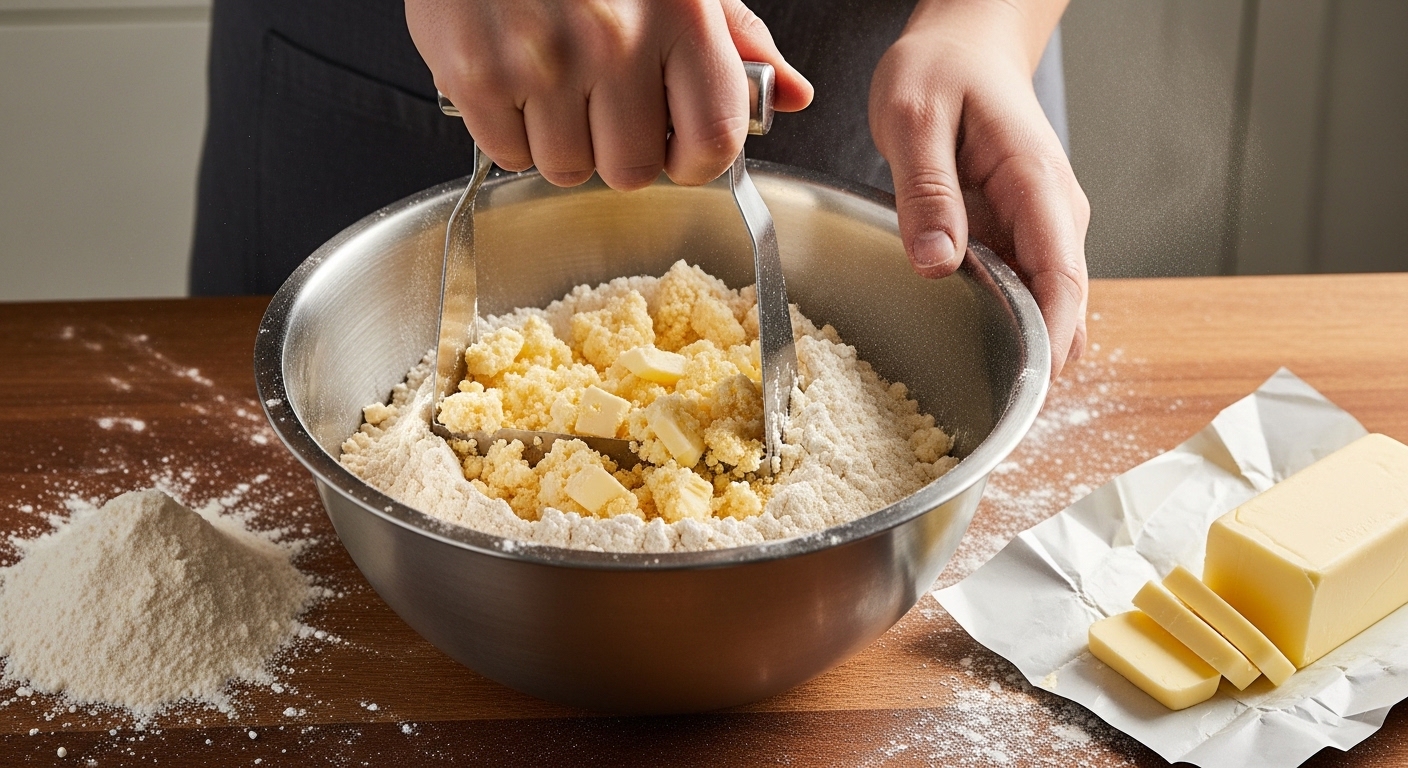
A pastry blender is this handheld tool with a handle on top and several curved metal blades underneath. You press it into ingredients—usually butter and flour—and kind of mash, cut, and mix them together at the same time. It’s not slicing like a knife, not mixing like a spoon, it’s somewhere in between, doing a job that’s oddly specific but super important.
And here’s the thing, it’s mostly used when you need to combine cold butter into dry ingredients without fully melting or blending it smooth. Because in baking, especially for things like pie crusts or biscuits, you don’t want the butter to disappear completely. You want little chunks. Tiny pockets. Bits that stay intact.
That’s what creates that flaky, crumbly texture people go on and on about.
What Does a Pastry Blender Look Like?
It’s honestly simpler than you’d expect, like something you could almost DIY if you were desperate enough. But the design is kinda clever in its own quiet way.
- A sturdy handle (plastic, wood, or metal)
- Several U-shaped metal blades or wires
- Compact size so it fits in one hand
- Slightly curved bottom to press into mixtures
When you press it down into flour and butter, those blades cut through the butter and coat it with flour at the same time. It’s repetitive, kinda rhythmic, almost like kneading but without the mess on your hands… though let’s be real, baking always gets messy anyway.
Why Not Just Use Your Hands?
You can use your hands, and a lot of bakers actually do. But there’s a small catch that sneaks in quietly—heat.
Your hands are warm. Butter is supposed to stay cold. So when you mix butter into flour with your fingers, you’re slowly warming it up, and that changes the texture in a way that’s not always ideal. It melts faster, blends too smoothly, and suddenly your dough behaves different than expected.
A pastry blender avoids that. It keeps things cool, controlled, and just rough enough.
Still, some people swear by the hand method. Others say once you try a pastry blender, you don’t really go back. It’s one of those small kitchen debates that never fully settles.
What Is a Pastry Blender Used For?
Now this is where it starts making more sense, because the pastry blender isn’t some all-purpose tool. It has very specific jobs, and it does them pretty well.
Common Uses
- Mixing butter into flour for pie crusts
- Making biscuit dough
- Preparing scones
- Crumbling toppings (like for cobblers or crisps)
- Cutting shortening into dry ingredients
Basically, anytime a recipe says “cut in the butter,” this tool is exactly what they mean.
And yeah, that phrase “cut in” sounds confusing at first, like you’re supposed to slice something precisely, but it really just means blending fat into flour while keeping some texture.
How to Use a Pastry Blender (Without Overthinking It)
It’s actually pretty straightforward, though it might feel awkward the first time you try.
Step-by-Step
- Add your flour and cold butter into a bowl
- Hold the pastry blender firmly
- Press down into the mixture
- Lift slightly, then press again
- Repeat until the mixture looks crumbly
You’re aiming for a texture that looks like coarse crumbs, sometimes described as “pea-sized bits” of butter. That phrase shows up everywhere, and yeah, it’s oddly specific but kinda helpful.
If you go too far and everything becomes smooth, you’ve overdone it. Not the end of the world, but not ideal either.
Pastry Blender vs Fork (Is There Even a Difference?)
A lot of people just use a fork instead, especially if they don’t bake often. And honestly, it works… sort of.
Here’s a quick comparison:
| Feature | Pastry Blender | Fork |
|---|---|---|
| Efficiency | Faster, more even | Slower, uneven |
| Effort | Less tiring | More effort needed |
| Texture Control | Better precision | Harder to control |
| Durability | Stronger build | Can bend or break |
A fork kinda smashes and mixes, but it doesn’t cut through butter as cleanly. You end up working harder for slightly worse results, which is fine if you’re just experimenting, but not great if you care about texture.
Types of Pastry Blenders You’ll See
Not all pastry blenders are exactly the same, which might surprise you a little.
1. Blade Style
These have flat metal strips instead of wires. They’re stronger and cut through butter more aggressively. Good for firm fats, though sometimes a bit harder to clean.
2. Wire Style
These use curved wires instead of solid blades. Slightly gentler, easier to clean, and more common overall.
3. Ergonomic Designs
Some modern ones come with soft grips or angled handles. They’re designed to reduce wrist strain, which you might not think about until you’ve been pressing down repeatedly for a few minutes and your hand starts complaining.
When You Actually Need a Pastry Blender
Here’s the honest answer—you don’t always need it.
If you bake occasionally, a fork or even your hands will do the job. But if you bake often, especially things like pies or biscuits, a pastry blender starts to feel less like a luxury and more like a quiet necessity.
It’s one of those tools that doesn’t seem important until you’ve used it a few times, then suddenly everything feels easier and more consistent.
Real-World Example (Why It Matters More Than You Think)
Let’s say you’re making a pie crust. You follow the recipe, measure everything carefully, but you skip the pastry blender and use your hands instead.
The butter melts slightly. The dough becomes smoother than it should. You bake it, and instead of a flaky crust, you get something denser, almost bread-like.
It still tastes okay, sure. But it’s not the same.
That difference, small as it seems, is exactly where the pastry blender quietly proves its worth.
Cleaning and Maintenance (Because Nobody Talks About This)
Cleaning a pastry blender can be a bit annoying, not gonna lie. Dough gets stuck between the blades, especially if you let it sit too long.
Here’s how to deal with it:
- Rinse immediately after use
- Use a small brush or sponge to get between blades
- Avoid letting dough dry on it
- Most are dishwasher safe, but check first
It’s one of those tools that rewards quick cleaning. Ignore it for too long, and it becomes a tiny nightmare.
Common Mistakes People Make
Even though it’s a simple tool, people still mess it up in ways that quietly ruin recipes.
Overmixing
You keep pressing and blending until everything looks smooth. That’s not the goal. You want texture, not uniformity.
Using Warm Butter
If the butter isn’t cold, the whole process kinda falls apart. It blends too easily and you lose those little pockets.
Pressing Too Hard
You don’t need to crush the life out of it. Gentle, repeated pressing works better than brute force.
A Quick Quote From Baking Experts
“The key to flaky pastry lies in keeping the fat distinct within the dough.”
That idea shows up in baking books and culinary schools everywhere, and it’s exactly what the pastry blender helps you achieve, even if you didn’t realize it before.
Can You Replace a Pastry Blender?
If you don’t have one, here are some alternatives:
- Two knives (used in a crisscross motion)
- A fork
- Your hands (quick and careful)
- Food processor (fast but easy to overdo)
Each method works, but none quite replicate the balance of control and ease that a pastry blender gives. It’s like using the right tool vs making do with whatever’s nearby.
Is It Worth Buying One?
If you bake once every few months, probably not urgent. But if you find yourself making dough, crusts, or biscuits even semi-regularly, then yeah, it’s worth it.
It’s not expensive. It doesn’t take up much space. And it quietly improves results in a way that’s hard to notice until you compare side by side.
Kind of like switching from a dull knife to a sharp one… you didn’t realize how much harder things were before.
Final Thoughts (The Part You Didn’t Expect to Care About)
A pastry blender feels like one of those tools you ignore until a recipe forces you to think about it, and then suddenly it becomes this oddly specific solution to a problem you didn’t fully understand before.
It’s not flashy. It’s not complicated. But it sits right at that intersection of technique and texture, quietly shaping how your baked goods turn out.
And once you’ve used it properly, you’ll probably stop questioning why recipes keep mentioning it… you’ll just reach for it without thinking, which is kinda the whole point of a good kitchen tool, isn’t it.

Jamesmathew is an expert Amazon affiliate writer, helping readers discover top products, smart deals, and practical buying guides through honest reviews and insightful content.