

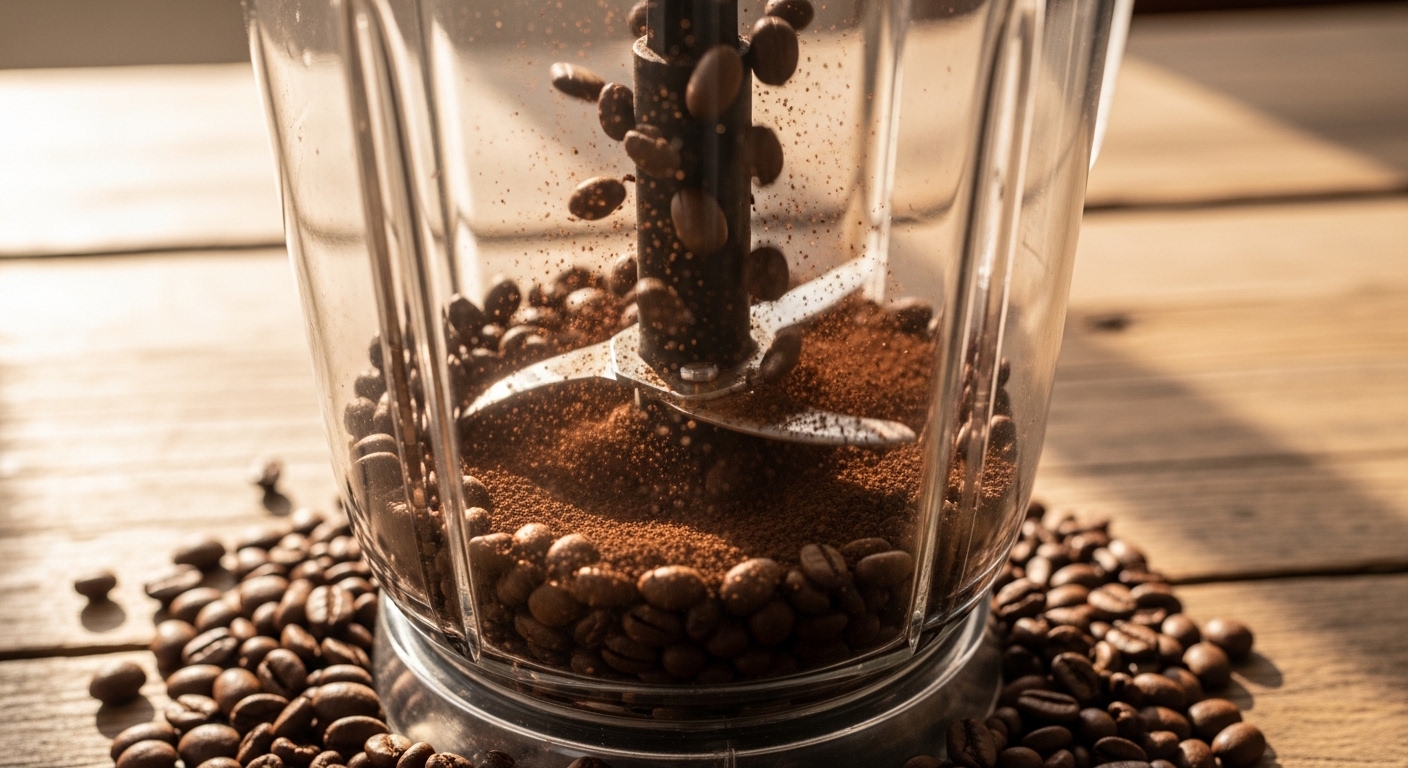
You’re standing there, staring at a bag of whole coffee beans and thinking, can you grind coffee beans in a blender or is this about to be a dumb mistake I’ll regret in 30 seconds, and yeah… that hesitation? it’s valid, honestly.
Because technically, yes—you can grind coffee beans in a blender. But the way it happens, the way it feels, the way the coffee ends up tasting… it’s not always what you think it’ll be, not even close sometimes.
Let’s unpack it properly, without pretending it’s all neat and perfect.
Can You Grind Coffee Beans in a Blender? (Short Answer, Slightly Messy Truth)
Yes, you can grind coffee beans in a blender. But it’s kinda like using a hammer to fix a watch—possible, but you gotta be careful or things go sideways fast.
Blenders use fast-spinning blades, not burrs like proper coffee grinders. That means instead of evenly grinding beans, they chop them randomly, like chaos but caffeinated.
What you get is:
- Uneven grind sizes (some powder, some chunks… annoying mix)
- Less control over texture
- Heat buildup if you blend too long (and heat messes with flavor, which is sad honestly)
Still, if you’re stuck without a grinder, a blender can do the job—just not perfectly, and not quietly either.
How a Blender Actually Grinds Coffee Beans (It’s Not Really “Grinding”)
Let’s be real for a second: your blender isn’t grinding, it’s kinda… violently slicing.
Inside the blender:
- Sharp blades spin at high speed
- Beans bounce around randomly
- Some hit the blades multiple times, others barely
That randomness is why your coffee ends up inconsistent. One sip might taste strong, the next weak, and you’re like wait what just happened.
Compare that to burr grinders, which crush beans evenly between two surfaces. That consistency is what gives you balanced flavor.
So yeah, the blender is more of a “good enough” hack than a proper solution.
Step-by-Step: How to Grind Coffee Beans in a Blender (Without Ruining Them)
If you’re gonna do it, at least do it right-ish.
1. Use Small Batches
Don’t dump the whole bag in there like you’re making a smoothie. That’s chaos.
- Add 1/4 to 1/2 cup of beans at a time
- Smaller batches = more control
2. Use the Pulse Setting
This part matters more than people think.
- Pulse in short bursts (2–3 seconds)
- Shake the blender slightly between pulses
- Repeat until you get your desired texture
Holding the button down continuously? yeah, that’s how you burn flavor and get dust + chunks combo.
3. Tilt the Blender Slightly
This feels weird but works.
Tilting helps beans move toward the blades more evenly instead of just spinning in circles doing nothing useful.
4. Check the Grind Frequently
Open the lid, look inside, feel it if you need to.
You’re aiming for:
- Coarse grind → like sea salt (for French press)
- Medium grind → like sand (for drip coffee)
- Fine grind → kinda like powder (hard to achieve in blender, btw)
5. Let It Rest Between Pulses
Blenders heat up fast, and heat kills those delicate coffee aromas.
So pause a bit. Let it breathe. Sounds dramatic, but it matters.
Pros and Cons of Grinding Coffee Beans in a Blender
Let’s not sugarcoat it. There’s good and bad here.
Pros
- You already have one at home
- Saves money (no need for a grinder immediately)
- Works in emergencies (which is probably why you’re here, tbh)
Cons
- Uneven grind consistency
- Can overheat beans
- Hard to get fine grind
- Noisy… like aggressively noisy
- Flavor isn’t as clean or balanced
Honestly, it’s a trade-off. Convenience vs quality. You decide what matters more in that moment.
Blender vs Coffee Grinder: What’s the Real Difference?
Here’s a quick comparison, because this is where things get clearer.
| Feature | Blender | Coffee Grinder |
|---|---|---|
| Grind consistency | Uneven, random | Even and controlled |
| Flavor quality | Slightly compromised | Rich and balanced |
| Heat generation | Higher | Lower |
| Ease of use | Medium (needs technique) | Easy |
| Cost | Already owned (usually) | Extra purchase |
If you care about your coffee tasting like… actual coffee and not confusion in a cup, a grinder is worth it eventually.
What Type of Coffee Can You Make with Blender-Ground Beans?
Not all brewing methods are blender-friendly, which sounds obvious but people still try espresso and get disappointed.
Works Okay:
- French press
- Cold brew
- Drip coffee (with some inconsistency)
Doesn’t Work Well:
- Espresso (needs very fine, even grind)
- Turkish coffee (super fine grind required)
So if you’re planning espresso with blender-ground beans… yeah, don’t. It’s just not gonna hit right.
Tips to Improve Blender Coffee Grinding Results
You can’t make it perfect, but you can make it better.
Use a Dry Blender Jar
Moisture + coffee beans = clumping and weird grinding behavior. Keep it dry.
Clean the Blender First
If your blender smells like garlic or yesterday’s smoothie… your coffee will too. Not ideal.
Grind in Short Sessions
Don’t rush it. Coffee kinda punishes impatience in small ways.
Sift the Grounds (Optional but Smart)
If you wanna get fancy:
- Use a fine sieve
- Separate larger chunks
- Re-grind them if needed
It’s extra effort, yeah, but improves consistency a bit.
Common Mistakes People Make (You Might Be Doing One Right Now)
Let’s call them out gently.
- Overfilling the blender
- Blending continuously instead of pulsing
- Expecting espresso-level grind
- Ignoring heat buildup
- Not checking grind size mid-process
These mistakes don’t ruin everything, but they do make your coffee… meh.
Does Grinding Coffee in a Blender Affect Taste?
Short answer: yes, a little. Sometimes more than a little.
Because of uneven grind size:
- Some particles over-extract (bitter taste)
- Others under-extract (sour taste)
So your cup ends up slightly confused, like it can’t decide what it wants to be.
Also, heat from the blender can dull the natural oils and aromas in the beans. That’s where coffee gets its personality, so losing that is kinda a big deal.
Still drinkable? sure. Amazing? not really.
Real-World Scenario: When a Blender Actually Makes Sense
Imagine this:
You just bought premium whole beans, feeling fancy. Then you realize… no grinder. None. Not even a cheap one.
That’s when the blender becomes your backup hero. Not perfect, not elegant, but it gets caffeine into your system, which is, let’s be honest, the main goal sometimes.
Or maybe you’re traveling, staying somewhere random, and all you’ve got is a blender. Same story.
It’s about adapting, not achieving perfection.
Should You Buy a Coffee Grinder Instead?
If you drink coffee regularly, yeah—you probably should.
Even a basic burr grinder will:
- Improve flavor noticeably
- Give consistent grind size
- Make your mornings less chaotic
But if you only drink coffee occasionally, or you’re just experimenting, a blender is fine for now.
It’s not wrong. Just… limited.
Final Thoughts: So, Can You Grind Coffee Beans in a Blender?
You can, and sometimes you should, especially when options are limited and you just need your coffee fix without overthinking life too much.
But it’s not a long-term solution if you care about taste, consistency, or that quiet satisfaction of making a really good cup.
A blender gets you through the moment. A grinder builds the habit.
And honestly, there’s something kinda scrappy and real about using what you’ve got—even if the results are a bit uneven, a bit noisy, a bit imperfect… just like most things, if we’re being real about it.

Jamesmathew is an expert Amazon affiliate writer, helping readers discover top products, smart deals, and practical buying guides through honest reviews and insightful content.