

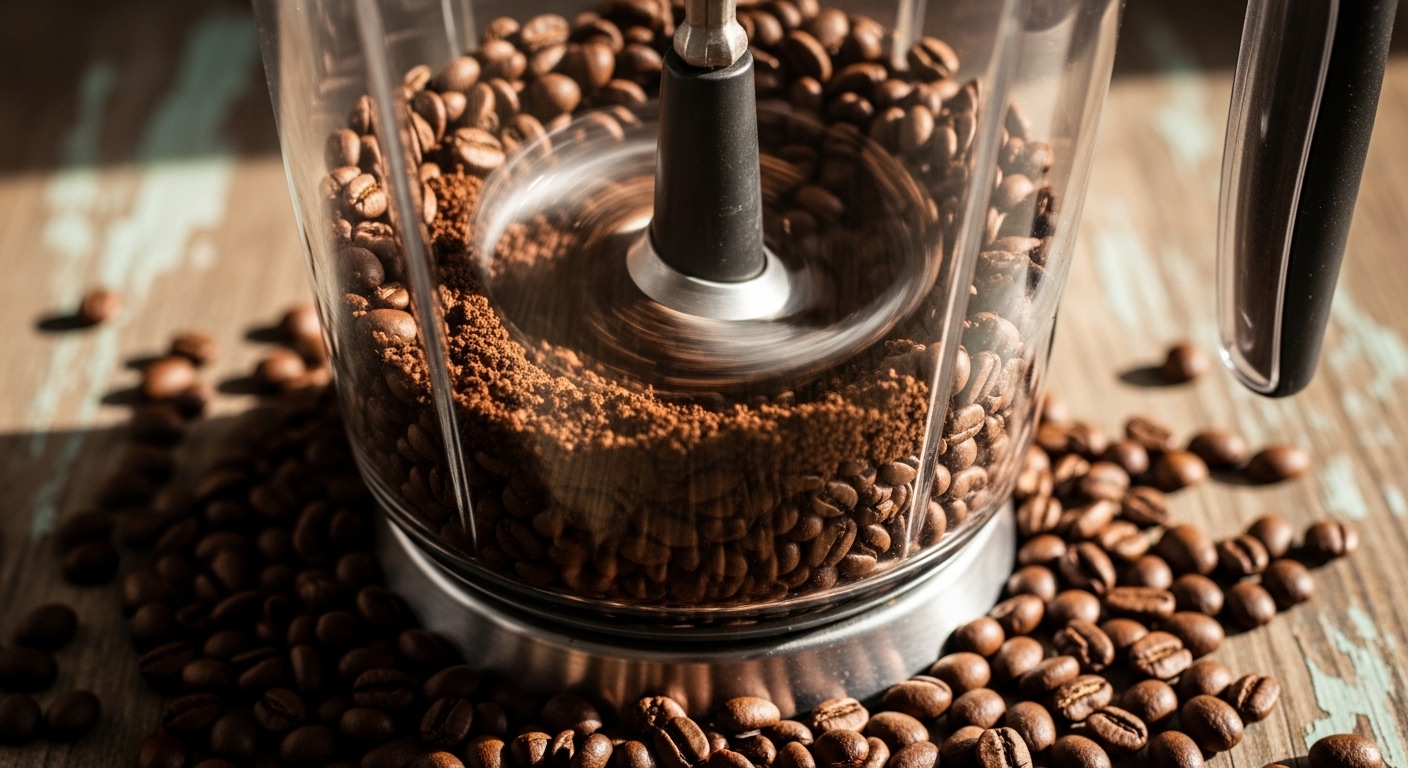
Can I grind coffee beans in a blender without ruining everything, that’s probably what you’re thinking while staring at a half-empty bag of beans and realizing your grinder is either missing, broken, or just nowhere to be found. And yeah, you’re not alone in this situation, it happens more often than people admit. You’ve got coffee beans, you’ve got a blender, and now you’re wondering if this slightly chaotic idea will actually work or just turn your morning into a bitter disappointment.
The short answer is yes, you can grind coffee beans in a blender, but the real answer is a bit messier, and honestly, a little more interesting than that. Because it depends on how you do it, what blender you’re using, and how picky you are about your coffee. Some people get surprisingly decent results, others end up with uneven chunks and fine dust that tastes like regret and burnt toast.
Can I Grind Coffee Beans in a Blender Without Ruining the Flavor?
Yes, you technically can grind coffee beans in a blender, but you’ve got to understand what’s happening inside that machine. A blender doesn’t crush beans in the same controlled way a proper burr grinder does. Instead, it kind of smashes and spins them around with blades that were honestly designed more for smoothies than coffee precision.
So what you get is uneven grind sizes. Some particles turn into fine powder, others stay chunky. And that inconsistency is where flavor issues creep in. Coffee extraction depends heavily on uniform grind size, so when everything is mixed, you might taste bitterness in one sip and sourness in the next. It’s not ideal, but it’s workable if you’re careful.
A study from the Specialty Coffee Association has repeatedly emphasized that grind uniformity directly affects extraction quality, and even small inconsistencies can shift taste noticeably. That’s why baristas obsess over grinders like it’s a sacred ritual or something.
But hey, you’re not in a café. You’re just trying to get caffeine into your system, so let’s not be dramatic about it.
How to Grind Coffee Beans in a Blender the Right Way
If you’re going to do this, there’s a slightly less chaotic way to go about it. Not perfect, but better than just dumping everything in and hoping for the best.
Here’s a simple approach:
- Use small batches, don’t overload the blender
- Pulse instead of blending continuously
- Shake the blender slightly between pulses
- Stop frequently and check consistency
- Aim for short bursts of 1–2 seconds
The pulsing part is important. If you just let it run, the heat from the blades can actually start affecting the beans, which messes with flavor. Coffee oils are sensitive, and heat exposure can make things taste flat or slightly burnt, even before brewing.
Also, don’t expect espresso-level precision. You’re aiming for something closer to medium grind consistency, maybe a bit rough around the edges.
And yeah, you’ll probably still get a mix of fine powder and uneven chunks. That’s normal, not a failure.
What Happens When You Grind Coffee Beans in a Blender
When you grind coffee beans in a blender, three things usually happen at once, and they kind of compete with each other.
First, the blades smash some beans instantly into fine dust. Second, other beans bounce around and barely get broken. Third, everything heats up slightly if you go too long.
That combination creates a messy grind profile that affects brewing.
Here’s how it typically plays out depending on your brewing method:
| Brewing Method | Result with Blender Grind | Taste Quality |
|---|---|---|
| French Press | Acceptable | Medium |
| Drip Coffee | Fair | Mild inconsistency |
| Espresso | Poor | Bitter or sour imbalance |
| Cold Brew | Surprisingly good | Smooth overall |
Cold brew is the forgiving hero here. Because it steeps for so long, uneven grind size doesn’t ruin it as much. French press also handles it decently, though you might get a little sediment at the bottom.
Espresso though? That’s where things fall apart. Espresso needs very precise, fine grind consistency, and a blender just doesn’t care about that level of detail.
Common Mistakes When Grinding Coffee Beans in a Blender
People often assume it’s just a simple swap: grinder equals blender. But there are a few easy mistakes that mess things up quickly.
One mistake is overfilling. A blender works best when beans have space to move. If it’s too full, the blades just spin and barely grind anything.
Another issue is blending too long. It feels logical to keep going until everything looks fine, but that usually overheats the beans and makes the coffee taste dull.
Also, some people forget to clean the blender properly afterward. Coffee oils stick around, and if you blend a smoothie later, you might get a weird coffee-fruit hybrid flavor that nobody asked for.
And then there’s the biggest mistake of all: expecting perfection. A blender is a backup tool, not a dedicated grinder. Treating it like one sets you up for disappointment.
Pros and Cons of Using a Blender for Coffee Beans
Let’s break it down in a simple way so you can actually decide if it’s worth it.
Pros
- You already own it, no extra cost
- Works in emergencies or travel situations
- Can produce usable coffee for basic brewing methods
- Quick if you don’t overthink it
Cons
- Uneven grind size affects flavor
- Can heat beans if overused
- Hard to control consistency
- Not suitable for espresso or high-end brewing
- Cleanup can be slightly annoying
It’s basically a “good enough for now” solution, not a long-term coffee strategy.
Better Alternatives If You Don’t Have a Grinder
If you’re reading this and thinking “okay, blender sounds risky,” there are a few other methods people use when they’re in a pinch.
Some of them are surprisingly old-school:
- Mortar and pestle (slow but very controlled)
- Rolling pin inside a zip bag (oddly effective)
- Hammer method (works, but chaotic)
- Food processor (slightly better than a blender sometimes)
None of these are perfect, but they all show one thing: humans have been improvising coffee grinding for a long time. The blender just happens to be the modern version of that improvisation.
What Coffee Experts Say About Blade Grinding
Most coffee professionals prefer burr grinders for one simple reason: consistency.
Blade grinding, which is what a blender does, creates randomness in particle size. And randomness equals uneven extraction.
According to brewing guidelines often cited in coffee training programs, “uniform grind size is one of the most critical factors in achieving balanced extraction.”
That doesn’t mean blade grinders or blenders are useless. It just means they’re not optimized tools. Think of them like using a kitchen knife instead of a surgical scalpel. Both cut, but one is clearly more precise.
Still, many home users rely on blenders daily, and they manage just fine. Taste preference also matters more than perfection sometimes.
So, Should You Grind Coffee Beans in a Blender?
If your grinder is missing or broken, yes, go ahead and grind coffee beans in a blender. It will work, and you will get coffee, which is the main goal when your brain is half asleep in the morning anyway.
But if you’re chasing consistency, smooth flavor, and that café-level experience, then a blender is only a temporary solution. It gets the job done, just not elegantly.
The truth is, coffee is flexible. Humans have been making it in all kinds of ways for centuries, from rough stone grinding to modern machines that cost more than a small kitchen. Your blender just sits somewhere in the middle of that messy evolution.
And honestly, once you learn how to pulse it right and avoid overheating, you can get a decent cup out of it. Not perfect, but definitely drinkable, and sometimes that’s all you really needed in the first place.

Jamesmathew is an expert Amazon affiliate writer, helping readers discover top products, smart deals, and practical buying guides through honest reviews and insightful content.