

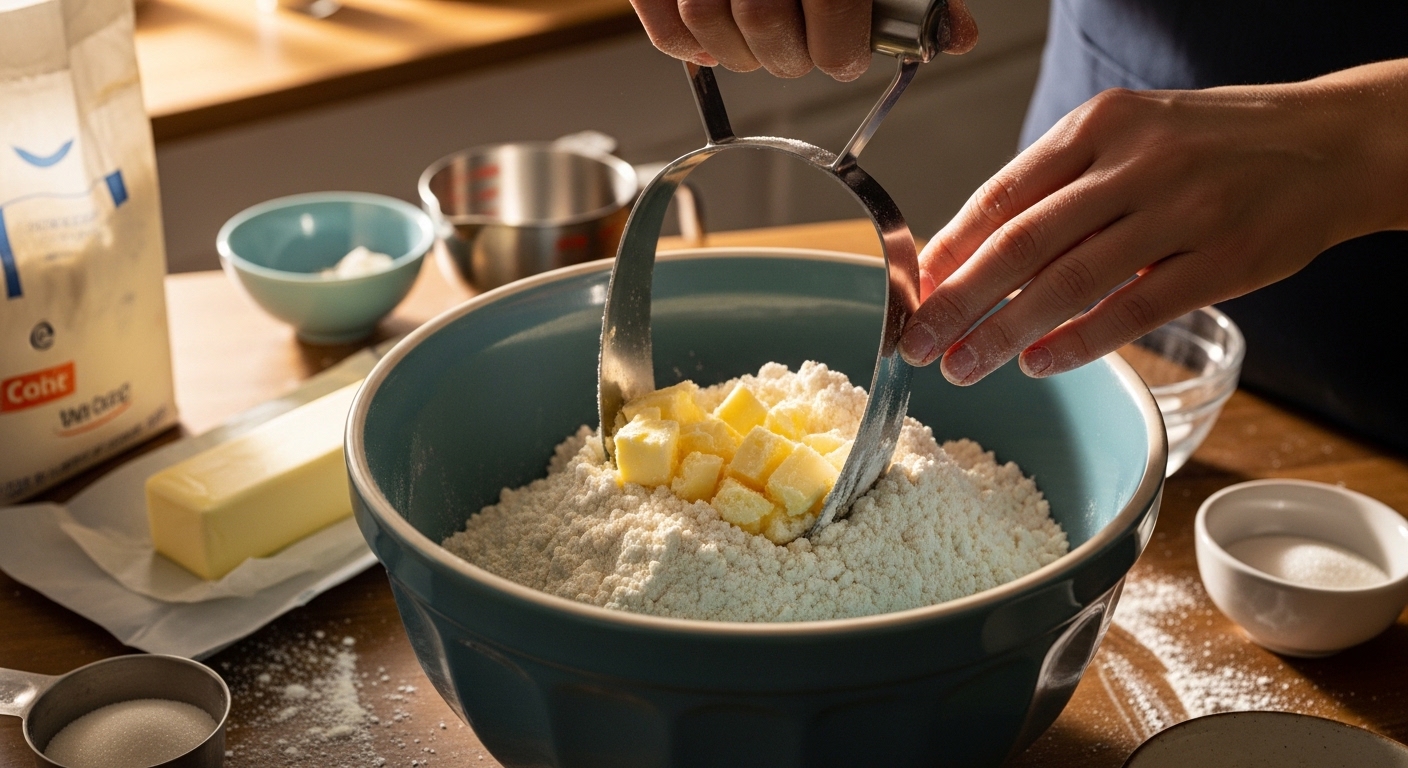
You’re staring at a recipe and it casually says “cut in the butter with a pastry blender,” and you kinda pause there like… wait, what does a pastry blender do exactly, and why is everyone acting like you already own one. It’s that moment where the instructions feel oddly confident and you’re just holding a fork wondering if you’re about to ruin everything.
So yeah, let’s actually talk about it in a way that makes sense, not in that stiff cookbook tone that assumes you’ve been baking since 1890 or something.
What a Pastry Blender Actually Does (In Real Kitchen Terms)
A pastry blender is basically a small handheld tool that helps you mix solid fat (usually butter) into flour without fully melting or mushing it into oblivion. But that’s the boring explanation, and honestly it doesn’t tell you why it matters.
What it really does is create those tiny little bits of butter coated in flour that later turn into flaky layers when baked. It’s like you’re setting up a situation, not just mixing ingredients. You’re kind of… engineering texture, which sounds dramatic but it’s true.
When you press the pastry blender into the mixture, its curved metal blades cut through butter chunks and break them into smaller pieces. Not too small, not too smooth. You want unevenness. Weirdly, uneven is the goal here, which feels wrong at first.
If you overmix, everything becomes paste-like, and then your biscuits or pie crust ends up dense instead of tender. Nobody wants that. It’s the culinary version of trying too hard.
What Does a Pastry Blender Look Like?
If you’ve never seen one, it kinda looks like a handle with a bunch of thick wire loops or metal strips shaped into a half dome underneath. Not fancy. Not intimidating. Slightly awkward-looking, even.
There are usually two common designs:
- Wire loop style – thinner wires, more flexible, sometimes feels a bit flimsy but works fine
- Flat blade style – thicker metal strips, sturdier, cuts through cold butter more easily
You hold it from the top and press downward into the flour and butter mixture, rocking it slightly. It’s repetitive but weirdly satisfying, like popping bubble wrap but slower and less chaotic.
Why Recipes Keep Insisting on Using One
Recipes don’t just throw in “use a pastry blender” for decoration. There’s a real reason behind it, even if they don’t explain it.
Here’s what happens when you use it properly:
- Butter stays cold instead of melting into the flour
- You get pea-sized bits of fat distributed throughout
- Those bits create steam pockets while baking
- Steam = flakiness
It’s not magic, it just feels like magic when your crust comes out right for once.
A quote from baking science writer Harold McGee sums it up pretty neatly:
“Flaky pastry depends on keeping fat and flour partially separate until baking.”
And that’s literally what the pastry blender helps you do, even if you didn’t know that’s what you were aiming for.
What Does a Pastry Blender Do in Different Recipes?
This is where it gets a bit more interesting, because it doesn’t just do one job in one dish. It shows up in a bunch of places, each time doing slightly different emotional labor for your recipe.
In Pie Crusts
This is its main stage, honestly.
You’re cutting cold butter into flour until it resembles coarse crumbs with some larger chunks still visible. Those chunks are the future flaky layers. If you go too far, you lose them, and the crust gets kinda meh.
In Biscuits
Here, the pastry blender helps keep things light and airy. You don’t want a uniform dough. You want inconsistency, which feels like bad advice but is actually correct.
The butter pieces melt during baking and create little air pockets. That’s what gives biscuits that soft, layered inside instead of a bread-like texture.
In Crumble Toppings
For things like apple crumble or streusel, you use a pastry blender to mix butter into sugar and flour until it forms clumps.
Not smooth. Not dough. Just clumpy bits that bake into crispy topping. It’s messy and that’s kinda the point.
In Scones
Scones are tricky, and a pastry blender helps keep them from becoming dry hockey pucks. Again, it’s about not overworking the dough.
You’re aiming for a dough that barely holds together. Which sounds like you’re doing something wrong, but nope, that’s exactly right.
Can You Use Something Else Instead?
Short answer: yes. Slightly longer answer: yes, but it depends how patient or chaotic you’re feeling.
If you don’t have a pastry blender, people usually use:
- Forks – works okay, just slower and less efficient
- Your hands – surprisingly good, but butter melts faster from body heat
- Food processor – fast but easy to overdo it in seconds
- Knives (cross-cut method) – feels a bit dramatic but gets the job done
Each method has trade-offs. The pastry blender sits in that sweet spot of control and ease. It doesn’t rush you, but it doesn’t fight you either.
When You Should NOT Use a Pastry Blender
This part doesn’t get talked about enough, which is weird because it matters.
Don’t use a pastry blender when:
- The butter needs to be fully creamed (like in cakes or cookies)
- You’re working with melted butter recipes
- The mixture needs to be completely smooth
Basically, if the goal is uniform texture, this tool is not your friend. It thrives in controlled chaos, not perfection.
How to Use a Pastry Blender Properly (Without Overthinking It)
You don’t need a technique manual, but a few small things make a big difference.
- Start with cold butter. Like actually cold, not “room temp-ish”
- Cut butter into small cubes before adding it
- Press the blender down and rock slightly, don’t just mash randomly
- Stop when you see a mix of fine crumbs and small chunks
That last step is where people mess up. You keep going because it doesn’t look “done,” but it actually is. Baking has this annoying habit of rewarding restraint.
Common Mistakes People Make
Even though the tool is simple, it’s still easy to get things slightly off.
- Overmixing – turning everything into paste
- Warm butter – ruins the whole flaky structure
- Rushing – ironically leads to worse results
- Ignoring texture cues – recipes say “pea-sized” for a reason
A small stat that kinda puts things into perspective: according to baking tests done by America’s Test Kitchen, overworked pastry dough can reduce flakiness by up to 40 percent. That’s not a small difference. That’s the difference between “wow this is good” and “it’s fine I guess.”
Is a Pastry Blender Worth Buying?
If you bake occasionally, you might get by without it. But if you find yourself making pie crusts, biscuits, or anything crumbly more than a few times a year, it’s honestly worth it.
It’s not expensive. It doesn’t take up much space. And it removes a lot of guesswork from a step that’s weirdly easy to mess up.
Think of it less like a fancy gadget and more like a shortcut to consistency. Not perfection, just… less frustration.
Cleaning and Maintenance (Because No One Mentions This)
Pastry blenders can get dough stuck between the wires or blades, which is mildly annoying but manageable.
Quick tips:
- Rinse immediately after use before dough dries
- Use a small brush or sponge to get between wires
- Avoid letting butter residue sit too long
It’s not high-maintenance, just slightly more effort than tossing a spoon in the sink.
Final Thoughts (The Part You Actually Care About)
So, what does a pastry blender do? It helps you not ruin textures you didn’t even realize were fragile in the first place. It keeps butter where it needs to be, in tiny stubborn pieces that later turn into something flaky and soft and honestly kind of impressive.
You don’t need one, but once you use it and see the difference, it’s hard to go back to guessing your way through with a fork.
And next time a recipe casually says “use a pastry blender,” you won’t pause in confusion. You’ll just be like, yeah okay, I know what you’re trying to make happen here.

Jamesmathew is an expert Amazon affiliate writer, helping readers discover top products, smart deals, and practical buying guides through honest reviews and insightful content.