

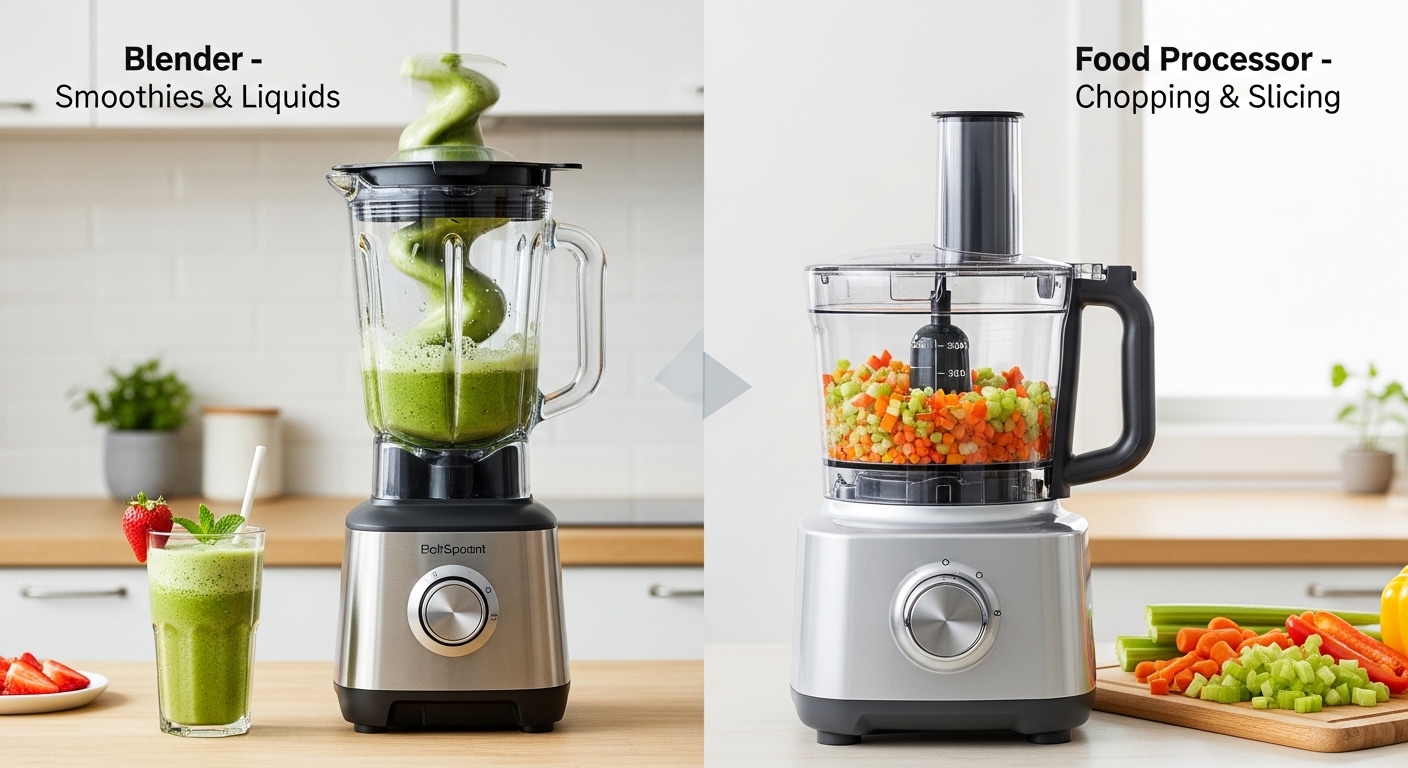
You’re standing there, maybe in your kitchen or maybe just mentally pacing around the idea, wondering what’s the difference between a blender and a food processor and why it somehow feels like you should already know this but don’t, and honestly it’s a bit annoying because both of them just spin blades and make noise, right?
Well… yeah, but also very not yeah.
Let’s untangle this in a way that actually makes sense when you’re halfway through making something and suddenly realize you picked the wrong machine and now your onions look like sad juice.
Blender vs Food Processor: The Core Difference (without sounding like a manual)
A blender is basically obsessed with liquids. It wants them. Needs them. Thrives in them. If you don’t give it enough liquid, it kinda throws a tantrum and just spins air like it forgot what it was doing.
A food processor, on the other hand, is more like that friend who can handle chaos. Dry stuff, chunky stuff, uneven stuff—it just goes for it. No emotional dependency on liquids whatsoever.
So if you had to reduce it (which feels unfair but okay):
- Blender = smooth, liquid-based things
- Food processor = solid, chunky, structured prep
But don’t run away yet, because that’s just the surface and honestly, it gets more interesting the deeper you go.
How a Blender Actually Works (and why it behaves the way it does)
Blenders have this tall, kinda narrow jar situation going on. That shape isn’t random—it creates a vortex, which sounds fancy but just means everything gets pulled down into the blades like a tiny whirlpool.
That’s why smoothies work so well. The liquid pulls the fruit down, the blades chop it, and everything cycles around again. It’s like a loop that never gets bored.
Typical blender behavior:
- Needs liquid to function properly
- Creates very smooth textures
- Best for pouring, not scooping
- Usually has fixed blades at the bottom
If you try to make something dry, like chopping nuts without liquid, you’ll notice it just… doesn’t cooperate. Things sit on top, judging you.
How a Food Processor Does Its Thing (it’s a bit more chaotic, in a good way)
Food processors are wider, shorter, and honestly a bit more aggressive in personality. Instead of creating a vortex, they rely on brute force and blade variety.
And yeah, blade variety matters more than you think.
You can swap attachments and suddenly:
- It slices
- It grates
- It shreds
- It kneads dough (yes, dough, like actual bread dough, not kidding)
That’s something a blender would absolutely refuse to do. Like, flat out.
Food processors don’t need liquid because they’re not trying to blend—they’re trying to process (the name wasn’t very creative but it is accurate).
Texture Is Where Everything Falls Apart (or comes together, depends how you see it)
This is probably the biggest difference, and it’s the one people notice too late.
A blender doesn’t do “coarse.” It just doesn’t. Even when it tries, it ends up somewhere between uneven and overdone.
A food processor, though, can stop whenever you want. You pulse it. You control it. You decide if you want chunky salsa or something closer to paste.
Let’s break it down in a way that sticks:
| Task | Blender Result | Food Processor Result |
|---|---|---|
| Smoothie | Perfectly smooth | Weirdly chunky |
| Salsa | Too watery | Just right, if you’re careful |
| Nut butter | Possible, but slow | Faster, more control |
| Dough | Nope | Yes, and surprisingly well |
| Soups | Silky smooth | Kinda rough texture |
So yeah, texture is not just a small detail—it’s basically the whole point.
When You Should Use a Blender (and not overthink it too much)
There are moments where the choice is so obvious it almost feels silly to question it, but still, people do (no judgment).
Use a blender when you’re making:
- Smoothies
- Milkshakes
- Soups (especially creamy ones)
- Sauces that need to be silky
- Protein shakes or anything drinkable
If it’s something you’d pour into a glass, the blender is your guy.
And honestly, trying to use a food processor here just feels like forcing a square peg into a round hole, except the peg is spinach and now it’s stuck everywhere.
When a Food Processor Makes Way More Sense
Now this is where things get slightly more… practical, I guess.
Food processors are better when you’re doing prep work or anything that isn’t supposed to become liquid.
Use it for:
- Chopping vegetables
- Making dough
- Grinding meat
- Shredding cheese
- Making dips like hummus (though blenders can try, they struggle a bit)
There’s also something oddly satisfying about watching it chop onions in seconds without making you cry (well, mostly).
The Overlap Zone (because yes, they do overlap, annoyingly)
Here’s where people get confused, and fair enough.
Some things can be done in both, but the results won’t be identical. Not even close sometimes.
Take hummus:
- Blender: smoother, but harder to get going
- Food processor: easier, slightly grainier unless you really work it
Or smoothies:
- Blender: perfect
- Food processor: technically possible, but feels wrong, like eating cereal with a fork
So yeah, overlap exists, but it’s not equal. It’s more like a compromise.
Real-World Scenario (the kind that actually matters)
Let’s say you’re making dinner and you need to:
- Chop onions
- Slice carrots
- Make a sauce
- Blend a soup
If you only have a blender, step 1 and 2 become… frustrating. You’ll either over-blend or under-process.
If you only have a food processor, step 3 and 4 might not come out as smooth as you want.
So ideally? You’d have both. But that’s not always realistic, and honestly, most people don’t want two bulky machines sitting around.
If You Can Only Choose One (this is the part people care about)
This depends on how you cook, not what sounds cooler.
Pick a blender if:
- You drink smoothies often
- You like creamy soups
- You don’t do much chopping or baking
Pick a food processor if:
- You cook full meals regularly
- You prep a lot of ingredients
- You bake or make dough
If you’re still stuck, think about what annoys you more:
- Lumpy drinks → get a blender
- Slow prep work → get a food processor
That usually clears it up pretty quick.
A Small Thing People Don’t Mention Enough
Cleaning.
Yeah, not glamorous, but very real.
Blenders are usually easier to clean. Add water, a drop of soap, blend for a few seconds, done-ish.
Food processors? More parts. More corners. More “how did food even get in there” moments.
It’s not a dealbreaker, but it’s one of those things you only realize after using it for a while.
What About Combo Machines (are they worth it or kinda meh?)
There are machines that try to do both, and they’re… okay.
Not amazing, not terrible, just somewhere in the middle.
They usually:
- Blend decently
- Process decently
- Don’t fully replace either
If you’re tight on space or budget, they’re not a bad choice. But if you care about performance, separate machines still win.
A Slightly Honest Conclusion (because sugarcoating this would be weird)
So what’s the difference between a blender and a food processor?
It’s not just about blades or shapes or technical stuff—it’s about what kind of cooking you actually do when nobody’s watching.
Blenders are for transforming things into smooth, almost drinkable states. Food processors are for handling the messy, uneven, very real parts of cooking that happen before something becomes a final dish.
And yeah, you can survive with just one. People do it all the time. But once you really understand what each one does, you stop guessing and start choosing, which feels oddly satisfying in a way that’s hard to explain but you’ll notice it the next time you reach for the right machine without hesitating.
And that moment, small as it is, kinda proves you get it now.

Jamesmathew is an expert Amazon affiliate writer, helping readers discover top products, smart deals, and practical buying guides through honest reviews and insightful content.