

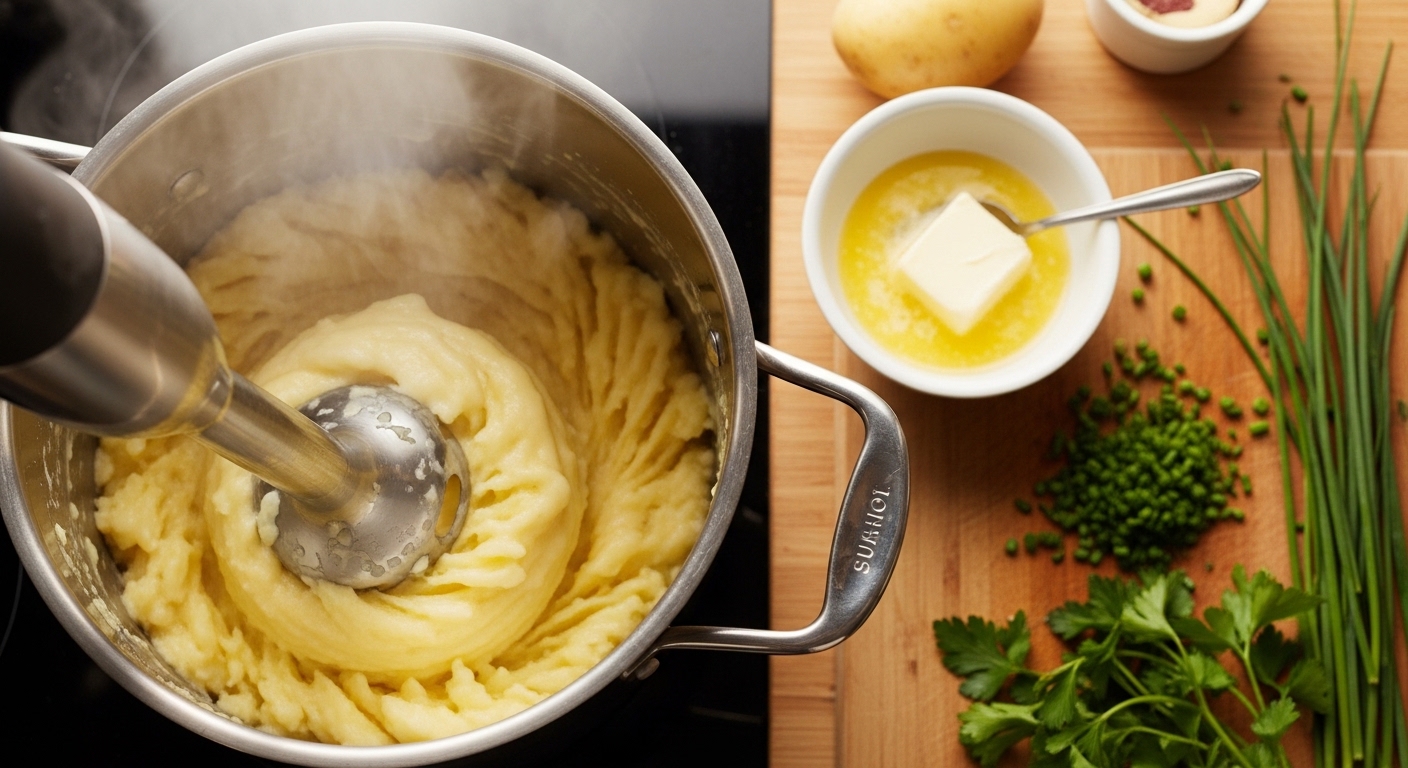
Can you use an immersion blender for mashed potatoes without ruining them is the kind of question that usually shows up right when you’re already halfway through boiling the potatoes and suddenly second guessing everything. You’re standing there with a pot of steam, a stick blender in hand, thinking “this should be easier than it feels right now,” and yeah, you’re not wrong for wondering it.
You can use an immersion blender for mashed potatoes, but whether you should is a slightly different story, and it gets messy in a very specific way that nobody really warns you about until it’s too late.
can you use an immersion blender for mashed potatoes: the quick honest answer
Can you use an immersion blender for mashed potatoes? Yes, technically you can. But the texture outcome depends heavily on how long you blend and what kind of potatoes you used in the first place.
If you overdo it even a little bit, the potatoes go from fluffy and comforting to this weird sticky paste that feels more like wallpaper glue than food. It’s not dangerous or anything, just… disappointing in a very personal way.
Cookbooks and test kitchens often warn about this. Serious Eats has repeatedly pointed out in its potato texture experiments that overmixing potatoes activates starch too aggressively, turning them gummy instead of fluffy. That’s basically the core issue here.
So the real answer is:
- Yes, you can use an immersion blender
- But it’s high risk for gluey texture
- And it demands very careful timing
can you use an immersion blender for mashed potatoes without ruining texture?
Here’s where things get a bit science-y but also kinda simple.
When you boil potatoes, the starch granules inside swell up with water. If you mash gently, you keep some structure. But when you hit them hard with a spinning blade like an immersion blender, those starch cells rupture aggressively and release too much starch into the mix.
That excess starch is what causes:
- gumminess
- stickiness
- that “stretchy mashed potato” effect nobody asked for
Potato types matter a lot more than people think
Not all potatoes behave the same, and this is where most people accidentally mess up.
| Potato type | Starch level | Blender result | Risk level |
|---|---|---|---|
| Russet | High | Very fluffy but easy to overmix | High |
| Yukon Gold | Medium | Creamy, slightly safer | Medium |
| Red potatoes | Low | Chunky, resistant to blending | Lower but uneven |
So if you’re already thinking can you use an immersion blender for mashed potatoes made from russets, the answer is basically “yes, but blink wrong and you’ve got paste.”
what actually happens when you use an immersion blender
When you bring an immersion blender into mashed potatoes, three things usually happen in stages:
- First 5–10 seconds: looks amazing
Everything smooths out quickly, lumps disappear, you feel like a genius. - Around 10–20 seconds: texture shifts
It starts getting thicker, almost elastic. - After that: danger zone
The potatoes become sticky, slightly shiny, and lose that fluffy structure completely.
A chef once described this in a New York Times Cooking discussion as “potato paste behaving like it’s been overworked in a gym.” Slightly dramatic, but honestly not wrong.
So again, can you use an immersion blender for mashed potatoes safely? Only if you stop extremely early. Like earlier than your instinct tells you to.
how to actually do it (if you still want to try)
If you’re committed to using an immersion blender, there is a safer way to approach it. Not perfect, but safer.
Step-by-step method
- Drain potatoes fully
Any extra water makes things worse later. - Let them steam dry for 2–3 minutes
This removes surface moisture so blending doesn’t turn soupy. - Add warm butter and milk first
Fat helps coat starch slightly, reducing overreaction. - Insert immersion blender at low speed
Don’t start on turbo mode unless you like chaos. - Blend in very short pulses (2–3 seconds max each)
Check texture constantly. - Stop while they still look slightly imperfect
This is the hardest part mentally. - Finish by folding gently with a spoon
Yes, a spoon after a blender. Kinda ironic, but it works.
can you use an immersion blender for mashed potatoes without milk or butter?
You can, but honestly it gets risky fast.
Without fat, potatoes tend to seize up quicker when blended. That creamy buffer layer is gone, so starch interacts directly with blades and heat.
A lot of home cooks report that dry-blended potatoes turn:
- dense
- chewy
- weirdly elastic
So if you’re asking can you use an immersion blender for mashed potatoes with no added dairy, the practical answer is: you can, but it’s basically the hardest difficulty mode.
common mistakes people make (and regret later)
This is where most mashed potato disasters quietly begin.
Mistake list:
- Blending for too long because it still “looks fine”
- Using hot potatoes straight from boiling water without resting
- Using high speed immediately
- Trying to “fix lumps” after blending has already started
- Adding cold milk (this shocks the starch structure weirdly)
A small but real detail: temperature matters more than people expect. Potatoes at slightly lower heat are less likely to overreact when blended.
immersion blender vs other tools for mashed potatoes
Here’s a clearer breakdown so you can see where the immersion blender actually stands.
| Tool | Texture result | Effort level | Risk of gluey potatoes |
|---|---|---|---|
| Immersion blender | Very smooth, can become gluey | Low | High |
| Potato masher | Rustic, slightly chunky | Medium | Low |
| Hand mixer | Fluffy but can overmix | Medium | Medium |
| Fork | Chunky, old-school texture | High effort | Very low |
Most chefs, including traditional French kitchen training references (like Larousse Gastronomique style guidance), lean toward manual mashing tools for a reason: control. Machines remove control fast.
So when you’re thinking again can you use an immersion blender for mashed potatoes, the real tradeoff is convenience vs texture safety.
small chef-style tips that actually help
These aren’t fancy tricks, just practical stuff people learn after messing it up once or twice.
- Warm your milk before adding it
- Salt the cooking water generously (like pasta water level saltiness)
- Use a mix of Yukon Gold and Russet if possible
- Don’t try to make “restaurant smooth” with a blender unless you’re very careful
- Stop earlier than you think you should
One chef quoted in a culinary workshop summary said something like:
“Mashed potatoes are finished when they still feel slightly underdone in your head.”
That sounds wrong emotionally, but it works physically.
can you use an immersion blender for mashed potatoes in large batches?
This is another hidden problem. Batch size changes everything.
In small batches, you can control blending time easily. But in large pots, the blender moves unevenly, so some parts get overworked while others stay chunky.
So if you’re scaling up:
- stir manually first
- blend in sections
- avoid deep full-pot blending
Otherwise you end up with uneven texture: half paste, half chunks, which is honestly worse than either extreme.
FAQ style quick answers
can you use an immersion blender for mashed potatoes and still get fluffy results?
Yes, but only if you use very short pulses and stop early. Otherwise fluff turns into paste quickly.
why do my mashed potatoes turn sticky with a blender?
Because high-speed blending releases too much starch, which binds and creates a glue-like texture.
is a potato masher safer than an immersion blender?
Yes, in most cases. It gives you more control and less starch breakdown.
final thoughts on can you use an immersion blender for mashed potatoes
So, circling back again to can you use an immersion blender for mashed potatoes, the honest takeaway is that it’s one of those tools that works best when you almost don’t use it.
It’s kind of like walking a thin line: a few seconds too far and you’ve crossed into that sticky zone that no amount of butter can fully rescue. But used carefully, it can actually give you smooth, creamy mashed potatoes with very little effort.
Just… watch it closely. Like, really closely. And maybe don’t trust the “it’s fine I’ll blend a bit more” voice in your head, because that voice has ruined many good potatoes before.

Jamesmathew is an expert Amazon affiliate writer, helping readers discover top products, smart deals, and practical buying guides through honest reviews and insightful content.