

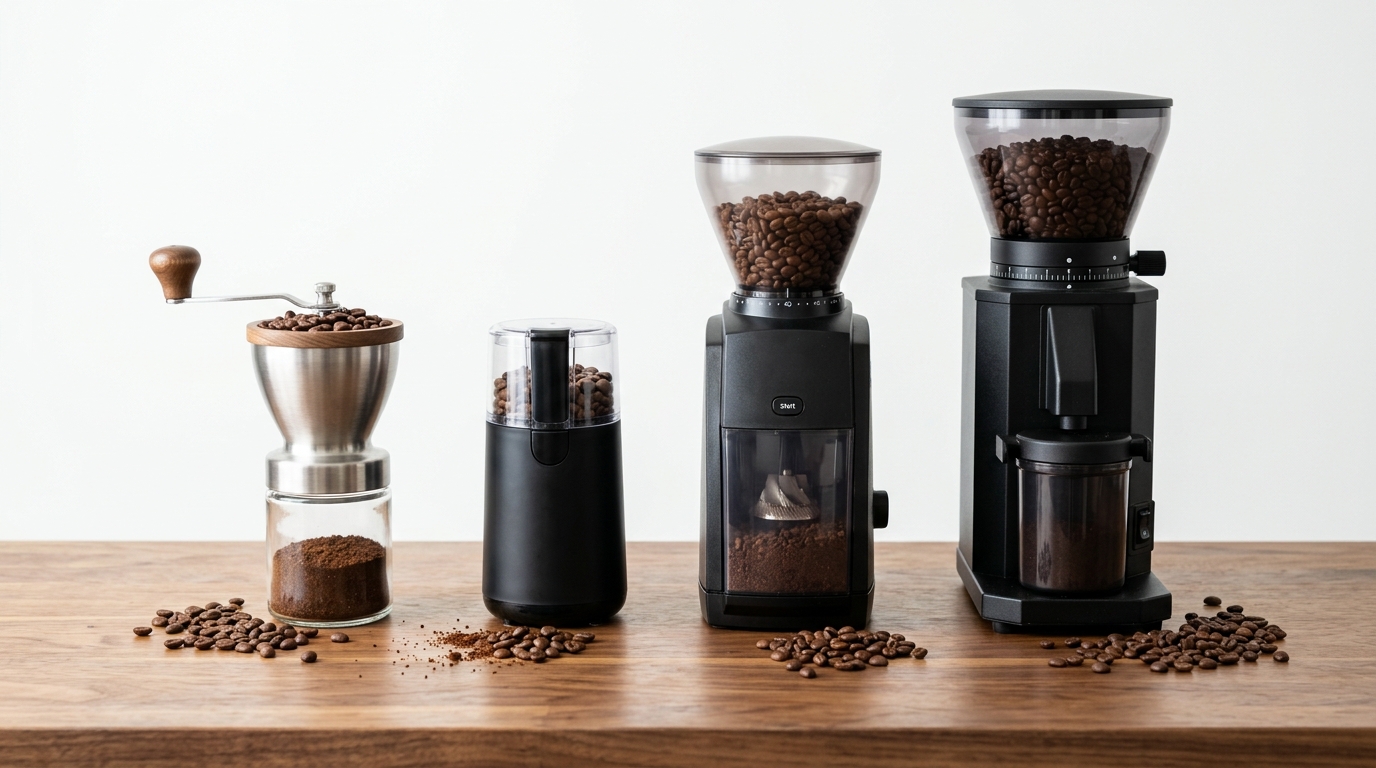
So you’re standing in some kitchen aisle, or maybe scrolling late at night, and you keep asking yourself what does a coffee grinder look like because the picture in your head honestly doesn’t match anything you’re seeing on the shelf. You had this image, probably from a movie or your grandma’s kitchen, of a little wooden box with a crank on top, and now you’re staring at something that looks more like a small robot with buttons. Yeah, that confusion is normal, more normal than you’d think actually.
Here’s the thing nobody tells you before you go shopping: there isn’t just one shape or style. A coffee grinder can look like a dozen different things depending on what kind it is, and once you understand the categories, the whole mystery kind of falls apart on its own.
The Two Big Families You’ll Run Into
Before we get into specific looks and shapes, you gotta understand there’s basically two major camps here, and everything else branches off from these.
Blade grinders look the most like what people expect a “grinder” to look like in a generic sense. Picture a small cylinder, usually plastic on the outside, with a lid you press down on. Underneath that lid sits a tiny propeller-looking blade, kind of like what’s inside a blender but way smaller. You dump beans in, press the lid, and it whirs and chops the beans into pieces. These things are usually short, maybe 6 to 8 inches tall, and they don’t take up much counter space at all.
Burr grinders, on the other hand, look completely different and honestly a bit more serious. These have two internal grinding surfaces, called burrs, that crush the beans between them rather than chopping them. From the outside a burr grinder often looks taller and more industrial, sometimes with a hopper on top that looks like a little clear plastic funnel where the beans sit before they get pulled down into the grinding chamber.
The Specialty Coffee Association has long emphasized that grind consistency is one of the biggest factors in extraction quality, right up there with water temperature and brew ratio, which is basically the whole reason burr grinders exist and look the way they do, the internal geometry is doing real work, not just chopping randomly.
Manual Grinders: The Ones People Picture Wrong
When people say “coffee grinder” and picture a hand crank, they’re thinking of manual burr grinders. These come in two very distinct visual styles and its worth knowing both.
The first is the classic box style, wooden, sometimes with a drawer at the bottom to catch the grounds, and a crank sticking out the top or side. This is your grandma’s kitchen image, and its still sold today, mostly as a decorative or nostalgic piece.
The second, and way more common now, is the handheld cylinder style. Imagine a metal or ceramic tube, about the size of a thick water bottle, with a hand crank on top and a small container at the bottom that unscrews to dump out your fresh grounds. Coffee nerds carry these while traveling because their small enough to fit in a backpack.
Electric Burr Grinders: What They Actually Look Like
This is probably the style most people end up buying, and it’s worth breaking down what you’re actually looking at when you see one.
| Part | What It Looks Like | What It Does |
|---|---|---|
| Hopper | Clear plastic or glass funnel on top | Holds whole beans before grinding |
| Body | Boxy or cylindrical housing, usually stainless steel or plastic | Contains the motor and burr chamber |
| Grind Selector | Dial or digital display on the front or side | Controls grind size, fine to coarse |
| Chute | Small spout near the bottom | Where ground coffee exits into a container |
| Container | Clear plastic or glass jar underneath | Catches the finished grounds |
Most of these stand somewhere between 12 and 16 inches tall, which honestly surprises a lot of first time buyers because they always look smaller in the online photos than they do sitting on an actual counter.
Espresso Grinders: The Tall Ones
If you’ve ever walked into a coffee shop and seen a tall black machine sitting right next to the espresso machine, thats an espresso grinder, and it looks nothing like the ones sold for home drip coffee. These things are big, often 18 to 24 inches tall, with a large hopper on top that can hold a pound or more of beans at once. The grind chamber sits lower and there’s usually a metal portafilter holder or a dosing lever sticking out the front where the barista taps to release the grounds directly into the espresso basket.
Commercial models from brands like Mahlkonig or Mazzer tend to have this heavy, almost industrial look, lots of exposed metal, sometimes a timer display glowing on the front panel.
Built-In Grinders: The Hidden Kind
Not every grinder announces itself as a separate object sitting on your counter. A lot of modern coffee machines have the grinder built directly into the body of the machine, so what your actually looking at is one unified appliance rather than two separate pieces.
These usually have:
- A bean hopper visible on top, often a curved clear dome
- A single control panel for both grinding and brewing
- No visible moving grinder parts since everything is enclosed
Brands like Breville and De’Longhi make these a lot, and from the outside they just look like a fancy coffee maker, you’d never guess theres a whole grinding mechanism hiding inside unless someone told you.
Quick Visual Comparison
Just so this sticks better, here’s a rough side by side of size and shape differences you’ll notice in stores or online.
- Blade grinders – short, round, plastic, looks like a mini food processor
- Manual box grinders – wooden, boxy, crank on top, drawer at bottom
- Manual handheld grinders – slim metal tube, crank on top, screw off base
- Electric burr grinders – tall rectangular or cylindrical, clear hopper, digital or dial controls
- Espresso grinders – large, heavy, industrial looking, portafilter cradle
- Built-in grinders – hidden inside larger coffee machine, bean dome visible
Coffee researcher and author James Hoffmann has pointed out in his writing that burr grinders tend to produce far more uniform particle sizes than blade grinders, which often create a mix of overly fine dust and larger uneven chunks in the same batch. That inconsistency is actually part of why blade grinders look so simple, theres just less precision engineering happening inside that little plastic cup.
Why the Look Actually Matters
You might be thinking, who cares what it looks like as long as it grinds beans, and fair point honestly. But the shape usually tells you something real about performance. A blade grinder’s simple round shape means simple internals, and thats reflected in the grind quality, which tends to be inconsistent no matter how careful you are with timing. A burr grinder’s taller, more complex shape reflects the fact theres actual engineering inside, two burrs spinning at a fixed distance apart, creating uniform particles every single time.
If your someone who just wants coffee in the morning and doesn’t care much, a blade grinder’s compact look might suit your kitchen fine. But if your chasing better flavor, that taller, more serious looking burr grinder is usually where you end up eventually anyway.
Final Thoughts
So next time someone asks you what does a coffee grinder look like, you can actually give them a real answer instead of just picturing one generic box. It could be a tiny plastic cylinder, a nostalgic wooden crank box, a sleek countertop machine with a glass hopper, or a hulking commercial unit sitting behind a cafe counter. They all do roughly the same job in wildly different bodies, and now that you know what your looking at, picking the right one gets a whole lot easier.

Jamesmathew is an expert Amazon affiliate writer, helping readers discover top products, smart deals, and practical buying guides through honest reviews and insightful content.