

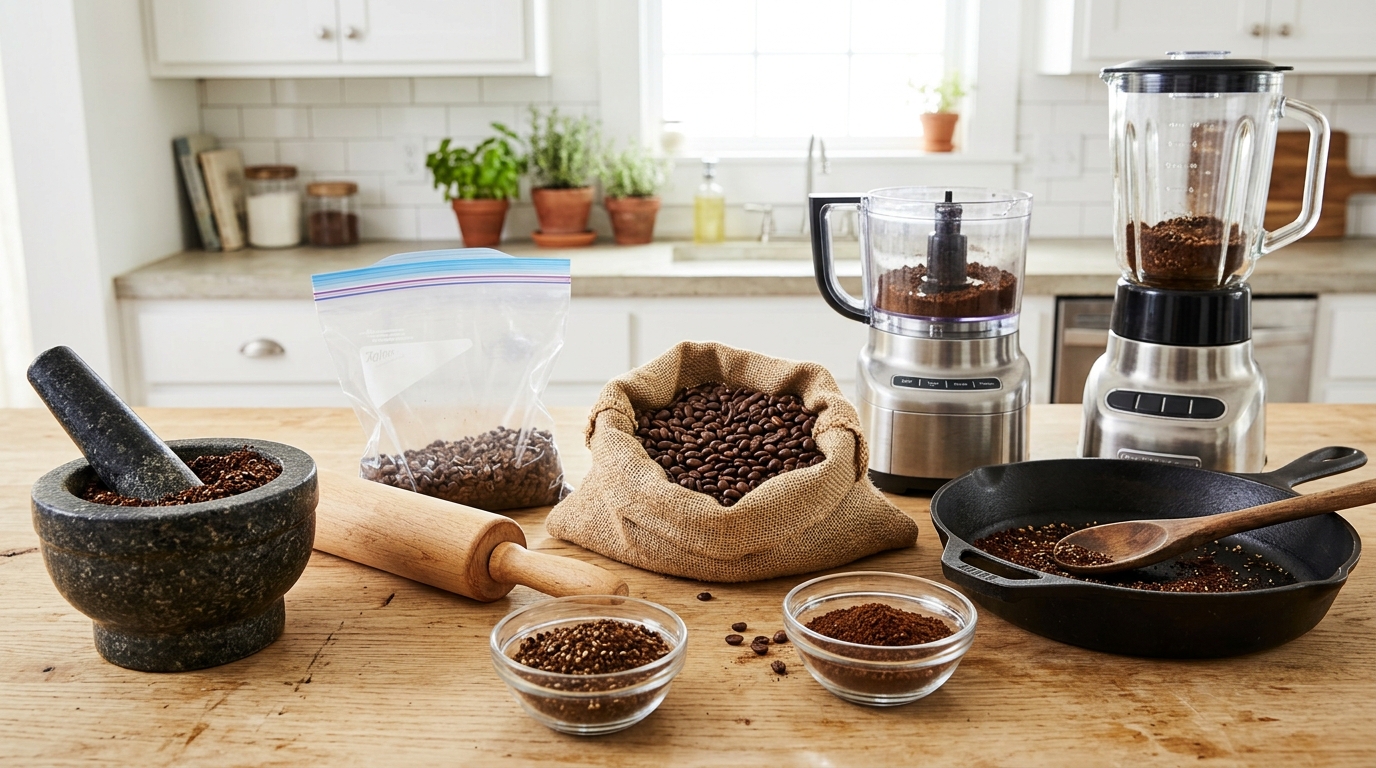
You keep staring at those whole coffee beans and wondering, can you grind coffee beans without a grinder? Yeah, it happens more often than you’d think. Maybe your grinder stopped working, maybe you never owned one in the first place, or perhaps you found a bag of fresh beans and didn’t realize they weren’t pre-ground. Whatever landed you here, don’t worry too much. There are several ways to break down coffee beans using common kitchen tools, and while none of them perfectly replace a quality burr grinder, some methods work surprisingly well. You might even discover that improvising teaches you more about coffee than simply pressing a button ever did.
Freshly ground coffee almost always delivers a richer aroma and deeper flavor because the beans begin losing their volatile compounds soon after grinding. That’s why finding a way to grind whole beans, even without specialized equipment, is usually worth the extra effort.
Why Freshly Ground Coffee Makes Such a Difference
Coffee beans are tiny containers filled with aromatic oils, carbon dioxide, and hundreds of flavor compounds. Once those beans are ground, oxygen begins interacting with their exposed surfaces, gradually reducing freshness.
According to the National Coffee Association, coffee tastes best when brewed shortly after grinding because the aromatic compounds dissipate rapidly. Even waiting half an hour can noticeably reduce flavor in some brewing methods.
Grinding your own beans allows you to:
- Preserve aroma until brewing.
- Control grind size for different brewing methods.
- Improve extraction and flavor.
- Reduce waste from stale pre-ground coffee.
It’s not magic, honestly, but sometimes the smell alone makes the extra effort feel worthwhile.
Can You Grind Coffee Beans Without a Grinder?
Absolutely, you can.
The challenge isn’t breaking the beans apart. Coffee beans are fairly brittle, so many household tools can crush them. The real challenge is achieving a consistent grind size. Uneven particles often lead to uneven extraction, where some grounds become bitter while others remain under-extracted and sour.
Still, if you’re making coffee at home and don’t have access to a grinder, these alternatives can get the job done.
Best Household Methods to Grind Coffee Beans
Use a Blender
A standard kitchen blender is probably the closest substitute to an electric coffee grinder.
Add a small amount of beans, pulse repeatedly instead of running continuously, and gently shake the blender between pulses to redistribute larger pieces.
Pros:
- Fast
- Easy
- Suitable for drip coffee
Cons:
- Uneven grind
- Can heat the beans if blended too long
Small batches usually produce better results than filling the blender halfway.
Try a Food Processor
Food processors work similarly to blenders but generally leave larger coffee particles behind.
Pulse rather than blend continuously.
A coarse grind from a food processor works reasonably well for:
- French press
- Cold brew
- Cowboy coffee
It struggles with espresso because achieving a fine, consistent texture is difficult.
Crush Beans With a Rolling Pin
This method takes a bit more patience than people expect.
Place coffee beans inside a thick freezer bag or between folded parchment paper. Roll firmly across the beans until they’re crushed, then continue applying pressure until reaching your desired consistency.
The process can actually feel oddly satisfying, even if your countertop complains a little.
Use a Mortar and Pestle
People have crushed seeds, herbs, and spices with a mortar and pestle for thousands of years, and coffee beans are no exception.
Add only a handful of beans at a time.
Press down firmly before grinding in circular motions.
This method offers surprisingly good control over grind consistency, though it requires more effort than electric alternatives.
Many specialty coffee enthusiasts still use this technique for small batches.
Hammer Method
If you’re truly out of options, a clean hammer can break coffee beans.
Place beans inside multiple sealed freezer bags and gently tap them until crushed.
Don’t swing like you’re driving nails. Controlled taps work much better and keep beans from scattering everywhere if the bag tears.
It’s definitely the loudest method on this list.
Comparing Different Grinding Alternatives
| Method | Grind Quality | Best For | Effort |
|---|---|---|---|
| Blender | Medium | Drip coffee | Low |
| Food processor | Coarse | French press | Low |
| Rolling pin | Medium | Pour over | Medium |
| Mortar and pestle | Good | Multiple brew styles | High |
| Hammer | Coarse | Emergency use | Medium |
No substitute perfectly matches a burr grinder, but some come surprisingly close when used carefully.
Which Grind Size Works Best?
Different brewing methods require different particle sizes.
| Brewing Method | Recommended Grind |
|---|---|
| Espresso | Extra fine |
| Moka Pot | Fine |
| Pour Over | Medium |
| Drip Coffee | Medium |
| French Press | Coarse |
| Cold Brew | Extra coarse |
When grinding coffee beans without a grinder, aim for consistency rather than perfection.
Large chunks mixed with powder usually produce less balanced coffee.
Tips for Better Results
A few small adjustments can noticeably improve your homemade grind.
- Grind only what you need immediately.
- Work in small batches.
- Shake beans between crushing sessions.
- Avoid overheating beans.
- Sift grounds if necessary.
- Store unused beans whole rather than crushed.
These little habits seem almost boring until you compare two cups side by side.
Common Mistakes to Avoid
Many first-time attempts go wrong because people rush the process.
Avoid these mistakes:
- Grinding too many beans at once.
- Running a blender continuously.
- Leaving large bean fragments.
- Turning everything into fine powder unnecessarily.
- Using damp equipment.
Moisture is particularly troublesome because coffee absorbs odors and water surprisingly quickly.
Does Grinding Method Affect Flavor?
Yes, although perhaps not exactly how you’d imagine.
The biggest influence isn’t the tool itself but the consistency of the grind.
Research published by the Specialty Coffee Association has consistently shown that uniform particle size promotes even extraction, helping avoid excessive bitterness and sourness in the same cup.
An uneven grind creates competing flavors because tiny particles over-extract while larger pieces remain under-extracted.
That’s why burr grinders remain the gold standard.
Still, many home brewers enjoy excellent coffee using improvised methods simply because the beans themselves are fresh.
Real-World Example
Imagine two identical bags of freshly roasted beans.
One person grinds them with a burr grinder.
The other uses a mortar and pestle carefully for several minutes.
The burr grinder produces a more consistent grind and likely a cleaner-tasting cup.
The mortar-and-pestle version may have slightly less clarity but still tastes significantly fresher than supermarket coffee that was ground weeks ago.
Freshness often outweighs perfect consistency.
What Experts Say
James Hoffmann, World Barista Champion and coffee author, has frequently emphasized that grind consistency plays a critical role in brewing quality. His educational work highlights that particle uniformity contributes directly to balanced extraction and repeatable results.
The Specialty Coffee Association similarly recommends matching grind size to the brewing method while minimizing inconsistent particle distribution.
Those recommendations aren’t just for professionals. Even home brewers notice the difference after a little practice.
Final Thoughts
So, can you grind coffee beans without a grinder? Absolutely. While no household substitute fully replaces a quality burr grinder, several everyday kitchen tools can produce coffee grounds suitable for brewing a satisfying cup. A blender, food processor, rolling pin, mortar and pestle, or even a carefully used hammer can help when you’re in a pinch.
The key is patience rather than perfection. Focus on creating the most even grind possible, brew soon after crushing the beans, and enjoy the freshness that whole coffee beans naturally preserve. Sometimes the coffee ends up tasting better simply because you took the extra time to prepare it yourself.
FAQ: Can You Grind Coffee Beans Without a Grinder?
Can I use a blender instead of a coffee grinder?
Yes. Pulse small batches instead of blending continuously to achieve a more even grind while preventing excessive heat that may affect coffee flavor.
Is crushing coffee beans with a rolling pin effective?
Yes. A rolling pin can produce medium to coarse grounds suitable for drip or pour-over coffee, though consistency requires patience and repeated rolling.
Which alternative method gives the best results?
A mortar and pestle generally provides the best control over grind size among household tools, making it one of the most effective grinder alternatives.
Can I make espresso using manually crushed coffee beans?
It’s possible, but difficult. Espresso requires a very fine, uniform grind that most household methods cannot consistently achieve for balanced extraction.
Does freshly crushed coffee taste better than pre-ground coffee?
Usually yes. Freshly crushed beans retain more aroma and flavorful oils, producing a richer, more vibrant cup when brewed immediately after grinding.

Jamesmathew is an expert Amazon affiliate writer, helping readers discover top products, smart deals, and practical buying guides through honest reviews and insightful content.