

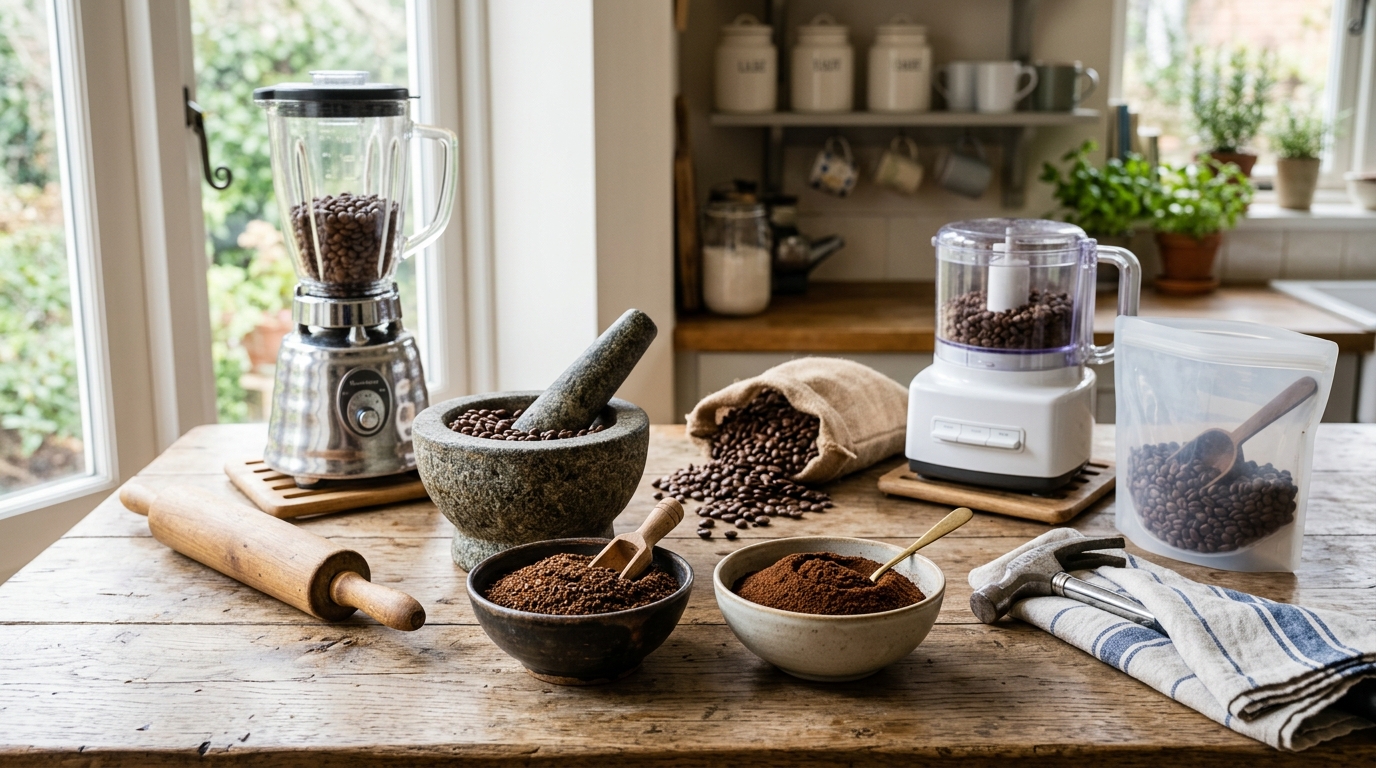
You keep staring at those coffee beans without grinder, kinda wondering if buying whole beans was a slightly overconfident move. Maybe the grinder broke, maybe you never owned one in the first place, or maybe you found a forgotten bag of fresh beans sitting in the cupboard looking way too expensive to waste. The good news is, you don’t actually have to give up on good coffee today. There are several ways you can crush, brew, or even use whole coffee beans without owning a dedicated grinder, and some of them work better than people usually expect.
Whole coffee beans stay fresher much longer than pre-ground coffee because less surface area is exposed to oxygen. According to the National Coffee Association, freshly ground beans generally produce more flavorful coffee because the aromatic compounds begin escaping almost immediately after grinding. That’s why figuring out what to do with coffee beans without grinder isn’t just about making coffee today—it can help you enjoy better tasting cups while keeping your beans fresh until you finally grab a grinder.
Can You Use Coffee Beans Without a Grinder?
Yes, you absolutely can.
Will every method produce café-quality results? Probably not. But you’ll still end up with drinkable, sometimes surprisingly delicious coffee.
The biggest challenge isn’t crushing the beans. It’s getting them crushed evenly. Uneven particles extract differently during brewing. Tiny powdery bits become bitter while larger chunks stay under-extracted and weak. Thats where most homemade grinding methods struggle a little.
Still, if you’re making:
- French press
- Cold brew
- Cowboy coffee
- Immersion brewing
…you’ve actually got a fair bit of room for imperfect grounds.
Why Whole Beans Are Worth Keeping Whole
It might feel easier to just buy pre-ground coffee forever, but whole beans really do have advantages.
| Whole Beans | Pre-Ground Coffee |
|---|---|
| Stay fresh longer | Lose aroma faster |
| Better flavor | Flavor fades quickly |
| Flexible grind size | Fixed grind only |
| Longer shelf life | Shorter shelf life |
Research published by the Specialty Coffee Association consistently shows that freshly ground coffee preserves volatile aromatic compounds much better than coffee ground days or weeks earlier.
So if you’re temporarily without a grinder, don’t rush into throwing the beans away.
Best Ways to Grind Coffee Beans Without a Grinder
Let’s go through the methods that actually work.
Use a Rolling Pin
This is probably the easiest option.
Put the beans inside a heavy freezer bag or between two sheets of parchment paper. Press down gently first before rolling firmly back and forth.
A rolling pin creates surprisingly consistent coarse grounds, making it a decent choice for French press.
Tips:
- Use a thick towel underneath.
- Roll slowly.
- Keep checking consistency.
- Don’t rush it or the bag may split.
It’s oddly satisfying too, if I’m being honest.
Crush Them With a Mortar and Pestle
This method has existed for hundreds of years.
Many spice grinders today are basically mechanical versions of this old tool.
How to do it:
- Add a small handful of beans.
- Press downward first.
- Begin grinding in circles.
- Continue until reaching desired texture.
The advantage?
You control the grind size much better than with most household alternatives.
It does take some elbow grease though.
Use a Heavy Frying Pan
No rolling pin?
Flip a heavy cast iron skillet upside down or use the bottom of a sturdy pan.
Place beans inside a thick towel.
Press firmly.
Rock slightly.
Repeat.
Eventually the beans crack apart.
Not elegant, but it works surprisingly okay.
Hammer Method
Sounds dramatic because…well, it kinda is.
Wrap beans securely inside several layers of cloth.
Tap gently with a hammer.
Don’t swing like you’re building a fence.
Several light taps work much better than one huge hit.
This method usually creates coarse grounds suitable for immersion brewing.
Food Processor
A food processor isn’t ideal, but many people already have one.
Use the pulse setting only.
Never leave it running continuously.
Pulse for:
- 2 seconds
- Stop
- Shake container
- Repeat
Eventually you’ll reach a reasonably coarse consistency.
It’s inconsistent, yet perfectly usable for cold brew.
Blender
A blender works similarly.
Many modern blenders even include pulse settings specifically recommended by manufacturers for harder ingredients.
Again:
- Small batches
- Short pulses
- Shake between pulses
Don’t expect espresso-quality grounds.
Expect “pretty good” coffee instead.
Brewing Coffee Without Perfect Grounds
Here’s something people don’t always realize.
Different brewing methods forgive uneven grounds differently.
French Press
French press is incredibly forgiving.
Even if your grounds are slightly chunky, immersion brewing extracts flavor gradually.
Steep around four minutes.
Press slowly.
Done.
Cold Brew
Cold brew might actually be the best answer when asking what to do with coffee beans without grinder.
Because extraction happens over 12–24 hours, consistency matters much less.
Roughly crushed beans work surprisingly well.
Cowboy Coffee
This old method has survived generations for a reason.
Simply:
- Boil water.
- Add crushed coffee.
- Simmer briefly.
- Let grounds settle.
- Pour carefully.
Not fancy.
Actually pretty enjoyable.
Turkish Coffee?
Probably don’t attempt it.
Turkish coffee requires extremely fine powder-like grounds.
No household improvisation really gets close enough.
What If You Don’t Want to Crush Them?
Believe it or not, whole coffee beans have uses besides brewing.
Make Coffee-Infused Syrup
Whole beans can flavor sugar syrup.
Heat together:
- Water
- Sugar
- Whole beans
Let steep.
Strain.
Use in:
- Iced coffee
- Cocktails
- Pancakes
- Ice cream
The flavor becomes surprisingly smooth.
Flavor Cream
Drop whole beans into warm cream.
Let them infuse 30–60 minutes.
Remove beans.
Now you’ve got coffee-flavored cream perfect for:
- Desserts
- Hot chocolate
- Whipped cream
- Custards
Homemade Coffee Extract
Fill a jar with:
- Whole beans
- Vodka
Seal.
Wait several weeks.
Shake occasionally.
You’ll end up with homemade coffee extract useful in baking.
Can You Boil Whole Coffee Beans?
Technically yes.
Practically…it’s disappointing.
Whole beans expose very little surface area to water.
Extraction stays extremely weak.
You’ll probably end up with lightly coffee-scented water instead of actual coffee.
Cracking them first—even just slightly—makes a massive difference.
Mistakes People Make
Sometimes the problem isn’t lacking a grinder.
It’s choosing the wrong workaround.
Avoid these mistakes:
- Grinding huge batches at once.
- Using thin plastic bags.
- Overheating beans in blenders.
- Trying to achieve espresso-fine powder manually.
- Brewing immediately after smashing beans into uneven dust.
Little adjustments honestly help more than fancy equipment sometimes.
Real-World Example
Imagine two friends camping.
One packed expensive Ethiopian whole beans.
The other forgot the grinder.
Instead of giving up, they used a clean rock wrapped in a towel to gently crush the beans before making cowboy coffee over a fire.
Was it perfect?
Not remotely.
Did everyone finish their mugs anyway?
Absolutely.
Sometimes good coffee isn’t about perfection. It’s about adapting.
How Long Whole Coffee Beans Stay Fresh
Storage matters almost as much as grinding.
Keep beans:
- In an airtight container
- Away from sunlight
- Away from moisture
- At room temperature
Avoid refrigerators.
Coffee easily absorbs surrounding odors, which nobody really wants unless garlic-flavored coffee suddenly becomes trendy.
The National Coffee Association recommends using roasted coffee within a few weeks after opening for the best flavor, although properly stored beans remain safe much longer.
Should You Buy a Grinder Eventually?
Probably yes.
Even an affordable burr grinder dramatically improves consistency compared to improvised methods.
Blade grinders are cheaper but produce uneven particles.
Burr grinders crush beans between two abrasive surfaces, resulting in much more uniform grounds.
If you drink coffee several times each week, it’s honestly one kitchen purchase that earns its keep fairly quickly.
Quick Comparison of Grinding Alternatives
| Method | Difficulty | Grind Quality | Best Brewing Method |
|---|---|---|---|
| Rolling pin | Easy | Good | French press |
| Mortar and pestle | Medium | Very good | French press, pour-over |
| Hammer | Easy | Fair | Cowboy coffee |
| Frying pan | Easy | Fair | Cold brew |
| Blender | Easy | Fair | Cold brew |
| Food processor | Easy | Fair | French press |
Expert Insight
James Hoffmann, World Barista Champion and respected coffee educator, has often emphasized that grind consistency affects extraction more than people initially realize. While improvised methods won’t match a quality burr grinder, they can still produce enjoyable coffee when paired with forgiving brewing techniques.
Likewise, the Specialty Coffee Association recognizes grind uniformity as one of the major factors influencing extraction quality, alongside water temperature, brew ratio, and contact time.
Final Thoughts
Running into whole beans without a grinder feels like one of those tiny kitchen problems that somehow becomes bigger than it should. Thankfully, you have more options than you might’ve guessed. A rolling pin, mortar and pestle, blender, or even a sturdy frying pan can get you close enough to brew a satisfying cup. No, the results won’t perfectly match freshly ground coffee from a premium burr grinder, but they’ll usually beat letting quality beans sit untouched.
The trick is matching your homemade grind to forgiving brewing methods like French press, cold brew, or cowboy coffee. Those methods hide imperfections remarkably well. Until you buy a grinder, you’re far from stuck—you’ve still got coffee waiting to happen, just in a slightly more creative way.
FAQs
What to do with coffee beans without grinder if I only have basic kitchen tools?
Use a rolling pin, mortar and pestle, heavy pan, or blender. These methods produce usable grounds, especially for French press or cold brew.
Can I brew whole coffee beans without crushing them first?
Yes, but extraction remains extremely weak because water cannot reach much of the bean’s interior, resulting in a very mild, underwhelming cup.
Is a blender better than a food processor for grinding coffee beans?
Both work similarly. A blender with short pulse settings usually produces slightly more consistent coarse grounds than most standard food processors.
Which brewing method works best with uneven coffee grounds?
French press and cold brew are the most forgiving because immersion brewing reduces the impact of inconsistent particle sizes during extraction.
Do whole coffee beans last longer than ground coffee?
Yes. Whole beans retain freshness and aroma significantly longer because less surface area is exposed to oxygen, moisture, and environmental contaminants.

Jamesmathew is an expert Amazon affiliate writer, helping readers discover top products, smart deals, and practical buying guides through honest reviews and insightful content.