

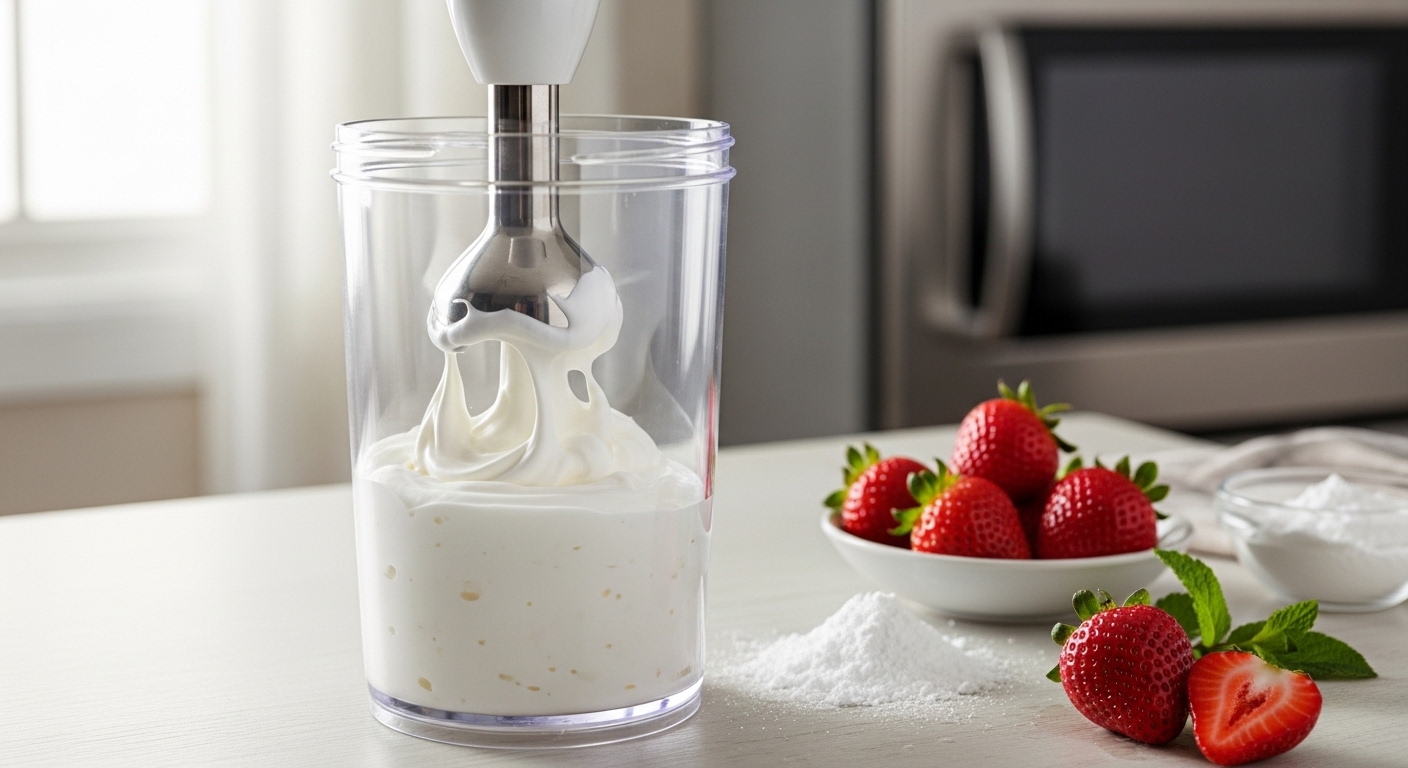
Can you make whipped cream with an immersion blender without it turning into a sad liquid mess or overwhipped butter halfway through? Yeah, that’s usually the exact thought that hits you when you’ve got cream in the fridge, dessert halfway ready, and suddenly you realize your whisk is nowhere to be found. It feels like one of those small kitchen panic moments that shouldn’t matter but somehow does.
And honestly, you’re not the only one who wonders this in a slightly frustrated way while staring at a jug of cream like it might answer back.
The short answer is yes, you can absolutely make whipped cream with an immersion blender, but there’s a bit more going on under the surface than just “turn it on and hope.” The texture, timing, even the temperature of your cream… all of it quietly decides whether you get fluffy peaks or a weird soupy foam that refuses to behave.
What Happens When You Try to Make Whipped Cream with an Immersion Blender
When you use an immersion blender to whip cream, you’re basically forcing fat molecules to trap air at high speed. Cream isn’t just liquid fat; it’s a suspension of fat globules in water, and when you agitate it fast enough, those fat globules break open and start sticking together.
According to basic dairy science principles (often referenced in food tech research and USDA dairy composition data), heavy cream usually contains around 36% milk fat, which is the sweet spot for stable whipped cream. Anything lower starts getting risky, like it might not hold structure properly.
Now here’s the weird part people don’t expect: immersion blenders are aggressive. Like, borderline too efficient. One second it’s liquid, and the next second it’s thick, and if you’re not paying attention it just jumps straight into butter territory. No warning, no polite transition.
That’s why so many people say they “can’t get it right,” when actually they just blinked at the wrong moment.
Choosing the Right Cream (This Matters More Than the Blender)
If you pick the wrong cream, no amount of blending skill will save it. Slight exaggeration maybe, but not by much.
You want:
- Heavy cream or whipping cream (not light cream)
- Fat content between 30%–36%
- Fresh cream, not close to expiry (older cream sometimes separates weirdly)
- Cold cream, straight from the fridge
Temperature is actually more important than most people think. Cold fat holds air better because it solidifies slightly during whipping, forming that structure you want.
A pastry chef once said in a culinary workshop quote often repeated in baking circles: “Warm cream is already halfway to failure before you even start whipping it.” Sounds dramatic, but it’s kind of true in practice.
If your kitchen is hot, even the bowl can mess things up a bit. Some people even chill the immersion blender head for a few minutes, which sounds a bit extra but it does help.
Step-by-Step: How to Make Whipped Cream with an Immersion Blender
This is where most people either succeed easily or accidentally make butter without meaning to.
Here’s a simple flow that actually works:
- Pour cold heavy cream (1 cup / 240 ml) into a tall container
- Add optional sugar (1–2 tablespoons powdered sugar works best)
- Add a tiny splash of vanilla extract if you want flavor
- Insert immersion blender fully at the bottom
- Start on low speed first if your blender has settings
- Move slowly up and down, not too fast
- Stop immediately once soft peaks form
Soft peaks usually appear in about 30–60 seconds, which surprises people because it feels too quick. If you go past that, you’ll see stiff peaks. A few seconds more and it starts clumping. And then suddenly… butter. Just like that.
It’s honestly a very unforgiving process, but also kind of fun once you get used to it.
Common Mistakes People Make (And Why It Keeps Failing)
Here’s a small breakdown of what usually goes wrong:
| Mistake | What Happens | Why It Fails |
|---|---|---|
| Using warm cream | Doesn’t whip or stays runny | Fat doesn’t stabilize |
| Over-blending | Turns grainy or becomes butter | Fat separates completely |
| Wrong container | Splashing and uneven whipping | Poor airflow distribution |
| Low-fat cream | Never thickens | Not enough fat structure |
One of the most common issues is impatience. People think “it’s not working” after 10 seconds and keep blending too long, which ironically is what causes the failure.
It’s a bit like watching toast in a toaster and pulling it out too late because you got distracted.
Troubleshooting: If It Goes Wrong Midway
If your whipped cream starts looking weird, don’t panic too fast.
- If it’s too runny: blend a little longer, but carefully
- If it looks slightly grainy: stop immediately, it’s near butter stage
- If it becomes butter: you can actually rinse it and salvage it into homemade butter (not what you wanted, but not wasted either)
- If it won’t thicken at all: your cream is probably too low fat or too warm
There’s a small “point of no return” that happens fast with immersion blenders, and learning to recognize it is basically the skill.
Immersion Blender vs Other Methods
Let’s be real, immersion blender isn’t the only way to do this.
| Method | Speed | Control | Risk of Failure | Texture Quality |
|---|---|---|---|---|
| Immersion blender | Very fast | Medium | High if careless | Very good |
| Hand whisk | Slow | High | Low | Slightly airy |
| Electric hand mixer | Medium | High | Medium | Very consistent |
The immersion blender wins on speed but loses slightly on forgiveness. It’s like the “fast but slightly chaotic” option.
A hand whisk takes longer, but you basically have full control over the texture. That’s why older cookbooks often recommend whisking by hand, especially for beginners.
Why It Works So Fast (A Bit of Food Science Without Making It Boring)
Cream becomes whipped cream because of something called fat globule destabilization. When you agitate cream, the fat molecules break their natural coating and start sticking together, forming a network that traps air bubbles.
Food science texts (like those used in culinary institutes) often note that optimal whipping happens when:
- Fat content is above 30%
- Temperature is between 4°C–7°C
- Air incorporation happens rapidly but not too violently
Immersion blenders basically accelerate this process aggressively. That’s why results come quickly, but also why timing is so sensitive.
It’s kind of like speeding up a process that normally wants a slow handshake into a full sprint.
Real Kitchen Experience (Not the Clean Version)
In real kitchens, especially home kitchens, things rarely go perfectly smooth.
You’ll often see something like:
- Cream looks fine
- Blender goes in
- Suddenly it’s thick
- You think “just a few more seconds”
- Now it’s butter-ish
It’s almost funny how fast it changes state. One moment you’re making dessert topping, the next moment you’re accidentally starting a dairy product you didn’t plan for.
A lot of home cooks report that their “first successful attempt” usually comes after at least one failure. That seems consistent across baking forums and cooking communities.
Final Thoughts
So, can you make whipped cream with an immersion blender? Yes, and pretty easily once you understand the timing. It’s one of those kitchen tricks that feels complicated only until you’ve messed it up once or twice and suddenly your brain just “gets it.”
The real secret isn’t fancy technique or special tools. It’s mostly about cold cream, paying attention, and stopping earlier than you think you should.
And yeah, it might still surprise you how fast it turns from liquid to perfect whipped cream… or from perfect whipped cream to butter if you look away for too long.

Jamesmathew is an expert Amazon affiliate writer, helping readers discover top products, smart deals, and practical buying guides through honest reviews and insightful content.