

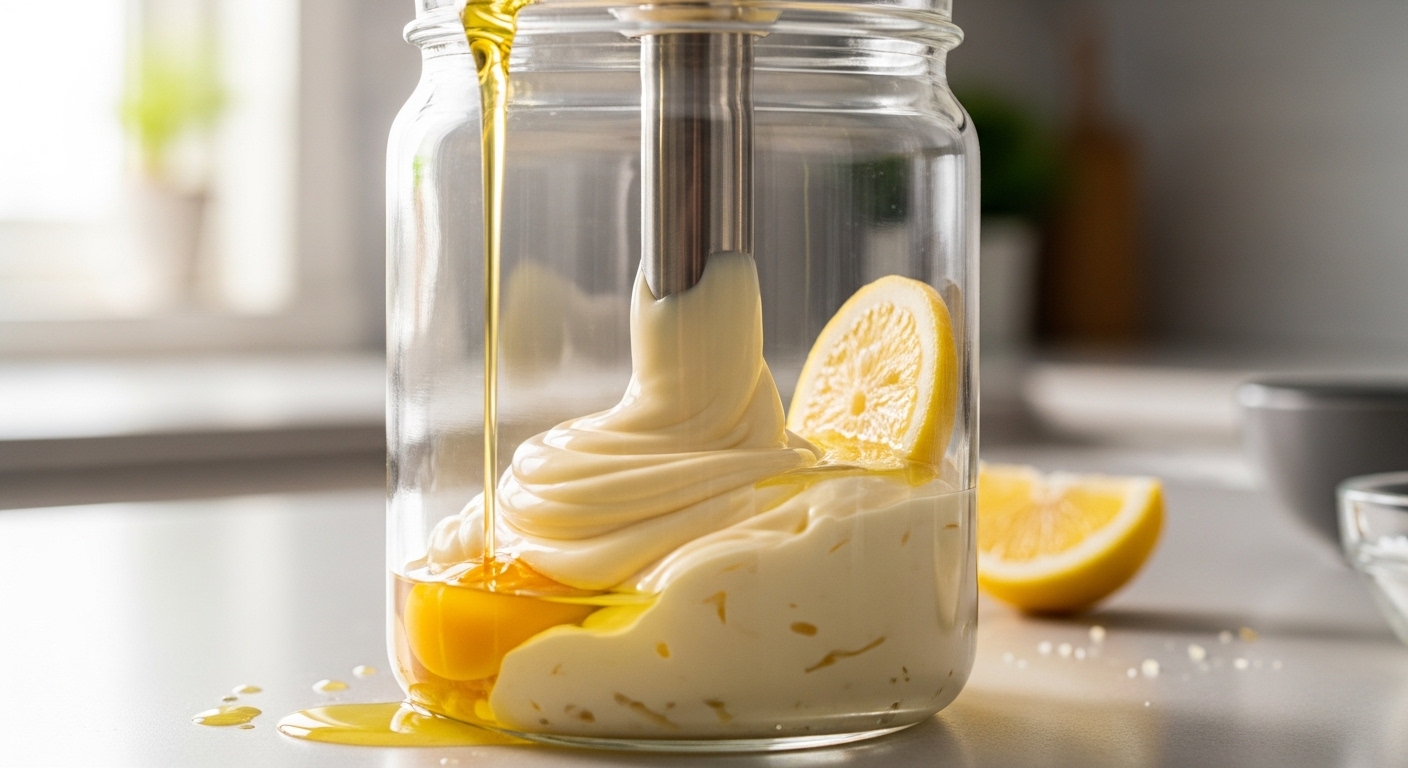
How to make mayonnaise with an immersion blender is one of those things you try once when you’re already annoyed at store-bought mayo and somehow it just sticks in your brain like “wait, why was I buying this forever?”. You’re probably standing in your kitchen at some odd hour, oil bottle half-open, wondering if you’re about to waste eggs or accidentally create soup instead of that thick creamy thing you wanted.
And yeah, that uncertainty feeling is normal, even if nobody really says it out loud.
You’re not alone in it.
Why how to make mayonnaise with an immersion blender feels almost suspiciously easy
There’s a weird moment when you first see immersion blender mayo happen. It looks like nothing is happening… then suddenly it turns thick like magic, almost too fast for comfort.
Traditional mayo methods make you whisk like crazy, slowly drizzling oil while praying it doesn’t split. But with an immersion blender, the blade basically forces tiny droplets of oil into suspension instantly, forming an emulsion before your brain even catches up.
Food scientists explain this pretty cleanly. According to Harold McGee in On Food and Cooking, egg yolks contain lecithin, a natural emulsifier that helps oil and water mix in a stable structure. He notes, “lecithin molecules help stabilize oil droplets in water-based mixtures,” which is exactly what mayonnaise is doing at a microscopic level.
So yeah, it’s not magic. Just chemistry doing the heavy lifting while you pretend you’re a kitchen genius.
Ingredients you need for immersion blender mayonnaise (and why each one matters more than you think)
You don’t need much, but the quality kinda matters more than people admit.
- 1 whole egg (room temperature works best, cold can slow emulsification a bit)
- 1 cup neutral oil (sunflower, canola, or light olive oil)
- 1–2 tsp mustard (helps stabilize and adds mild tang)
- 1 tbsp lemon juice or vinegar
- Salt to taste
- Optional: garlic, chili flakes, herbs
A small detail people ignore: oil choice changes flavor a lot. Extra virgin olive oil can taste too bitter if overused, so many chefs mix it half and half with neutral oil.
A quick note from real kitchen practice: French culinary technique often leans on mustard not just for taste but for stability. It acts like a secondary emulsifier, kind of backup support if your egg yolk is being lazy that day.
Step-by-step: how to make mayonnaise with an immersion blender without messing it up
This is the part where things usually feel intimidating, but honestly it’s more about order than skill.
Step 1: Put everything in the jar (yes, all at once)
Take a tall jar or container that fits your immersion blender head snugly.
Add:
- egg first
- mustard
- lemon juice or vinegar
- salt
- oil goes last on top, don’t mix it yet
This layering matters more than people expect.
Step 2: Let it sit for like 20–30 seconds
Sounds pointless, but it helps the egg settle and oil float properly.
Step 3: Stick blender goes straight to the bottom
This is the crucial moment.
Turn it on while it’s touching the bottom. Don’t move it immediately.
You’ll see the bottom start turning white and thick almost instantly.
Step 4: Slowly lift the blender
After 5–10 seconds, gently lift it upward. The rest of the oil gets pulled in like it’s being swallowed.
At this point, you’re basically watching emulsification happen in real time.
Step 5: Taste and adjust
Add salt, more lemon, or even a tiny splash of water if it feels too thick.
And that’s it. It’s done. Slightly anticlimactic honestly.
Common mistakes when learning how to make mayonnaise with an immersion blender
People mess this up in predictable ways. Not because it’s hard, but because it feels too easy.
1. Moving the blender too early
If you start lifting before emulsification begins, it won’t form properly.
2. Wrong container size
Too wide = oil doesn’t get pulled into blade zone.
3. Cold ingredients
Not always fatal, but can slow the emulsification process.
4. Using too much olive oil
Can turn bitter or overpowering.
Troubleshooting table (because mayo sometimes has attitude)
| Problem | What it looks like | Fix |
|---|---|---|
| Too runny | Looks like salad dressing | Add another egg yolk and blend again |
| Split mayo | Oil floating, watery base | Restart with fresh egg, slowly add broken mix |
| Too thick | Paste-like texture | Add a teaspoon of water or lemon juice |
| Bitter taste | Overpowering olive oil | Mix with neutral oil next time |
Sometimes it just fails for no obvious reason, which is mildly annoying but normal.
Flavor variations you didn’t realize you could do so easily
Once you get basic immersion blender mayo right, it starts becoming a base instead of a final product.
Try these:
- Garlic mayo (add 1–2 cloves raw garlic)
- Spicy mayo (chili sauce or cayenne)
- Herb mayo (parsley, dill, coriander)
- Smoky mayo (smoked paprika)
- Citrus mayo (extra lemon zest)
There’s a kind of quiet satisfaction in realizing store-bought mayo suddenly feels unnecessary.
A small but important safety note about raw eggs
This part is not dramatic, just practical.
Most mayonnaise uses raw egg yolk. In many countries, eggs are pasteurized, which reduces risk of salmonella. The USDA notes that while risk is low, it’s still recommended to use fresh, clean eggs and proper refrigeration.
If you’re unsure, you can:
- use pasteurized eggs
- keep mayo refrigerated
- consume within 3–4 days
Not trying to scare you, just reality check.
Why immersion blender mayonnaise actually works so well (quick science breakdown)
Emulsion stability depends on droplet size. The smaller the oil droplets, the more stable the mixture.
Immersion blenders create high shear force right at the blade head, breaking oil into microscopic droplets instantly. That’s why you don’t need slow drizzling like traditional whisking methods.
A chef once described it something like:
“You’re not mixing mayo. You’re convincing oil to behave differently.”
That’s honestly not far off.
Real-world kitchen observations (the kind nobody puts in cookbooks)
In home kitchens, humidity, egg size, and even jar shape can slightly affect results. Not dramatically, but enough that your first attempt might feel different from your second.
Also, people often overthink timing. The truth is, once the emulsion starts, it stabilizes quickly. You either catch it or you don’t.
And if you do mess it up? You’re basically one egg away from fixing it.
Quick comparison: immersion blender vs traditional whisk method
| Method | Time | Difficulty | Failure risk |
|---|---|---|---|
| Immersion blender | 1–2 minutes | Low | Medium-low |
| Whisk by hand | 10–15 minutes | High | High |
| Food processor | 3–5 minutes | Medium | Low |
So yeah, immersion blender kind of wins unless you enjoy suffering a little.
Final thoughts on how to make mayonnaise with an immersion blender
Once you’ve done it a couple times, it stops feeling like cooking and starts feeling like a trick you can pull anytime. The funny part is how people still assume it’s complicated, even though it takes less time than making toast sometimes.
You’ll probably still second-guess it the first few times. That’s normal too.
But after that, store-bought mayo starts tasting… a bit unnecessary, maybe even slightly disappointing.

Jamesmathew is an expert Amazon affiliate writer, helping readers discover top products, smart deals, and practical buying guides through honest reviews and insightful content.