

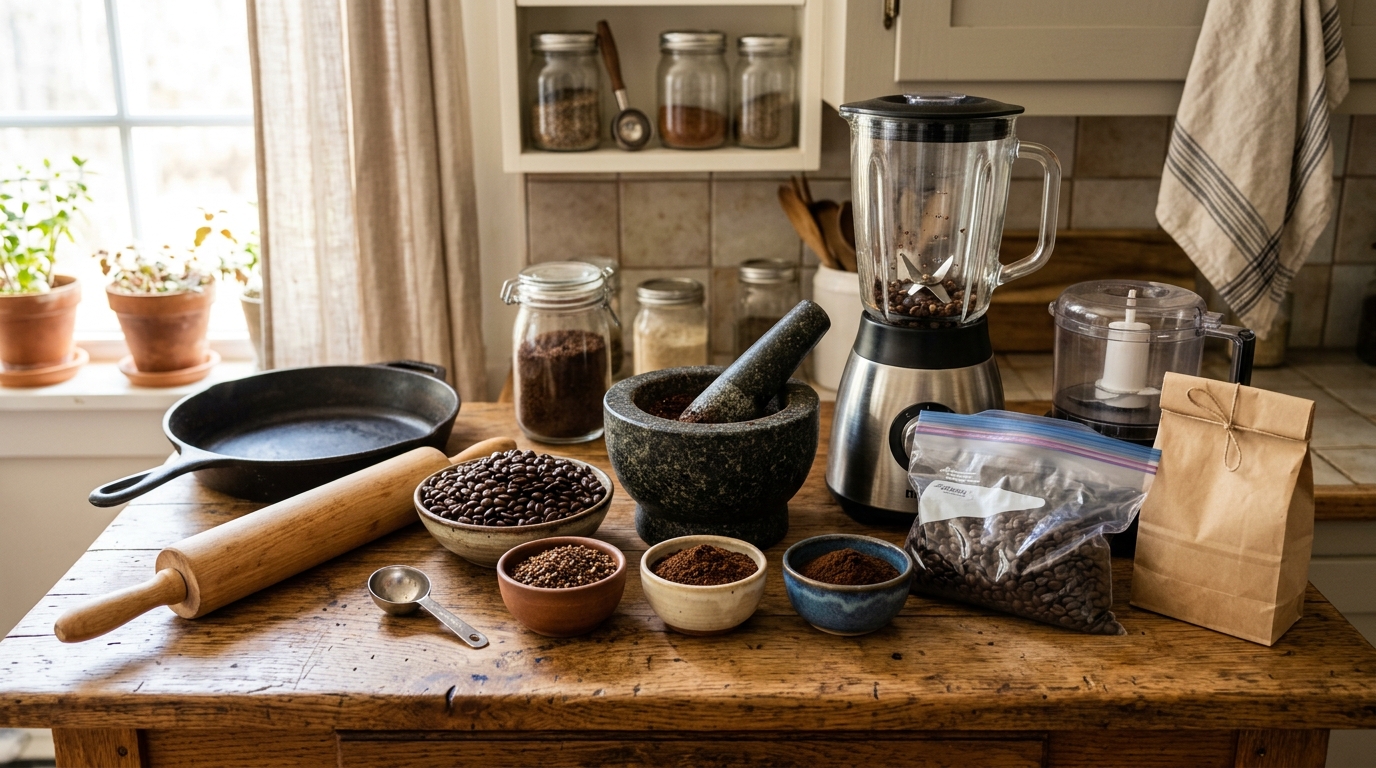
You probably searched how to use coffee beans without a grinder because the bag is already open, the kettle is almost boiling, and then it hits you—you’ve got whole beans, but nothing to crush them with. It feels a bit unfair honestly. Still, you don’t have to give up on that cup. There are a few surprisingly practical ways to get those beans ready, and while they aren’t perfect, they work better than most people expect.
Fresh coffee beans hold onto their aroma and flavor far longer than pre-ground coffee. That’s why many people buy whole beans even if they don’t own a grinder yet. The trick is knowing how to break them down without turning the kitchen into a tiny coffee battlefield.
According to the National Coffee Association, freshly ground coffee preserves more volatile aromatic compounds, which directly influence flavor and aroma. That explains why grinding just before brewing usually produces a richer cup.
Can You Really Use Coffee Beans Without a Grinder?
Yes, you can. It’s not the ideal method, but it isn’t some desperate last-minute hack either. People have been crushing coffee beans long before electric grinders became common in homes.
The goal isn’t necessarily creating perfectly uniform grounds. Instead, you’re trying to get the beans broken into reasonably consistent pieces suitable for your brewing method.
Different brewing methods are more forgiving than others.
| Brewing Method | Grind Needed | Works With Homemade Grinding? |
|---|---|---|
| French Press | Coarse | Yes, quite well |
| Pour Over | Medium | Fairly well |
| Drip Coffee Maker | Medium | Usually works |
| AeroPress | Medium-Fine | Can work with patience |
| Espresso Machine | Very Fine | Usually not recommended |
Espresso is where things become tricky. Without a proper burr grinder, producing consistently fine grounds is almost impossible.
Why Grind Size Actually Matters More Than You Think
Coffee extraction depends heavily on particle size.
If some pieces are huge while others become powder, strange things happen. The tiny particles extract very quickly and become bitter. The larger chunks stay under-extracted, making the drink taste sour or weak. Both flavors somehow arrive in the same cup, which is kinda frustrating.
Researchers from the Specialty Coffee Association have repeatedly emphasized that grind consistency is among the biggest factors affecting extraction quality.
Still, don’t let perfection stop you from making coffee today.
How to Use Coffee Beans Without a Grinder Using a Rolling Pin
This is probably the easiest method because almost every kitchen has a rolling pin.
What You’ll Need
- Rolling pin
- Thick freezer bag
- Kitchen towel
- Flat countertop
Steps
- Place the beans inside the freezer bag.
- Push out most of the air.
- Lay the towel underneath.
- Press down gently first to crack the beans.
- Roll back and forth until the grounds reach the desired size.
Try not to smash everything with full force immediately. Gentle pressure first actually produces more even pieces, funny enough.
This method works especially well for French press coffee.
Crushing Coffee Beans With a Mortar and Pestle
A mortar and pestle gives you much better control than people often realize.
Instead of pounding aggressively, use slow circular movements while applying pressure. Add only a small handful of beans at once.
Professional spice makers have used this technique for centuries because gradual crushing produces more uniform particle sizes.
Pros:
- Better consistency
- Little mess
- Good control
- Quiet operation
Cons:
- Takes longer
- Small batches only
- Requires patience
If you’re making coffee for just yourself, this method is honestly pretty solid.
Using a Hammer Without Making a Huge Mess
Yes, a hammer actually works.
Wrap the beans inside two freezer bags, then place them beneath a folded towel. Tap gently rather than swinging hard.
The towel prevents beans from flying everywhere while reducing noise.
Oddly enough, many campers use this trick because carrying a grinder into the woods isn’t always practical.
One thing though—don’t use a claw hammer directly on loose beans. You’ll regret cleaning that floor.
Blend Coffee Beans in a Blender
Many people already own a blender, making this one of the most convenient alternatives.
Pulse instead of blending continuously.
Continuous blending heats the beans through friction. Excess heat can drive away aromatic oils before brewing even begins.
Try short bursts like this:
- Pulse for 2 seconds.
- Shake the blender.
- Pulse again.
- Repeat several times.
Stop once the grounds look reasonably even.
It’s not perfect, but it gets the job done.
Can a Food Processor Crush Coffee Beans?
Yes.
A food processor behaves similarly to a blender, though it sometimes produces slightly more uneven grounds because the beans move differently around the bowl.
Use small batches.
Large quantities tend to bounce around instead of getting chopped consistently.
If your processor has multiple speed settings, choose the lowest speed first before increasing if necessary.
Use a Heavy Pan Instead
Here’s an old kitchen trick.
Spread the beans across a sturdy cutting board.
Cover them with parchment paper or a kitchen towel.
Take a heavy cast iron skillet or frying pan and press firmly while rocking slightly from side to side.
This gradually cracks the beans without scattering them around the room.
It feels strangely satisfying too.
Knife Method for Small Amounts
This works similarly to crushing garlic.
Lay the flat side of a chef’s knife over several beans.
Press downward carefully using your palm.
Once cracked, continue chopping until reaching roughly the desired grind size.
Don’t rush.
Sharp knives deserve respect even during coffee emergencies.
Best Brewing Methods for Uneven Coffee Grounds
Homemade grinding rarely creates identical particles.
Some brewing methods tolerate that much better than others.
French Press
Probably the most forgiving.
Long immersion brewing balances out minor inconsistencies.
Cold Brew
An excellent choice.
Cold extraction happens slowly over many hours, making uneven grounds much less noticeable.
Cowboy Coffee
Camping enthusiasts have relied on this approach for generations.
Simply simmer the grounds gently in water, allow them to settle, then pour carefully.
Drip Coffee
Works reasonably well, although extraction may vary slightly.
Espresso machines generally remain the least forgiving option.
Common Mistakes When Crushing Coffee Beans Without a Grinder
A few errors happen over and over.
- Crushing too many beans at once
- Using excessive force immediately
- Forgetting to remove air from storage bags
- Grinding into powder accidentally
- Brewing with wildly inconsistent particle sizes
- Heating beans too much inside blenders
Avoiding these simple mistakes noticeably improves flavor.
Does Freshness Change When You Crush Beans This Way?
Yes.
Once coffee beans break open, oxygen immediately starts reacting with aromatic compounds.
Research published in food science journals has shown that oxidation begins almost instantly after grinding.
That’s why it’s better to crush only what you’ll brew right away.
Leaving homemade grounds sitting overnight usually leads to flatter tasting coffee.
Whole beans, meanwhile, retain freshness much longer when stored properly.
Tips for Better Coffee Without a Grinder
Small improvements really stack together.
- Use filtered water whenever possible.
- Measure coffee instead of guessing.
- Brew immediately after crushing.
- Store whole beans inside airtight containers.
- Keep beans away from sunlight and moisture.
- Practice until your homemade grind becomes more consistent.
Even if today’s cup isn’t café-quality, tomorrow’s probably gets better.
Real-World Example
Imagine two friends camping.
One packed premium Ethiopian whole beans.
The other forgot the hand grinder.
Instead of settling for instant coffee, they crushed the beans using a rolling pin borrowed from the camp kitchen, brewed everything in a French press, and still ended up with a noticeably flavorful cup. Maybe not competition-level coffee, sure, but easily enjoyable around a campfire.
Situations like this happen more often than people think.
Expert Opinions on Grinding Coffee
James Hoffmann, World Barista Champion and coffee author, frequently emphasizes that grind consistency greatly affects extraction quality, though brewing method can compensate for minor inconsistencies.
The Specialty Coffee Association also recommends matching grind size to brewing style for improved extraction and flavor balance.
These experts generally agree on something important: consistency matters more than expensive equipment alone.
Final Thoughts
Learning how to use coffee beans without a grinder isn’t really about replacing proper coffee equipment forever. It’s about making good coffee when life decides to throw a tiny inconvenience your way.
Whether you grab a rolling pin, mortar and pestle, blender, heavy pan, or even a hammer, you can absolutely turn whole beans into something brewable. Some methods take longer. Some produce cleaner results. None of them are completely perfect, but perfection isn’t always sitting in your kitchen anyway.
The biggest difference comes from patience. Crush slowly, brew immediately, and match the grind as closely as possible to your brewing method. You’ll probably surprise yourself with how enjoyable the final cup actually is.
Can I boil whole coffee beans without crushing them?
Boiling whole beans extracts very little flavor because water cannot reach enough surface area. Lightly crushing them first produces a much richer cup.
Is a blender better than a food processor for coffee beans?
A blender usually creates slightly finer grounds, while a food processor often produces uneven pieces. Pulse gently with either appliance for better consistency.
Which homemade grinding method gives the best results?
A mortar and pestle generally offers the most control, creating more consistent grounds than hammers, rolling pins, or blenders with careful technique.
How long do crushed coffee beans stay fresh?
Crushed coffee tastes best within minutes. Flavor gradually declines after grinding because oxygen begins affecting aromatic oils almost immediately after exposure.
Can I make espresso without grinding coffee properly?
Not really. Espresso requires very fine, consistent grounds. Homemade crushing methods rarely achieve the precision needed for balanced espresso extraction.

Jamesmathew is an expert Amazon affiliate writer, helping readers discover top products, smart deals, and practical buying guides through honest reviews and insightful content.