

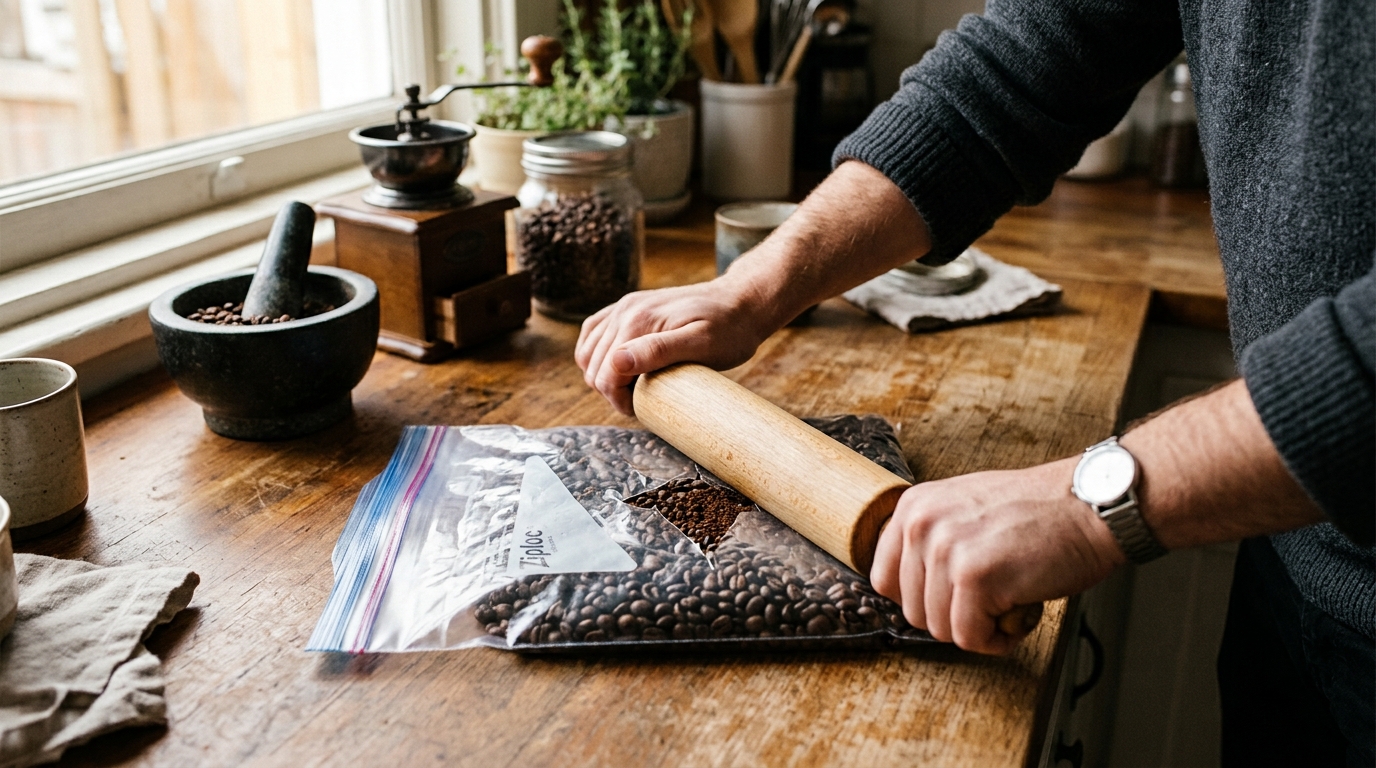
You probably searched how to grind coffee beans without grinder because your coffee is sitting there, your kettle is ready, and then… yeah, the grinder isn’t. Maybe it broke, maybe you never owned one, or maybe it’s tucked away in a box you don’t feel like opening. Funny thing is, fresh coffee doesn’t always care about fancy equipment as much as people say it does. You can still end up with a surprisingly good cup using tools already hanging around your kitchen. It isn’t perfect every single time, sure, though that’s kinda the charm.
Coffee lovers often assume grinding beans without a machine is some emergency trick reserved for camping trips. That’s not really true. People crushed roasted coffee long before electric grinders became common, and while modern grinders make life easier, they aren’t the only route between whole beans and your morning brew. With the right method, a little patience, and perhaps a slightly messy countertop, you’ll still make coffee worth drinking.
Why Freshly Ground Coffee Still Matters
Whole coffee beans protect the delicate oils and aromatic compounds trapped inside them. Once coffee is ground, oxygen begins stealing those flavors away. According to research published by the Specialty Coffee Association, freshly ground beans retain noticeably more aroma than pre-ground coffee, especially during the first few minutes after grinding.
That doesn’t mean you should panic if your grind isn’t perfectly uniform. A fresh but uneven grind usually tastes livelier than stale pre-ground coffee that’s been sitting for weeks. You might notice stronger aroma, brighter acidity, and a fuller body even if every particle isn’t exactly the same size.
Before You Start: Match the Grind to Your Brewing Method
Different brewing methods work best with different grind sizes.
| Brewing Method | Ideal Grind Size | Similar Texture |
|---|---|---|
| French Press | Coarse | Sea salt |
| Cold Brew | Extra coarse | Cracked pepper |
| Pour Over | Medium | Sand |
| Drip Coffee Maker | Medium | Regular sand |
| AeroPress | Medium-fine | Fine sand |
| Espresso | Very fine | Powdered sugar |
Without a grinder, matching these textures exactly gets… well, kinda tricky. Still, aiming close is usually enough.
Method 1: Use a Rolling Pin
A rolling pin is probably the closest substitute to a manual coffee grinder.
What You Need
- Rolling pin
- Zip-top freezer bag or thick towel
- Cutting board
Steps
- Place coffee beans inside a heavy-duty freezer bag.
- Push out most of the air.
- Lay the bag on a cutting board.
- Press firmly until the beans crack.
- Roll back and forth while applying even pressure.
Instead of smashing everything at once, work slowly. Rolling produces a surprisingly even consistency because you’re crushing rather than exploding the beans. Takes a few minutes, though your arms may quietly complain.
Best for:
- Pour over
- Drip coffee
- French press
Method 2: Crush Beans with a Mortar and Pestle
This is one of the oldest coffee grinding techniques in the world.
Ancient spice merchants, pharmacists, and coffee drinkers relied on mortar and pestle sets long before electric appliances became kitchen staples. Because you’re controlling every movement, it’s easier to achieve a consistent grind than many people expect.
How to Do It
- Add a small handful of beans.
- Hold the bowl firmly.
- Crush using downward pressure.
- Rotate the pestle in circles.
- Continue until reaching the desired texture.
The process feels oddly relaxing. A bit noisy, yes, though not unbearable. You may even start enjoying it after the second batch.
Best for:
- French press
- AeroPress
- Pour over
Method 3: Use a Blender
Many standard blenders can grind coffee beans reasonably well.
Pulse the beans instead of blending continuously. Long blending sessions generate heat, and heat begins changing coffee’s aromatic compounds. Short bursts help reduce this problem.
Tips
- Grind small batches.
- Shake the blender between pulses.
- Avoid running continuously for more than a few seconds.
- Stop frequently to check consistency.
One thing you’ll notice is that blenders create mixed particle sizes. Some pieces become powder while others stay chunky. That’s pretty normal.
Best for:
- Drip coffee
- Cold brew
Method 4: Food Processor
A food processor works similarly to a blender but often produces slightly more even results because the beans circulate differently.
Spread the beans evenly around the bowl before starting. Pulse repeatedly rather than letting the machine run nonstop.
It may never reach espresso-level fineness, and honestly that’s okay because food processors simply aren’t designed for microscopic consistency.
Method 5: Hammer Technique
This sounds dramatic. It kinda is.
What You’ll Need
- Hammer
- Thick freezer bag
- Kitchen towel
- Solid countertop
Wrap the bag inside the towel before striking. The towel helps prevent tears while keeping beans from launching across your kitchen like tiny caffeinated marbles.
Strike gently at first.
Seriously.
A few controlled taps work much better than one enthusiastic swing.
After cracking the beans, use lighter taps to reduce larger pieces further.
This method produces coarse grounds better than fine ones.
Method 6: Heavy Frying Pan or Cast Iron Skillet
If you own a heavy skillet, you’ve already got another coffee grinding tool.
Place beans between folded parchment paper or inside a freezer bag.
Press the skillet down firmly.
Rock it slightly while applying pressure.
Continue until the desired texture appears.
Cast iron distributes pressure surprisingly evenly, making it easier than using random heavy objects.
Method 7: Use a Chef’s Knife
Professional chefs sometimes crush garlic with the flat side of a knife. Coffee beans can be treated similarly.
Lay the flat blade over several beans.
Press carefully with the heel of your hand.
Repeat.
Then chop larger fragments into smaller pieces if needed.
This isn’t fast.
Actually, it’s kinda slow.
Still, if you only need enough coffee for one mug, it’ll get the job done.
Method 8: Manual Meat Tenderizer
The flat side of a meat tenderizer crushes roasted beans effectively.
Avoid the textured side because it tends to scatter fragments everywhere.
Use controlled pressure rather than repeated hard strikes.
A towel underneath reduces slipping while protecting your countertop.
Which Household Method Produces the Best Results?
Here’s a quick comparison.
| Method | Consistency | Speed | Effort | Best Grind |
|---|---|---|---|---|
| Mortar and Pestle | Excellent | Medium | Medium | Medium to coarse |
| Rolling Pin | Very Good | Medium | Low | Medium |
| Blender | Good | Fast | Low | Medium |
| Food Processor | Good | Fast | Low | Medium |
| Hammer | Fair | Fast | Medium | Coarse |
| Cast Iron Pan | Fair | Medium | Medium | Coarse |
| Chef’s Knife | Fair | Slow | High | Coarse |
| Meat Tenderizer | Fair | Medium | Medium | Coarse |
Common Mistakes When Grinding Coffee Beans Without a Grinder
Even simple methods can go sideways if you’re rushing.
Grinding Too Much at Once
Smaller batches produce more consistent results.
Large piles leave some beans untouched while others become powder.
Applying Too Much Force Immediately
Gradual crushing works better than aggressive smashing.
Oddly enough, patience saves time because you won’t need to restart uneven batches.
Ignoring Grind Size
Different brewing methods extract coffee differently.
A coarse grind inside an espresso machine creates weak coffee.
A powdery grind inside a French press usually creates muddy bitterness.
Using Thin Plastic Bags
Regular sandwich bags tear surprisingly easily.
Freezer bags are much stronger.
That tiny difference matters more than you’d think.
Can You Brew Whole Coffee Beans Instead?
Technically yes.
Practically… not really.
Whole beans expose very little surface area to water, meaning extraction becomes incredibly slow. After several minutes you’ll end up with lightly flavored water instead of proper coffee.
Crushing the beans, even roughly, dramatically improves extraction.
Does Uneven Grinding Ruin Coffee?
Not completely.
Professional baristas chase uniform particles because consistency improves extraction.
Home brewing is a little more forgiving.
If your grounds range from medium to slightly coarse, you’ll probably still enjoy the cup. The biggest issue appears when powder and large chunks exist together. Fine particles over-extract and become bitter while oversized chunks stay under-extracted and taste sour.
It’s balance you’re chasing, not perfection.
Tips for Better Results Every Time
A few simple habits make a noticeable difference.
- Use freshly roasted beans whenever possible.
- Grind only the amount you’ll brew immediately.
- Work in small batches.
- Clean tools before and after grinding.
- Check grind size frequently.
- Match grind size to your brewing method.
- Avoid overheating beans with electric appliances.
- Store remaining beans in an airtight container away from heat and light.
Those little adjustments don’t sound exciting, but they quietly improve every cup.
Real-World Example
Imagine you’re making coffee during a weekend cabin trip.
The electric grinder stayed at home.
Instead of settling for instant coffee, you grab a rolling pin, a freezer bag, and about 25 grams of whole beans. Five minutes later, you’ve produced a medium-coarse grind suitable for a French press. Is every particle identical? Nope. Does the coffee still smell incredible while blooming with hot water? Absolutely.
Situations like this happen more often than people admit.
What Coffee Experts Say
James Hoffmann, World Barista Champion and respected coffee educator, has frequently emphasized that grind consistency affects extraction more than simply achieving an ultra-fine grind. Even when perfect equipment isn’t available, aiming for reasonably even particles leads to better-tasting coffee.
The National Coffee Association USA also recommends grinding beans immediately before brewing whenever possible because freshness significantly impacts aroma and flavor.
Those recommendations line up with what plenty of home brewers discover through trial and error.
Frequently Asked Questions
Can I grind coffee beans with a rolling pin?
Yes. A rolling pin is one of the best household alternatives because it applies even pressure and produces relatively consistent grounds.
Is a blender better than a food processor?
They’re fairly similar. A food processor often creates slightly more even particles, while a blender is generally faster.
Can I make espresso without a grinder?
It’s difficult. Espresso requires an extremely fine, consistent grind that household methods rarely achieve.
How long does manual grinding take?
Most methods require between 3 and 10 minutes depending on the quantity and desired grind size.
Does hand grinding change the flavor?
The grinding method itself doesn’t significantly change flavor. Uneven particle size influences extraction more than the physical act of grinding by hand.
Final Thoughts
Learning how to grind coffee beans without grinder isn’t about pretending kitchen tools replace dedicated coffee equipment. They don’t. What they do offer is flexibility when life gets a little inconvenient. A rolling pin, mortar and pestle, blender, or even a heavy skillet can rescue your morning coffee with better results than many people expect.
You don’t need laboratory precision to brew a satisfying cup. Aim for a grind that’s reasonably even, match it to your brewing method, and use freshly roasted beans whenever you can. Coffee has always been a little forgiving, even if enthusiasts sometimes make it sound impossibly technical. The next time your grinder disappears, breaks, or simply isn’t around, you’ll already know you’ve got several workable options sitting quietly in your own kitchen.

Jamesmathew is an expert Amazon affiliate writer, helping readers discover top products, smart deals, and practical buying guides through honest reviews and insightful content.