

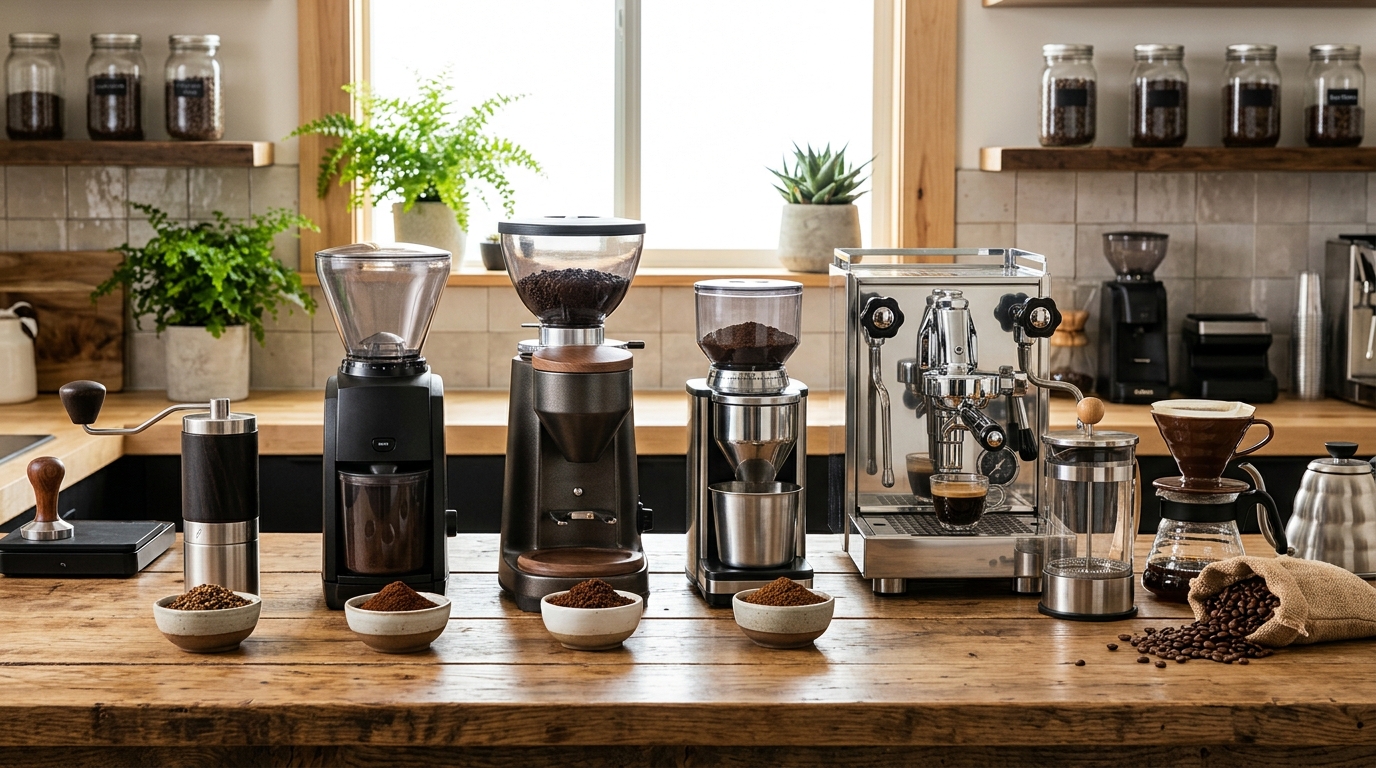
So you’re trying to choose a coffee grinder and every single option on the shelf looks like it was designed by the same three companies wearing different hats, right. You click on one, it’s $19.99 and has 800 reviews calling it “life changing,” you click on another, it’s $220 and the reviews are basically just photos of espresso shots. Somewhere in between all that is the actual answer, and honestly most articles online make it way more complicated then it needs to be.
Here’s the thing nobody tells you upfront: the grinder matters more then the machine you brew with. You could have a $2,000 espresso setup and still pull garbage shots if the grinder underneath it is inconsistant. Coffee professionals have said this for years — the grind is where the flavor is actually decided, brewing just reveals what the grind already set up.
Why the Grinder Is the Part Everyone Skips (and Shouldn’t)
Most people buy the coffee maker first and treat the grinder like an afterthought, a little accessory they’ll figure out later. Its backwards. The grinder is doing the heavy lifting because it controls something called extraction, which is basically how much flavor gets pulled out of the coffee particle by water. If your grind is uneven you end up with tiny dust particles that over-extract and taste bitter, sitting right next to chunky bits that under-extract and taste sour and weak. You get both flavors fighting each other in the same cup, and that muddled, can’t-quite-place-it taste is almost always a grind problem, not a bean problem.
One coffee consultant, Scott Rao, put it kind of bluntly when he said using a blade grinder is basically like chopping your coffee with a machete. Which, once you picture it, explains a lot about why blade-ground coffee tastes so inconsistent cup to cup.
Burr Grinder vs Blade Grinder: The Question Everyone Actually Has
This is the fork in the road for basically anyone learning how to choose a coffee grinder, so lets just get into it plainly.
Blade grinders work kind of like a mini blender. A spinning blade chops the beans, and the longer it runs the finer things get, in theory anyway. In practice the beans bounce around chaotically and you end up with a mixed bag — some parts turn to powder, other parts stay almost whole. They’re cheap, usually under $25, and they do let you grind fresh beans instead of buying pre-ground, which is still a step up. But that inconsistency is basically the root cause of most bad-grinder coffee problems — the sour-bitter muddle and flat, hard to reproduce results.
Burr grinders crush beans between two abrasive surfaces spaced at a controlled distance instead of just hacking at them randomly. This produces coffee particles that are much more uniform in size, which is basically the main reason burr grinders are preferred by most coffee professionals and serious home brewers. When the grind size is even, water pulls flavor out evenly too, so you get a cleaner, more balanced tasting cup instead of the sour-bitter tug of war.
Here’s a rough side by side so you can see it at a glance:
| Feature | Blade Grinder | Burr Grinder |
|---|---|---|
| Grind consistency | Poor, uneven particles | High, uniform particles |
| Price range | $15–$30 | $20–$500+ |
| Heat generated | More (can affect flavor) | Less, especially conical burrs |
| Adjustable grind size | Not really, just timing | Yes, precise settings |
| Best for | Beginners, drip coffee | Espresso, pour-over, French press, basically everything |
| Long term durability | Blades dull faster | Burrs wear slowly, last years |
If your only goal is coffee that’s better then instant, sure, a blade grinder works in a pinch. But if you actually care about tasting the difference between a light roast Ethiopian and a dark roast Sumatra, a burr grinder isn’t optional, it’s kind of the whole point.
Conical Burrs vs Flat Burrs: The Second Fork in the Road
Once you’ve settled on burr over blade (and you should, honestly, its not close), there’s a smaller decision waiting for you.
Conical burrs are cone shaped, with one burr stationary and the other rotating around it. They run cooler, quieter, and generally cheaper to manufacture, which is why most entry-level and mid-range burr grinders use this design. The tradeoff is that conical burrs produce a slightly less uniform grind then flat burrs do, though for most home brewing methods that difference is honestly hard to taste.
Flat burrs sit parallel to each other and move closer or further apart depending on your grind setting. They tend to produce tighter, more consistent particle sizes and generate less heat during the actual grinding process, which helps preserve aroma. This design got a big popularity boost after being used at the 2013 World Barista Championship, and its still considered by a lot of baristas as the gold standard for espresso-focused grinding. The downside — they’re usually louder and pricier.
Which One Should You Actually Buy
- If you’re mostly brewing drip, pour-over, French press, or AeroPress: a conical burr grinder in the $40–$100 range will genuinely transform your coffee.
- If espresso is your main event and you want that syrupy, dialed-in shot: look at flat burr grinders, even though they start higher, usually $150 and up.
- If you’re doing a bit of everything and don’t want to overthink it: a mid-range conical burr with a wide adjustment range covers almost every brew method reasonably well.
Grind Size and Why It’s Not Just One Setting
A lot of beginners assume “fine” and “coarse” are basically the only two settings that matter, but grind size actually needs to match your specific brew method pretty closely.
- Extra coarse — cold brew, cupping
- Coarse — French press, percolator
- Medium-coarse — Chemex, some pour-over cones
- Medium — drip machines, siphon brewers
- Medium-fine — pour-over V60, AeroPress
- Fine — espresso
- Extra fine — Turkish coffee
If you brew French press with an espresso-fine grind, you’ll get an over-extracted, bitter, sludgy mess. Go the other way, coarse grind for espresso, and the water rushes through too fast, leaving you with a weak, sour shot. This is exactly why a grinder with a wide, adjustable range matters so much more then people expect going in.
What to Actually Look For When You’re Choosing a Coffee Grinder
Beyond burr type, there’s a handful of practical things worth checking before you buy, and a lot of these get glossed over in flashy product descriptions.
- Number of grind settings — more settings means finer control, particularly important if you brew multiple methods.
- Hopper capacity — how many beans it holds at once, matters if you’re grinding for a household versus just yourself.
- Static and mess — cheaper grinders throw grounds everywhere, some higher end models include anti-static tech.
- Noise level — flat burrs and cheap blade grinders both tend to be loud, something to consider if you’re grinding early morning while someone’s still asleep.
- Ease of cleaning — burrs clog with oily coffee residue over time, removable burr chambers make a big difference long term.
- Manual vs electric — hand grinders are slower but often cheaper and surprisingly consistent, good for travel or small kitchens.
A Quick Word on Budget
You genuinely don’t need to spend $300 to get a solid upgrade over pre-ground coffee. Entry level burr grinders in the $20 to $40 range already outperform any blade grinder by a wide margin. Mid-range options, roughly $80 to $150, buy you better burr materials, more grind settings, and noticeably less static and mess. High-end grinders past $200 are really built for people chasing precision espresso or running a small cafe setup, not casual home brewers. The jump from a cheap burr grinder to a good burr grinder is dramatic; the jump from good to great is real but a lot more subtle for most people’s day to day cup.
Wrapping This Up
Choosing a coffee grinder isn’t about finding the fanciest looking machine on the shelf, its about matching the grinder to how you actually drink your coffee. If your mostly brewing drip or French press at home, a mid-range conical burr grinder will change your mornings more then any new coffee maker could. If espresso’s your thing, put the extra money toward a flat burr and don’t skimp there. And whatever you do, once you’ve made the jump from blade to burr, do yourself a favor and don’t go back, because you’ll notice it every single time you do.

Jamesmathew is an expert Amazon affiliate writer, helping readers discover top products, smart deals, and practical buying guides through honest reviews and insightful content.