

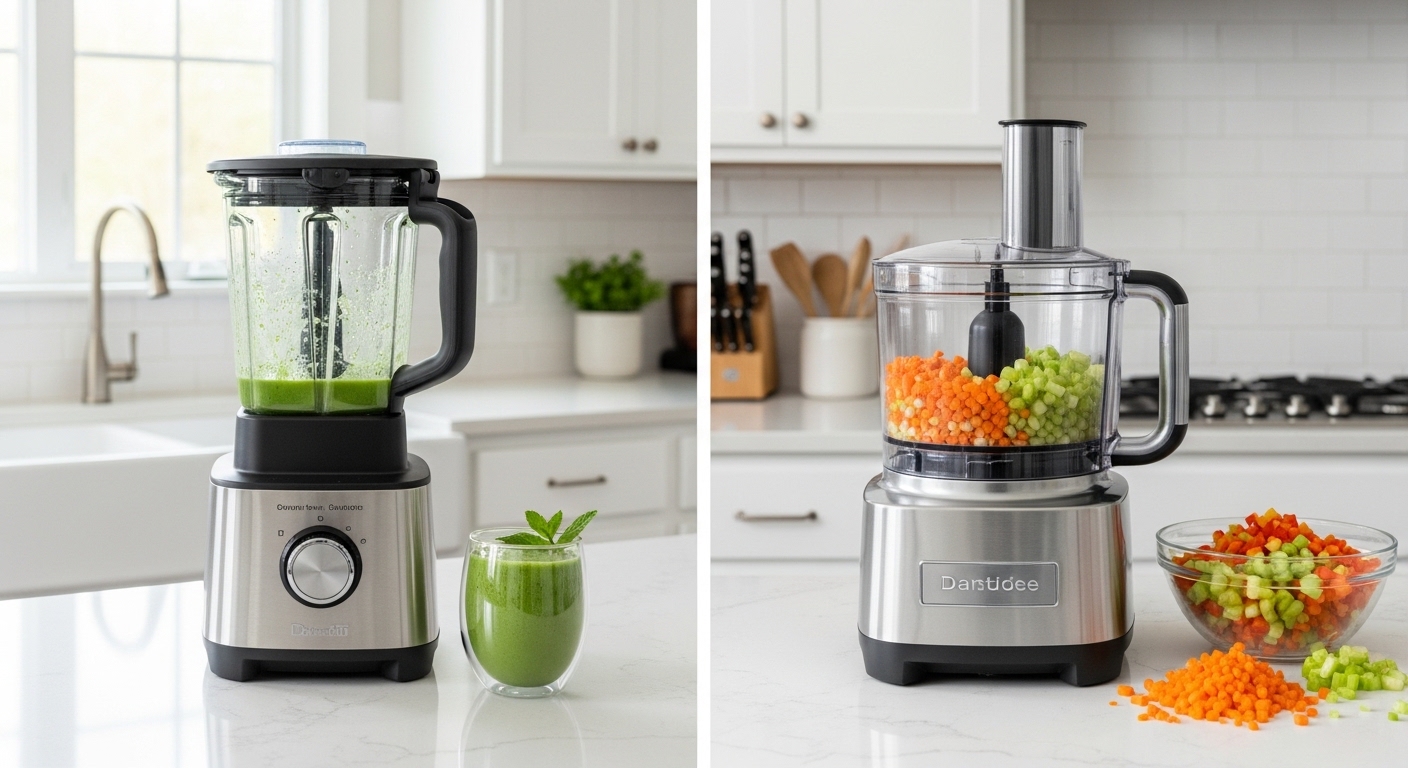
can i use a blender as a food processor is exactly the kind of question you end up asking when you’re standing in your kitchen, holding a knife in one hand and staring at your blender like it should be able to do more than just smoothies. And yeah, you’re not imagining things — it really does feel like these appliances overlap… but then also don’t, which is where the confusion starts kicking in a bit annoyingly.
You probably just want to chop onions faster, or make dough without destroying your wrist, or maybe you saw a recipe casually say “use a food processor” like everyone just owns one already. But you don’t. So now you’re wondering if your blender can quietly step in and save the day without turning everything into soup.
Let’s get into it properly, without pretending the answer is super clean (because it kinda isn’t).
Blender vs food processor — same kitchen, different personalities
At first glance, a blender and a food processor look like cousins who refuse to admit it. They sit there on the counter, both with sharp blades, both loud, both promising to “make cooking easier.”
But their jobs are actually pretty different.
A blender is designed mainly for liquids and soft foods. Think smoothies, soups, sauces. It pulls everything down toward the blades using a vortex motion.
A food processor, on the other hand, is more like a chopping machine. It pushes food outward and handles solid ingredients better — slicing, shredding, chopping, mixing dough.
Here’s a quick comparison that makes things less confusing:
| Feature | Blender | Food Processor |
|---|---|---|
| Best for | Liquids, smoothies, soups | Chopping, slicing, dough |
| Blade motion | Vertical vortex pull | Horizontal spreading chop |
| Texture control | Smooth, uniform | Chunky to fine control |
| Liquid requirement | Usually needed | Not required |
| Dough handling | Poor | Good |
A culinary technician once said something like, “Blenders liquefy intention, food processors shape it.” Sounds dramatic, but honestly it fits.
So, can i use a blender as a food processor for real tasks?
Short answer: yes, but not for everything, and sometimes it gets messy real quick.
Long answer: it depends on what you’re trying to do and how patient you are that day.
Blenders can handle some food processor jobs surprisingly well, especially if you tweak your method a bit. But they also fail hard in situations where dryness or texture control matters.
Tasks your blender can actually replace a food processor for:
- Chopping soft vegetables (onions, tomatoes, peppers)
- Making pesto or herb sauces
- Mixing pancake or crepe batter
- Pureeing cooked vegetables
- Crushing nuts (carefully, in short bursts)
- Making hummus or bean dips
Tasks where your blender starts struggling:
- Kneading dough (it just doesn’t have the structure)
- Shredding cheese evenly
- Slicing vegetables cleanly
- Dry chopping large quantities
- Anything that requires controlled chunks instead of puree
A small but important detail people miss: blenders need moisture. Without liquid, things just sit there awkwardly spinning or sticking to the sides like they’re confused about life.
What a blender does surprisingly well (you probably underestimate it)
Most people think a blender is “just for smoothies,” but modern blenders, especially ones with higher wattage (around 700 to 1500 watts), can do a lot more than expected.
Here’s what it secretly excels at:
- Sauces and dips: If you’re making something like garlic sauce or tahini-based dips, a blender actually gives smoother results than many food processors.
- Soups: Hot soups blended directly give a restaurant-like texture.
- Nut butters (with patience): It takes time, but it works if you scrape and pulse properly.
- Quick chopping of soft stuff: If you don’t overfill it, onions get minced fast (sometimes too fast, honestly).
One interesting fact: many high-speed blenders spin at over 20,000 RPM. That’s way faster than most food processors. So it’s not about power alone — it’s about how that power is used.
Where things go wrong when you treat a blender like a food processor
This is where most kitchen frustration happens. You think, “it’s basically the same thing,” and then suddenly you’ve got onion puree instead of chopped onion.
Common problems include:
- Food sticking to the blades and not circulating
- Over-processing in seconds (no middle ground)
- Uneven chopping when trying dry ingredients
- Motor strain when trying dough or thick mixtures
A chef once joked, “a blender is like a hyperactive apprentice — fast, powerful, but needs supervision or it ruins everything.”
And yeah… that’s kind of accurate.
When you really should use a food processor instead
Even if you can technically use a blender, there are moments when a food processor just behaves better.
You should probably switch if:
- You’re prepping large quantities of vegetables
- You need texture control (like coarse vs fine chopping)
- You’re making pastry dough or pizza dough
- You want uniform slicing or shredding
- You’re batch cooking for more than 3–4 people
Food processors usually range between 400 to 1200 watts, but their blade system is designed for control rather than speed chaos. That difference matters more than people think.
Practical tricks if you must use a blender as a food processor
If you don’t have a food processor and still want to make it work, there are some real-world hacks that actually help.
1. Use pulse mode, not continuous blending
This prevents turning everything into paste instantly.
2. Cut ingredients smaller before blending
Don’t overload it — seriously, half the problems start here.
3. Add minimal liquid
Just enough to keep things moving, not swimming.
4. Work in batches
Even if it feels annoying, it gives way better texture control.
5. Shake or scrape between pulses
Yes, it’s extra work, but it saves you from uneven mush.
Comparison breakdown (real-world kitchen behavior)
Here’s how both appliances behave in actual cooking situations:
| Task | Blender result | Food processor result |
|---|---|---|
| Onion chopping | Too fine, sometimes watery | Even chunks |
| Smoothies | Perfect | Not suitable |
| Dough mixing | Often fails | Reliable |
| Nut chopping | Risk of paste | Controlled texture |
| Soup blending | Excellent | Good but less smooth |
| Herb chopping | Can over-blend fast | Ideal |
Common mistakes people make (you might be doing one)
It’s funny how most blender frustration comes from just a few repeated mistakes:
- Filling it too much (classic one)
- Expecting dry chopping like a knife
- Running it too long instead of pulsing
- Ignoring blade design differences
- Using the wrong speed setting completely
One small but real observation from kitchen users: people often blame the blender when it’s actually just being used outside its design limits. Not saying that fixes everything, but it explains a lot.
So… can i use a blender as a food processor or not?
Yes, you can. But it’s more like borrowing a friend’s bike that wasn’t built for your route. It works, just not always comfortably.
A blender can replace a food processor for many everyday soft tasks, especially if you adjust how you use it. But once you get into structured chopping, dough, or texture-sensitive cooking, the difference becomes pretty obvious.
And maybe that’s the simplest way to think about it:
A blender transforms, while a food processor prepares.
Both are useful. Just not interchangeable in every situation, even if your kitchen shelf wishes they were.
If anything, once you understand their limits, cooking gets way less frustrating — and you stop accidentally turning onions into accidental soup, which honestly happens more often than people admit.

Jamesmathew is an expert Amazon affiliate writer, helping readers discover top products, smart deals, and practical buying guides through honest reviews and insightful content.